Frequently Asked Questions
The most-asked questions about rf connectors and coax.
What exactly is an RF connector?
An RF connector is a mechanical and electrical interface that joins two coaxial cables—or a cable to a device—while preserving signal integrity at radio frequencies. Think of it as the handshake between transmitter, receiver, antenna, and every link in between.
How does coaxial cable actually work?
Coax carries a high-frequency signal along a central conductor, surrounded by a dielectric insulator, a braided or solid shield, and an outer jacket. The concentric geometry confines the electromagnetic field between the two conductors, which is what gives it a predictable, uniform impedance.
Why do I keep seeing 50 ohm and 75 ohm mentioned?
Those are the two dominant characteristic impedances in the industry: 50 ohm is the standard for RF, test equipment, and most radio gear, while 75 ohm is the norm for cable TV and broadcast video. Mixing the two creates an impedance mismatch that shows up as reflected power and degraded signal quality.
What are the most common connector types a newcomer will meet?
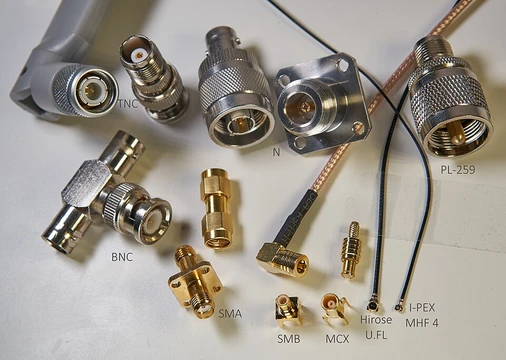
BNC, SMA, N-type, and F-type cover the vast majority of everyday applications, from test gear and Wi-Fi antennas to cable-TV wall plates and military hardware. Each has a distinct coupling mechanism (bayonet, thread, or compression), a different physical size, and a different practical frequency ceiling.
What is VSWR and why is it such a hot topic?
VSWR (Voltage Standing Wave Ratio) quantifies how well a load's impedance matches the transmission line, with 1:1 representing a perfect match. A high reading means energy is reflecting back toward the source, which can overheat power amplifiers and reduce effective radiated power.
Crimp or solder—what's the real-world difference?
A crimped termination uses a mechanical compression sleeve and is fast, repeatable, and easy to redo in the field, while a soldered joint fuses the braid and center pin to the connector with molten alloy. Soldered joints generally survive more vibration and thermal cycling, but crimps win on convenience and reworkability.
Which manufacturers are the key figures in this space?
Amphenol, Pasternack, Times Microwave, and Molex dominate commercial and industrial RF catalogs and datasheets. On the defense and aerospace side, Amphenol's military divisions and firms like Aeroelectric carry much of the heritage and spec-driven design.
What does attenuation actually cost me in practice?
Attenuation is the signal loss, measured in dB, that accumulates as a wave travels down the cable, and it increases with frequency. A ten-meter run of RG-58 at 1 GHz can shed several dB, which is enough to push a marginal wireless link below its receiver sensitivity threshold.
Where should a total beginner start learning?
Begin with the IEEE 1130 series of connector standards and a single coax datasheet (say, Times Microwave's RG-58 or LMR-400) to pick up the core vocabulary. From there, a short pass through transmission-line theory—impedance, reflection, and the Smith chart—ties every other topic together.
What's a standout milestone in RF connector history?
The N-type connector, introduced by Amphenol in the late 1940s for military radar, became the de facto workhorse for high-power RF and is still the go-to for antenna feeds today. Its simple threaded coupling and robust weather-sealing let it outlast nearly every rival of its era.