Twin-lead
Balanced parallel-wire feedline with lower loss than coax.
Last updated

Offaperry · CC BY-SA 4.0
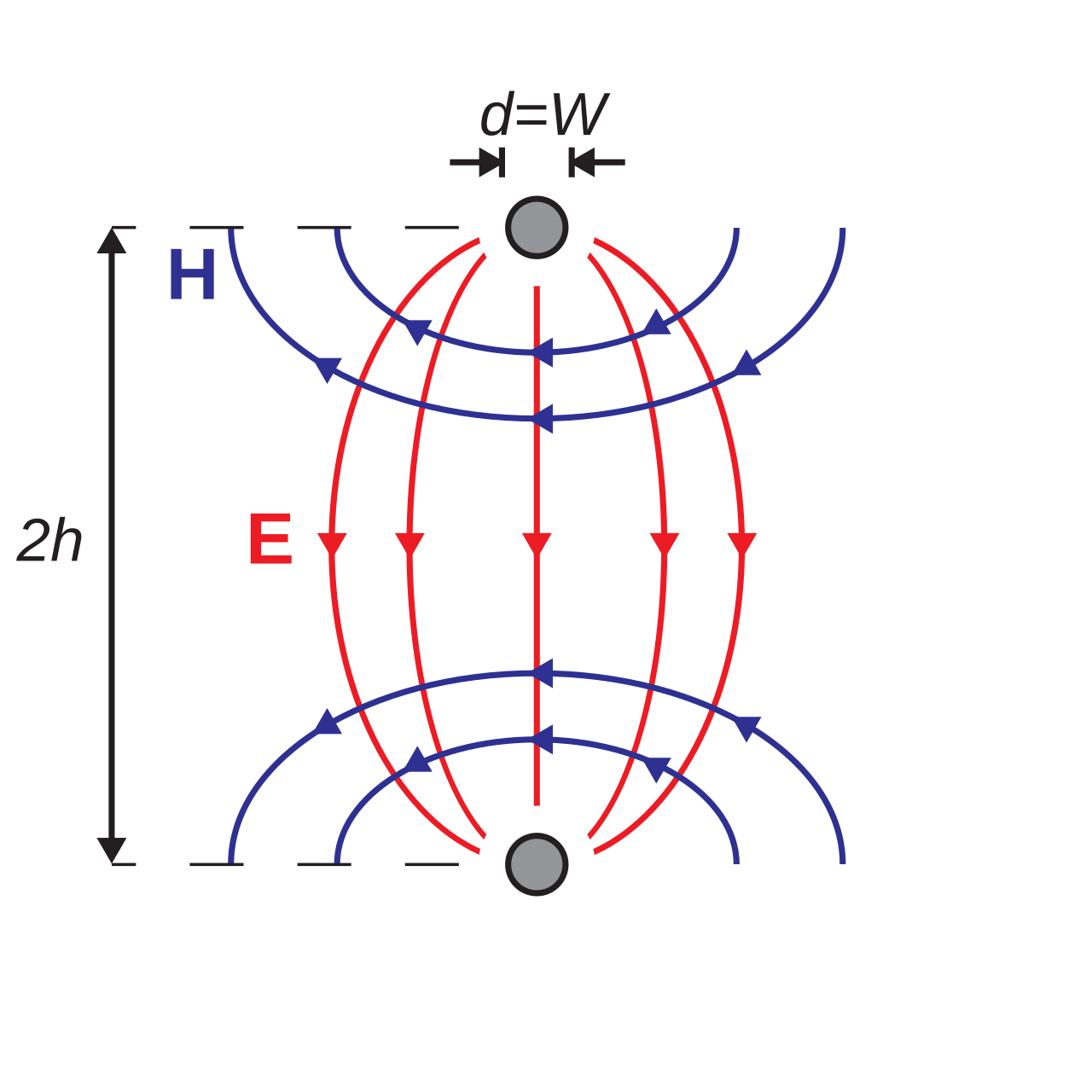
Twin-lead is a flat cable with two conductors, designed as a balanced transmission line for radio frequency (RF) signals. It consists of two stranded copper wires, or solid copper-clad steel wires, kept a consistent distance apart by a plastic ribbon—usually polyethylene, which acts as a good insulator at radio frequencies. This uniform spacing is essential for the cable to work as a transmission line; any sudden change in that spacing would cause some of the signal to bounce back toward the source instead of passing through. The plastic also covers and insulates the wires.
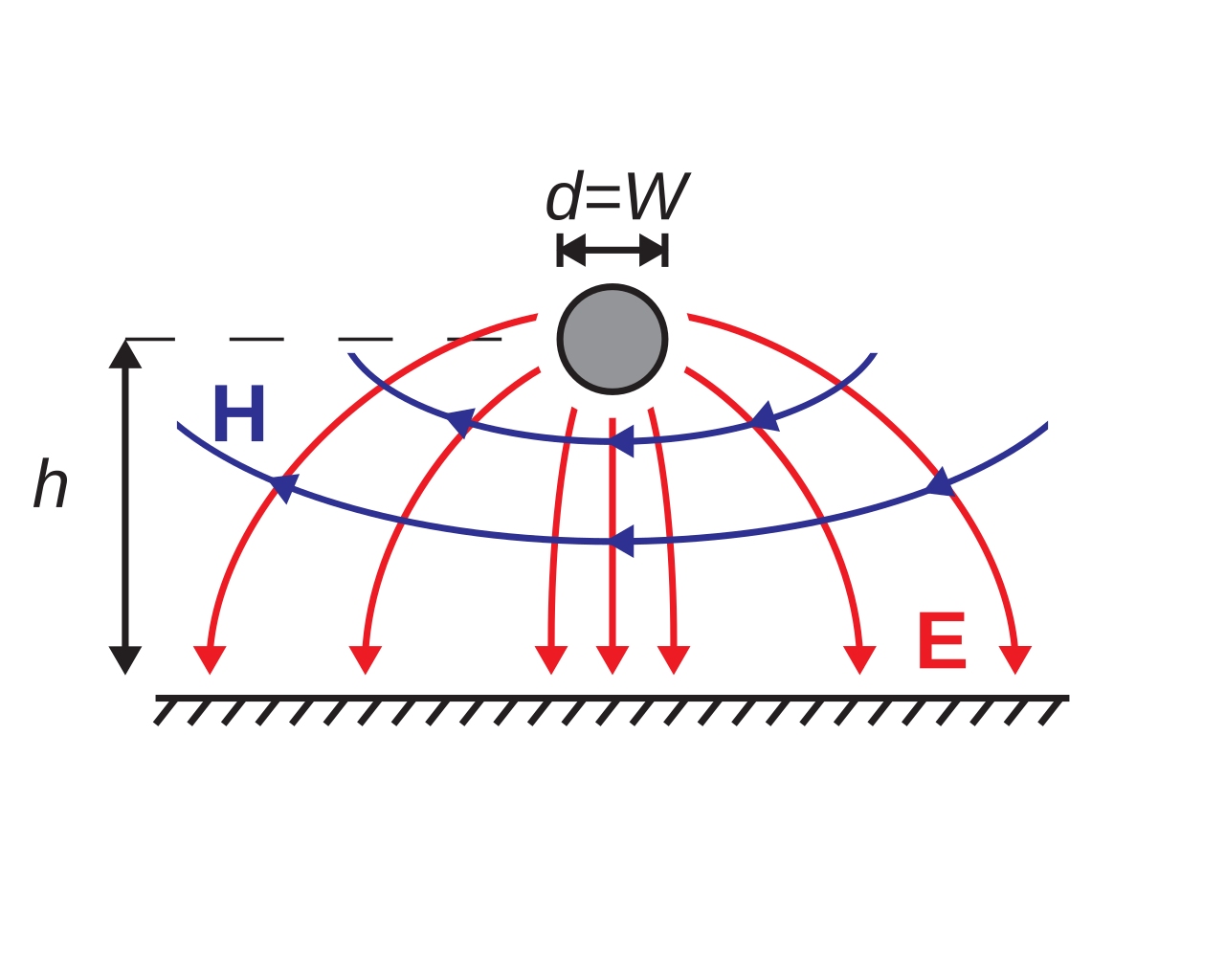
The term "twin lead" most often refers specifically to 300 Ω ribbon cable, the most common type, but it can also describe any kind of parallel wire line. Parallel wire line comes in several characteristic impedance values, including twin lead ribbon cable (75 or 300 Ω), window line (300, 350, or 450 Ω), and open wire line or ladder line (500 to 650 Ω).
Characteristics and uses
Twin lead is mainly used as an antenna feedline at shortwave and VHF frequencies, connecting radio receivers and transmitters to their antennas. It can have significantly lower signal loss than flexible coaxial cable, the main alternative feedline at these frequencies. For example, at 30 MHz, RG-58 coaxial cable loses 6.6 dB per 100 meters, while 300 Ω twin-lead loses only 0.55 dB. The 300 Ω type is widely used to connect FM radios to their antennas and was once common for television antennas, until coaxial cable replaced it.
The drop in popularity of parallel-wire cable came partly from an influx of inexpensive military surplus coaxial cable, which is much easier to use. Parallel-wire cable is unshielded, making it far more vulnerable to interference.
Proximity to metal objects can inject signals into any type of parallel wire line—signals that shielded coaxial cable would block. Those same metal objects also distort the impedance of unshielded cable running near them, causing some signal power to reflect backward from that point. Twin-lead therefore requires wide routing around rain gutters, spacing away from metal fences, exterior wall siding, and metal roofs, and must be mounted on 1- to 2-foot standoff insulators when run up the sides of metal antenna masts.
Quick Facts
- Characteristic impedance values
- 75 Ω
- 300 Ω
- 350 Ω
- 450 Ω
- 500–650 Ω
- Common type impedance
- 300 Ω
- Wire spacing common type
- about 7.5 mm / 0.295 in
Facts from the source article.
Lore & Background
Twin-lead is mainly used as an antenna feedline at shortwave and VHF frequencies, connecting radio receivers and transmitters to their antennas. It can have significantly lower signal loss than flexible coaxial cable; for example, type RG-58 coaxial cable loses 6.6 dB per 100 m at 30 MHz, while 300 Ω twin-lead loses only 0.55 dB.

300 Ω twin-lead was widely used to connect FM radios to their antennas, and was previously used to connect television antennas to televisions until it was replaced by coaxial cable. The decline in popularity of parallel-wire cable came about in part because of an influx of inexpensive military surplus coaxial cable, which is far easier to use: parallel-wire cable is unshielded, so much more vulnerable to interference; proximity to metal objects can inject signals and distort impedance, causing reflections. Twin-lead therefore requires wide routing around rain gutters, spacing away from metal fences, exterior wall siding, and metal roofs, and must be mounted on 1–2 foot standoff insulators when run up the sides of metal antenna masts.
Reader's Guide
Twin-lead and other parallel-conductor transmission lines are mainly used to connect radio transmitters and receivers to their antennas. Their losses per unit length are an order of magnitude smaller than those of coaxial cable, the main alternative. Their disadvantages are greater vulnerability to interference and the need to keep them away from metal objects, which can cause power losses and impedance distortion.
When installed along the outside of buildings and on antenna masts, standoff insulators must be used; it is also common practice to twist the twin-lead on long free-standing lengths to average out any imbalance. 300 Ω twin-lead ribbon cable was the most common type in the middle-20th century, widely used to connect television sets and FM radios to their receiving antennas. Since the last quarter of the middle-20th century, it has been largely replaced by 75 Ω coaxial cable for television installations. Multiple forms of parallel wire line are used in amateur radio stations as feedline for balanced transmission, most often as 450 Ω window line instead of twin-lead ribbon cable.
The characteristic impedance of twin-lead is a function of the insulating material and its thickness, and the wire diameter and spacing. 300 Ω twin-lead is well matched with the natural impedance of a folded dipole antenna, which is normally around 275 Ω. To connect a balanced transmission line to an unbalanced line like coaxial cable, a device called a balun must be used.
Frequently Asked Questions
Who is Twin-lead?
Twin-lead is a flat, two-conductor feedline that carries RF signals as a balanced transmission line, built from two copper or copper-clad steel wires held at a fixed gap by a polyethylene ribbon. Unlike coax, it has no shielded center conductor; both wires carry the signal equally.
What are Twin-lead's key stats?
The most common variant is 300 Ω, using AWG 20 or 22 wire (0.52 or 0.33 mm²) spaced roughly 7.5 mm apart, though 75 Ω, 350 Ω, 450 Ω, and 500–650 Ω versions also exist. At 30 MHz a 300 Ω run dissipates about 0.55 dB per 100 m.
How does Twin-lead stack up against coax like RG-58?
At 30 MHz, 300 Ω twin-lead loses roughly 0.55 dB per 100 m while RG-58 coax sheds about 6.6 dB over the same distance—nearly a twelve-fold difference in favour of the flat cable. That dramatic loss advantage is why hams and broadcast engineers often reach for twin-lead over coax for long runs.
More in RF Connectors and Coax
Sources
Compiled from Wikipedia and the sources listed below. Text from Wikipedia is available under CC BY-SA 4.0; this entry is adapted from it.
- Wikipedia: Twin-lead (CC BY-SA 4.0).
Spotted an error? Know more?
Reader corrections go straight into our review queue. Suggest an edit · How this site is sourced