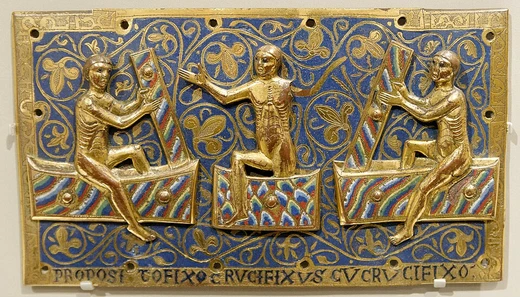
Raising of Jairus' daughter
A synoptic miracle of Jesus raising a synagogue ruler's daughter.
The raising of Jairus' daughter is a miracle attributed to Jesus in the synoptic Gospels of Mark, Matthew, and Luke. The story is interwoven with the healing of a bleeding woman and appears in Mark 5:21–43, Matthew 9:18–26, and Luke 8:40–56.
Quick Facts
- People involved
- Jesus Christ
- Peter
- James
- John
- Jairus and his daughter
- Country
- Israel
- Date
- During the lifetime of Jesus Christ
Facts from the source article.
Summary
The Lukan and Matthean accounts derive from the Markan account and are a typical example of a Synoptic triple tradition. The story has no equivalent in the Gospel of John. Comparisons with the healing of the royal official's son and the raising of Lazarus have been drawn, but most biblical scholars consider them entirely different and unrelated stories. Differences between the three Gospel narratives are well known and in line with ancient biographical writing practices. In Mark and Luke, Jairus, a ruler of a Galilean synagogue, asks Jesus to heal his 12-year-old daughter who is dying or at the point of death. In Matthew, the synagogue ruler is unnamed, the girl's age is not mentioned, she has already just died, and the father requests that Jesus lay his hand upon her so she will live again. The timing and setting differ: in Mark and Luke, the story follows the exorcism at Gerasa, with Jairus approaching Jesus as he disembarks from a boat. In Matthew, it is preceded by three other events, and Jesus is at Matthew the Apostle's house when the ruler arrives. Mark and Luke report a large crowd pressing against Jesus as he follows Jairus; Matthew mentions only Jesus and his disciples following the ruler.
Interpretations
The combined stories are an example of intercalation, where one incident is inserted within another, linked by the connection between the 12-year ailment and the 12-year-old girl. Twelve years also represents the age at which girls come of age in Judaism, so Mark and Luke mention the girl's age to emphasize the tragedy of her dying before her father could marry her off, receive a dowry, and expect grandchildren. The father may have faced financial loss and social disgrace in addition to personal sorrow. Jesus calls the bleeding woman 'daughter' as he travels to Jairus' daughter; both females have inferior status, as the girl's father represents her and she is not given her own name. The woman dares not face Jesus but secretly approaches from behind, and both females are ritually unclean by their afflictions, yet Jesus heals them by touching them. Luke adds that it is the father's only daughter, mirroring the raising of the widow of Nain's only son, suggesting that daughters and sons were treated as equals by Luke's Jesus. The episode shows that faith, especially as embodied by the bleeding woman, can exist in seemingly hopeless situations. The link between Jairus and the woman is faith, as both showed great faith in Jesus. The delay in healing the woman assured the restoration of Jairus' daughter, providentially ordered to test and strengthen Jairus' faith.
More in Resurrection
Spotted an error? Know more?
Reader corrections go straight into our review queue. Suggest an edit · How this site is sourced