Bouillon (restaurant)
Traditional French chain restaurants serving affordable cuisine.
Last updated
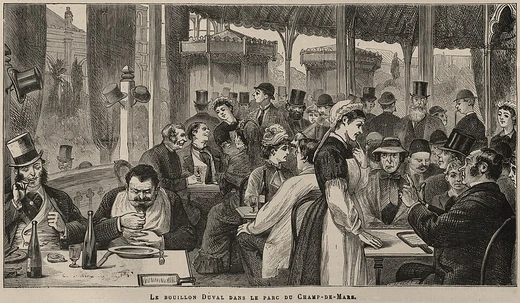
A bouillon is a traditional French restaurant, typically dating from the late 19th or early 20th century, that serves classic French cuisine in a spacious setting. The concept was invented to provide good quality food quickly at an affordable price, and the founder effectively created the chain restaurant model, though this had no influence beyond other bouillons. Some bouillon buildings are now listed historical monuments.
Quick Facts
- First bouillon concept introduced
- 1838
- Originator of revived idea
- Adolphe-Baptiste Duval (1811-1870)
- Year bouillon gandon-duval opened
- 1903
- Year bouillon racine renovated
- 1996
- Year of resurgence
- 2017
- Notable bouillons
- Bouillon Racine
- Bouillon Chartier Montparnasse
- Bouillon Pigalle
- Bouillon République
Facts from the source article.
History
In 1838 a Dutch company began selling bouillon in uniform outlets, but these first Bouillons Hollandais did not survive. In 1854 French butcher Adolphe-Baptiste Duval revived the idea and is typically erroneously credited with originating it. In 1903 Bouillon Gandon-Duval opened in an old restaurant converted by owner and architect Edouard Fournier. The following year a bouillon with luxurious Art Nouveau decoration opened on Boulevard Saint-Germain, designed by Jean-Marie Bouvier; today it is the site of Brasserie Vagenende, not a bouillon.
Edouard Chartier, with Louis Trezel, opened two further Bouillons Chartier in 1906: the Grand Bouillon Camille Chartier on Rue Racine and the Bouillon Edouard Chartier on Boulevard Montparnasse, both in Art Nouveau style with carved wood, ceramics, mirrors, and painted-glass details. Only a few authentic bouillons remain, including one in Faubourg-Montmartre and especially the one on Rue Racine, which has the most baroque Art Nouveau style. Camille Chartier remained owner until 1926; after being called Bouillon Ollé and Joussot, Mme.
Launois kept the restaurant until 1956. The next purchaser sold the goodwill to the University of Paris, which opened a staff restaurant there from 1962 until 1993; much décor survived but without special care. Complete renovation of Bouillon Racine took place in 1996, carried out by the Compagnons du Tour de France using nearly lost techniques, and it was later declared a historic building. Since 2017 the Parisian bouillon has seen a resurgence: Bouillon Chartier Montparnasse, which had been functioning as brasserie Montparnasse 1900, reprised its original vocation in 2019, and the Moussié brothers Pierre and Guillaume launched Bouillon Pigalle in 2017 and Bouillon République in 2021.
Popular culture
The novel A Killer at Sorbonne by René Reouven was inspired by characters and customers at Bouillon Racine, recalling the 1926 assassination of Symon Petliura by Sholom Schwartzbard at the exit of Bouillon Camille Chartier. In 1939 Fernandel sang of Chez Chartier in the song "Félicie aussi" by Albert Willemetz. Louis Aragon's novel Les Beaux Quartiers mentions Chez Chartier as the restaurant where young Edmond Barbentane lunches regularly. The closing scene of Mathieu Amalric's telefilm La Chose publique is set at Chez Chartier.
More in Restaurants in Paris
Sources
Compiled from Wikipedia and the sources listed below. Text from Wikipedia is available under CC BY-SA 4.0; this entry is adapted from it.
- Wikipedia: Bouillon (restaurant) (CC BY-SA 4.0).
Spotted an error? Know more?
Reader corrections go straight into our review queue. Suggest an edit · How this site is sourced