Temple of Amada
One of the oldest Egyptian temples in Nubia, relocated whole.
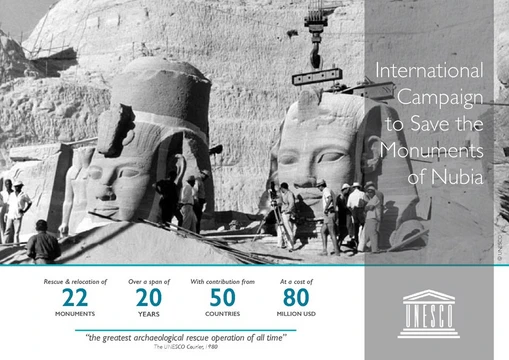
The Temple of Amada, constructed during the 18th Dynasty by Pharaoh Thutmose III, is one of the oldest Egyptian temples in Nubia. Three generations contributed to its building, and it was dedicated to Amun-Ra and Horakhty-Ra. It was relocated between 1964 and 1965 as part of the International Campaign to Save the Monuments of Nubia.
Quick Facts
- Part of
- Nubian Monuments from Abu Simbel to Philae
- Criteria
- (i)(iii)(vi)(i)(iii)(vi)
- Location
- New Amada, Egypt
Facts from the source article.
Temple interior
The original plan included a pylon, forecourt, portico, and sanctuary, but Thutmose IV roofed the forecourt, whose pillars and walls were decorated with offering scenes. The left side shows Thutmose IV, the right side Thutmose III and Amenhotep II. Reliefs depict the king in temple ritual with various deities. A layer of plaster applied during conversion to a church preserved the reliefs and inscriptions, including those about military exploits of Merenptah and Amenhotep II. The finest painted reliefs are in the innermost section, showing Thutmose III and Amenhotep II embraced by or offering to gods. In the vestibule, Amenhotep II is crowned by Horus and Thoth and runs with an oar and a hap. The cult room contains foundation and consecration scenes, including the ritual of the stretching of the cord and the making and laying of bricks. The exterior is dull and crumbling, but the interior has finely cut, brightly colored reliefs.
Historical records
Two important historical inscriptions are at Amada. One, on a stela at the rear wall of the sanctuary dated to Year 3 of Amenhotep II, describes his military campaign in Asia, where he hanged six dead chiefs on the walls of Thebes and a seventh on the walls of Napata as a warning to Nubians. The second, on a stela on the left thickness of the entrance doorway, records the defeat of a Libyan invasion in Year 4 of Merneptah. The temple was first published by Henri Gauthier in 1913.
Church
Around the 6th century, the temple was turned into a church. Christian worshippers covered the ancient hieroglyphs with plaster and painted scenes of saints, which lasted into the 1800s. Frederic Louis Norden noted in 1738 that these paintings showed the Trinity, apostles, and other saints. Franz Christian Gau recorded the remaining images in 1822. In 1830, Jean-Jacques Rifaud and Johann Matthias Neurohr suggested stripping away the Christian art to reveal the Egyptian carvings underneath, and the paintings were destroyed not long after.
Relocation
After the 1952 Egyptian revolution, planning began for the Aswan High Dam, which would create Lake Nasser and flood Lower Nubia, including Amada. UNESCO launched a campaign on 8 March 1960 to save Nubian monuments. At a Cairo meeting of engineers and archaeologists, disassembling Amada was deemed impossible due to its delicate, vibrantly colored reliefs, and consensus formed to let it be flooded. Christiane Desroches Noblecourt, head of the Centre d'Étude et de Documentation sur l'Ancienne Égypte and curator at the Louvre, objected. When lack of funds was cited, she declared France would take charge of the temple. In Paris, she asked two engineers to find a means of saving the temple; they proposed transporting it in one piece on rails to a higher location.
More in Relocated Monuments of Lower Nubia
Spotted an error? Know more?
Reader corrections go straight into our review queue. Suggest an edit · How this site is sourced