Religious cosmology
Explanations of the universe's origin, structure, and fate from religious traditions.
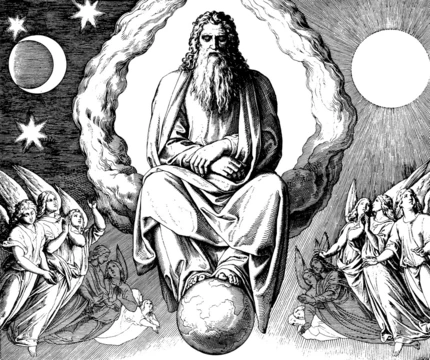
Religious cosmology encompasses explanations of the universe's origin, structure, evolution, and ultimate fate from a religious perspective, often including creation myths, spatial layouts, and moral prescriptions. It differs from scientific cosmology by not being limited to empirical observation and hypothesis testing, and it may incorporate ritual, narrative, doctrinal, and ethical dimensions. Notable examples include Zoroastrian, Indian, Abrahamic, Chinese, and Serer cosmologies, as well as those found in Gnosticism.
Quick Facts
- Zoroastrian cosmic duration
- 12000 years, divided into four equal periods of 3000 years each
- Zoroastrian creator deity
- Ahura Mazda
- Zoroastrian evil spirit
- Ahirman or Angra Mainyu
- Hindu time cycle
- cyclic Yuga with trillions of years
- Serer creator deity
- Roog
Facts from the source article.
Did You Know?
- In Chinese cosmology, a primordial universe called Wuji transformed into Taiji and then multiplied into everything known as the Wuxing.
- The Pangu legend describes a formless chaos coalescing into a cosmic egg, from which Pangu emerged and separated Yin from Yang with his axe.
- Gnostic teachings describe a higher world of Light called the Pleroma, radically distinct from the lower world of Matter, with a pre-creation crisis leading to the material world.
Zoroastrian
In Zoroastrian cosmology, the universe manifests a cosmic conflict between existence and non-existence, good and evil, and light and darkness, spanning 12000 years divided into four equal periods of 3000 years each. During the first period, called Infinite Time, Ahura Mazda dwelt in light while Angra Mainyu remained in darkness, separated by a great void. At the end of this period, Angra Mainyu attacked, but Ahura Mazda repelled him by reciting the Ahuna Vairya.
Biblical cosmology and Abrahamic faiths
The ancient Israelite universe consisted of a flat disc-shaped Earth floating on water, with heaven above and an underworld below that was morally neutral. Only after about 330 BC did Jews adopt the Greek idea of the underworld as a place of punishment and the righteous enjoying an afterlife in heaven, along with the concept of a spherical Earth at the center of concentric heavens. Most denominations of Judaism and Christianity hold that a single, uncreated God created matter from nothing, known as creatio ex nihilo. In his 2023 apostolic exhortation Laudate Deum, Pope Francis outlines three ways of understanding the human relationship with the cosmos: as an object of exploitation, as a mere setting, or as part of nature in constant interaction with it.
Indian
Buddhist cosmology, like other Indian religions, holds that the universe has no ultimate beginning or final end and is impermanent and always in flux, with no creator god. This cosmology underlies the Samsara theory of endless cycles of rebirth and redeath, originally involving five realms (hells, hungry ghosts, animals, humans, gods) and later six realms with the addition of demi-gods. The realms are interconnected, and beings cycle through them due to ignorance, desires, and karma. Hindu cosmology also considers existence cyclic, with diverse theories found in texts such as the Rigveda, including a universe cyclically created and destroyed by a god or goddess, no creator, a golden egg or womb, or self-created multitudes of universes. Time is conceptualized as a cyclic Yuga with trillions of years, and Mount Meru plays a central role in some models. Hindu cosmology posits divergent theories on the universe's structure, from three to twelve lokas, which are involved in theories of rebirth, samsara, and karma.
Serer religion
In Serer belief, the creator god Roog marks both the beginning and the end of all things. Because the Serer are farmers, trees hold deep meaning in their creation stories. The Saltigues, their high priests and priestesses, track the star Sirius—called Yoonir—to guide planting and other key activities. Yoonir itself stands as the universe’s symbol in Serer cosmology. A comparable Sirius-centered tradition exists among Mali’s Dogon people.
More in Religious Cosmologies
Spotted an error? Know more?
Reader corrections go straight into our review queue. Suggest an edit · How this site is sourced