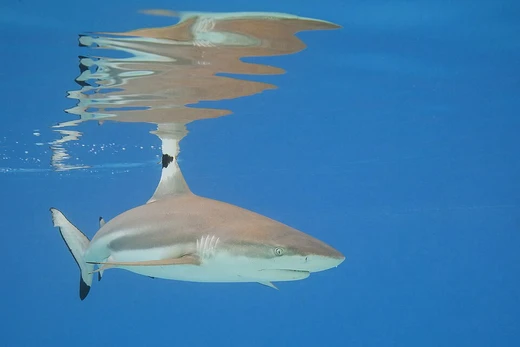
Southern stingray
A venomous but docile ray of the Western Atlantic.

The southern stingray (Hypanus americanus) is a whiptail stingray that lives in the warm, shallow waters of the western Atlantic, ranging from New Jersey down to southern Brazil. Its body is flat and diamond-shaped, with a top side that is mud brown, olive, or grey (darker in juveniles) and a white underside. A serrated, venomous spine sits at the base of its slender tail and is used for self-defense.
This ray is built for life on the seafloor. Its wing-like pectoral fins propel it across the bottom with a wave-like motion, allowing it to move quickly to escape predators, hunt, and travel long distances. Its eyes and small openings called spiracles are on top of its head, so it can breathe by drawing water in through the spiracles and out through its gills while lying on the seabed or buried in sediment. Females can grow to a disc width of 150 centimeters, while males reach about 67 centimeters.
Southern stingrays are nocturnal hunters. They spray water from their mouths or flap their fins to stir up the bottom and uncover hidden prey like small fish, worms, crustaceans, and bivalves. They are opportunistic and continuous foragers, often found alone or in pairs, though groups form for mating, protection, or resting. In some shallow nursery areas, population densities can reach up to 245 rays per square kilometer. They also swim with the tide to take advantage of better food availability.
To avoid predators, they bury themselves in the sand. Their venomous tail spine also repels threats, including great hammerhead sharks and humans. In coastal areas like the Gulf of Mexico, they have a commensal relationship with Nannopterum auritum birds: as the rays dig through the substrate for food, they expose hidden fish, and the birds follow behind to eat them.
Reproduction is ovoviviparous. Fertilized eggs develop inside the female, with embryos first feeding on a yolk sac and later on uterine milk. Females reproduce annually, giving live birth after a pregnancy of seven to eight months (135 to 226 days in captivity), with litters of two to ten young. Parental care ends at birth. Mating is rarely observed in the wild, but one study documented a female chased by two males, with one male biting her fin and releasing her after copulation. Females can mate again soon after giving birth.
Age of sexual maturity depends on location.
Quick Facts
- Genus
- Hypanus
- Species
- americanus
Facts from the source article.
Lore & Background
The southern stingray is adapted for life on the sea bed. Its flattened, diamond-shaped body is more angular than other rays, with a dorsal surface varying from olive brown and green in adults to dark grey in juveniles, and a white underside. The slender tail bears a long, serrated and venomous spine at the base, used for defense; these spines are not fatal to humans but cause incredible pain if stepped on. The eyes and spiracles are located on top of the head, allowing the ray to take in water while lying on the seabed or partially buried. Females can grow to a disc width of 150 cm, while males reach a maximum of 67 cm.
Southern stingrays are nocturnal predators that spray water from their mouths or flap their fins to disturb the substrate and expose hidden prey. They exhibit wave-like locomotion using their pectoral fins, which allows them to escape predators, forage efficiently, and maneuver quickly. They are often found singly or in pairs, and can reach population densities of up to 245 per square kilometer in shallow nursery grounds. They are opportunistic feeders, consuming small fishes, worms, crustaceans, and bivalves. To avoid predators, they bury themselves in substrate and use their venomous spines to repel threats, including great hammerhead sharks.
Reproduction is ovoviviparous: fertilized eggs develop inside the mother, with embryos receiving nutrients from the yolk sac and later from histotroph (uterine milk). Females reproduce annually, giving live birth after a gestation of seven to eight months (135 to 226 days in captivity), with litters of two to ten young. Mating is rarely observed, but one study documented a female chased by two males, with one male biting her fin and releasing her after copulation. Females can mate again soon after giving birth. Geographical location influences age of sexual maturity; in captivity, females mature at 5–6 years and males at 3–4 years. Primary nurseries are where females give birth, and secondary nurseries are where juveniles are raised to adults; an example of a primary nursery is in Belize.
Reader's Guide
The southern stingray holds significance as a species that bridges wild behavior and human interaction. In parts of the Caribbean, such as Grand Cayman and Antigua, it has become a tourist attraction, with individuals swimming with divers and snorkelers and being hand-fed at locations like Stingray City and the Sandbar. Some have become tame enough to be cradled in visitors' arms, leading locals to compare the hand-fed rays to over-fed household canines. However, there are concerns that this feeding and high levels of human interaction may be negatively impacting their behavior and ecology.
The species also appears in the aquarium trade, though it requires an immense 4,200-gallon system and will devour any fish or invertebrate it can capture. It is housed in public aquariums and theme parks, including Six Flags Discovery Kingdom and the Long Island Aquarium, where visitors can pet the rays in touch pools. In such settings, females have been observed biting one another on the edges of their fins, and reproduction has occurred within large public aquariums.
Ecologically, the southern stingray plays a role in shallow-water ecosystems through a commensal foraging relationship with Nannopterum auritum birds in coastal areas like the Gulf of Mexico. As the ray digs through the substrate in search of food, it exposes hidden prey, which the birds then eat. This interaction highlights the ray's influence on local food webs.
Did You Know?
- The southern stingray's tail spine is serrated and covered in venomous mucus, used for self-defense.
- In captivity, gestation lasts 135 to 226 days, producing litters of two to ten young.
- The species has a commensal foraging relationship with Nannopterum auritum birds in the Gulf of Mexico.
More in Reef Sharks and Rays, Part 2 1-24
Spotted an error? Know more?
Reader corrections go straight into our review queue. Suggest an edit · How this site is sourced