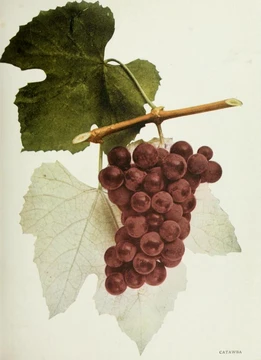
Persan (grape)
A rare Savoie red with disputed origins and a Swiss revival.
Last updated
Persan is a red wine grape from France, mainly found in the Savoie region. Its name hints at a Persian origin, but the grape likely comes from the Rhône-Alpes area instead. The name "Persan" probably comes from a mispronunciation of "Princens," which is also the name of a small hamlet near Saint-Jean-de-Maurienne in Savoie, where the vineyards have been known for their quality since the 1600s.
Quick Facts
- Region of earliest mention
- Isère department
- Swiss plantings of persan
- more than 1500 vines
Facts from the source article.
History
The exact origins of Persan are unknown. The name suggests a Middle Eastern origin via Cyprus, and one legend holds that Prince Louis of Savoy brought the vine from Cyprus, where he reigned as king in the 15th century.
Master of Wine Jancis Robinson proposes that "Persan" is a corruption of "Princens," combining local dialect words for "prime" and a landowner's fee. Records from the 17th century mention a highly regarded vineyard in the hamlet of Princens near Saint-Jean-de-Maurienne, which may have been the source of the Princens grape later called Persan. The earliest known use of the name Persan dates to 1846, when Albin Gras recorded plantings in the Isère department, noting the grape was called Etraire on the right bank of the Isère and Persan on the left bank.
Wine regions
In the 19th century, Persan was widely planted in Savoie and Isère until the phylloxera epidemic greatly reduced its numbers. It remains a permitted variety in the Vin de Savoie AOC and the Vin de Pays d'Allobrogie zone, but plantings had fallen to just 22 acres (9 hectares) by 2012. Efforts to revive the variety include increased plantings by Michel Grisard of Domaine Prieuré St-Christophe in Fréterive, who makes a varietal style. Grisard and other local producers are also working to replant Persan in the historic Princens vineyard of Saint-Jean-de-Maurienne.
Across the border in Switzerland, more than 1500 vines were planted outside Geneva, expected to be in full production by the 2016 vintage. In 2001, DNA testing confirmed that the Bécuet grape of the Susa Valley in Piedmont is Persan; there it is often blended with Avanà to make Ramiè, with some varietal Bécuet wines produced in the communes of Gravere and Giaglione.
Confusion with and relationship to other varieties
Persan was long thought to be the same as Étraire de la Dui, also found in Savoie. In 1902, ampelographer L. Rougier determined they were separate, with Étraire de la Dui likely an offspring of Persan. DNA testing by Swiss geneticist José Vouillamoz later "strongly suggested" a parent-offspring link, but the direction remains unknown.
Persan has also been confused with Mondeuse noire, Syrah, and Pinot noir. In 1876, Jules Guyot speculated it might be a local mutation of Pinot noir, but DNA testing dismissed that theory. Persan was crossed with Peloursin to create the red grape Joubertin.
Synonyms
Over the years Persan has been known under many synonyms, including Aguyzelle, Aguzelle, Bâtarde, Bâtarde longue, Beccu, Becouet, Becuet (also Bécuet or Becuét), Becuette (or Bécuette), Begu, Berla'd Crava Cita, Berla Cita, Berlo Citto, Biquet, Bucuet, Cul de Poule, Étraire, Étrière, Étris, Guzelle, Moirans, Persan Noir, Petit Becquet, Posse de Chèvre, Pousse de Chèvre, Presan, Pressan, Princens, Prinsan, Prinssens, Rives, Sérine, Sérinne pointue, Siranèze pointue, Siranne, and Siranne pointue.
Did You Know?
- Persan is an early budding, mid-ripening vine that produces small bunches of tiny berries.
- It can be very vigorous and usually needs heavy pruning to maintain reasonable yields.
- The vine thrives on stony, calcareous soils and is susceptible to powdery and downy mildew.
More in Red Wine Grape Varieties
Sources
Compiled from Wikipedia and the sources listed below. Text from Wikipedia is available under CC BY-SA 4.0; this entry is adapted from it.
- Wikipedia: Persan (grape) (CC BY-SA 4.0).
- Word definitions: the Codexery glossary, each quoted from its Wikipedia article.
Spotted an error? Know more?
Reader corrections go straight into our review queue. Suggest an edit · How this site is sourced