Isabella (grape)
A slip-skin hybrid grape with tropical adaptability.
Last updated
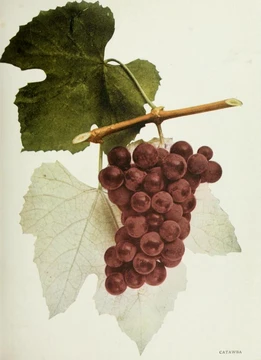
When mature, the grape's exterior exhibits a dark purple hue approaching black, while its interior consists of a soft green-yellow pulp.[1] This variety is of the slip-skin type, featuring sizable, nicely shaped bunches of fruit and a heavy bloom.[1]
Biology and range
Isabella has long been assumed to be a hybrid of wild Vitis labrusca and Vitis vinifera.[2] Microsatellite DNA analysis confirmed the vinifera parent is the rare French cultivar Meslier petit.[2] The Vitis labrusca parent is the American Ives' Seedling.[2] Isabella is grown in Portugal, Bali, Japan, Colombia, Brazil, and New York State.[3]
In Peru, where it is locally known as "Borgoña," it is widely popular as a table grape and for sweet table wine.[3] It is one of the most popular grapes in the former USSR, brought to Georgia, Azerbaijan, and Moldova from France through Odessa.[4] Along the southern coastline of the Black Sea, within Turkey, the Isabella grape can be located.[5] Port Macquarie in Australia and Ticino in Switzerland are locations where this grape is cultivated.[6]
What the specialist sources record
According to historian Eduardo Dargent, Isabella arrived in Peru from California and found ideal conditions in the southern coastal valleys.[7] In Tacna, the areas of Magollo and Calana also cultivate Isabella for local production.[7] Isabella has over 100 aliases including Borgoña, Odessa, and Fragola.[8] A semi-sweet red wine from Peru, called "borgoña", is produced from Isabella grapes grown in the Ica, Chincha, and Cañete valleys.[7]
References
- Wikipedia, "Isabella (grape)" (CC BY-SA 4.0), which cites: winemaking.jackkeller.net Winemaking Questions, Page 2: Isabella Grapes (original not read by us) en.wikipedia.org
- Wikipedia, "Isabella (grape)" (CC BY-SA 4.0), which cites: wineloverspage.com The Super Gigantic Y2K Winegrape Glossary: Isabella; The Oxford Companion to Wine, "Isabella" (we also read that source) en.wikipedia.org
- Wikipedia, "Isabella (grape)" (CC BY-SA 4.0), which cites: The Oxford Companion to Wine, "Isabella"; The Oxford Companion to Wine, "Isabella"; appellationamerica.com Isabella; appellationamerica.com Isabella; "La uva borgoña y los vinos tintos dulces del Perú" (we also read that source) en.wikipedia.org
- Wikipedia, "Isabella (grape)" (CC BY-SA 4.0), which cites: "ATLAS: IZABELLA"; "Грузинское вино. Сорта винограда"; Goldstein, "The Georgian feast: the vibrant culture and savory food of the Republic of Georgia", University of California Press, 1958, p. 4; "Radeda, red dry" (we also read that source) en.wikipedia.org
- Wikipedia, "Isabella (grape)" (CC BY-SA 4.0), which cites: Özhan Öztürk. Pontus: Antik Çağdan gümüze Karadeniz'in Etnik ve Siyasi Tarihi. Ankara, 2011. Phoenix Yayınları. s. 576 (original not read by us) en.wikipedia.org
- Wikipedia, "Isabella (grape)" (CC BY-SA 4.0), which cites: Pierre Cormon, "De nouveaux cépages pour protéger les vignes", Entreprise romande, 28 April 2026 (original not read by us) en.wikipedia.org
- "La uva borgoña y los vinos tintos dulces del Perú". facts only, no text reused. notasdecata.pe
- Wikipedia, "Isabella (grape)" (CC BY-SA 4.0), which cites: "Foundation Plant Services"; appellationamerica.com Isabella; "Грузинское вино. Сорта винограда" (original not read by us) en.wikipedia.org
Each numbered sentence above was checked against the source it cites before publication. Sentences citing Wikipedia adapt text from the English Wikipedia article Isabella (grape) (contributors), used under CC BY-SA 4.0; this entry is available under the same licence. Other sources were used for facts only; no text or images are copied from them.
More in Red Wine Grape Varieties
Sources
Compiled from Wikipedia and the sources listed below. Text from Wikipedia is available under CC BY-SA 4.0; this entry is adapted from it.
- Wikipedia: Isabella (grape) (CC BY-SA 4.0).
Spotted an error? Know more?
Reader corrections go straight into our review queue. Suggest an edit · How this site is sourced