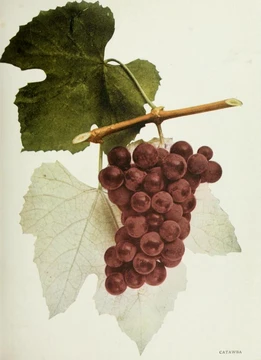
Cascade (grape)
A Seibel hybrid known for heavy yields and early ripening.
Last updated
Cascade is a red hybrid grape, the result of a complex cross, developed by French grape breeder Albert Seibel early in the 1900s in Aubenas, a town in the Rhône Valley region of France. The variety first became available for commercial use in North America in 1938, and since then it has been grown in both Canada and the United States, with a notable presence in New York. Because Cascade is very prone to several grapevine viruses in hotter growing regions, this weakness has limited how widely it has been planted.
Quick Facts
- Creator
- Albert Seibel
- Year of commercial release
- 1938
- Original designation
- Seibel 13053
- Name given by
- Finger Lakes Wine Growers Association
- Year renamed
- 1970
- Winter hardiness
- down to -10 °F
Facts from the source article.
History and pedigree
Cascade is a Seibel grape produced from a crossing of Seibel 7042 and Gloire de Seibel by Albert Seibel in the early 1930s. It was first released for commercial production in 1938, originally known as Seibel 13053. The Finger Lakes Wine Growers Association gave it the name "Cascade" in 1970, possibly because the highly productive vine bears fruit that appears to "cascade off the vine" like a waterfall, even from water sprouts and suckers. As an interspecific complex hybrid, its pedigree includes varieties from Vitis vinifera, Vitis labrusca, Vitis rupestris, Vitis rotundifolia, and Vitis lincecumii.
Its ancestors include Concord, Chasselas Musqué, the teinturier grape Alicante Bouschet, Alicante Ganzin, the Munson grape, and the rootstock Rupestris du Lot. In Canada, Cascade was crossed with Seyve-Villard at the University of Guelph Horticultural Research Institute of Ontario to produce the white wine grape L'Acadie blanc.
Viticulture
Cascade is a very early ripening variety that can be highly productive and high yielding, with berry skins that may have a bright blue hue. It is moderately winter hardy, withstanding temperatures down to -10 °F, and carries strawberry notes and aromas. The vine bears heavily—over 50 lbs per vine is common—and some growers believe it "can't be overcropped," meaning it retains its varietal character even at high yields. Its loose-berry clusters resist fungal infections such as downy and powdery mildew, but in some climates the vine is highly prone to soil-borne viral diseases like tomato ringspot virus, which causes yellow veins, stunted shoot growth, and poor fruit set.
Did You Know?
- In 1975 there were 183 acres (74 hectares) of Cascade planted in New York state.
- Cascade is usually ready for harvest by mid-August in Virginia.
- It is often blended with other hybrid grapes such as Maréchal Foch and Baco noir.
More in Red Wine Grape Varieties
Sources
Compiled from Wikipedia and the sources listed below. Text from Wikipedia is available under CC BY-SA 4.0; this entry is adapted from it.
- Wikipedia: Cascade (grape) (CC BY-SA 4.0).
Spotted an error? Know more?
Reader corrections go straight into our review queue. Suggest an edit · How this site is sourced