Frequently Asked Questions
The most-asked questions about red macroalgae and coralline algae.
What exactly is red macroalgae?
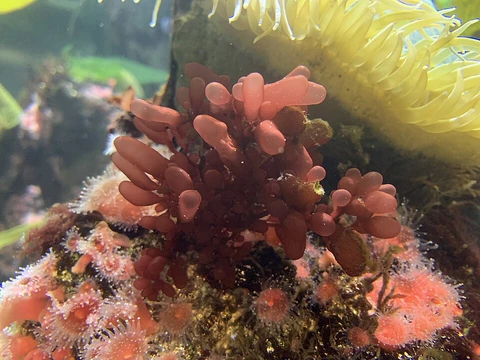
Red macroalgae are multicellular, visible-to-the-naked-eye members of the phylum Rhodophyta, ranging from a few millimeters to several meters in length. They are set apart from green and brown algae by cell walls that contain agar or carrageenan rather than cellulose, and by a distinctive suite of photosynthetic pigments.
What are coralline algae and how do they differ from other red algae?
Coralline algae are a subgroup of red algae whose cells are encrusted with calcium carbonate, giving them a hard, stony texture. Instead of growing as free-standing fronds, they form thin crusts over rocks, shells, and other hard surfaces, which is the main visual and structural distinction from the more familiar leafy red macroalgae.
Why do red algae look red?
The red, purple, or magenta hues come from the accessory pigment phycoerythrin, which absorbs blue-green light that penetrates deeper into the water column. This pigment advantage lets red algae photosynthesize at greater depths than most other algal groups.
Where in the ocean can you find red macroalgae and coralline algae?
Red macroalgae occur in virtually every marine environment, from tropical reefs to polar shores, and a handful of species even thrive in freshwater. Coralline algae are especially abundant on shallow tropical and temperate reefs, where they can form extensive encrusting layers over rocks and other hard substrates.
What is the most recognizable red macroalga for a newcomer?
Nori (species in the genera Porphyra and Pyropia) is probably the most widely known red macroalga, as it is the species harvested and dried for sushi wraps. In commercial and culinary contexts, carrageenan-producing species such as Chondrus crispus, commonly called Irish moss, are equally iconic.
Who are the key historical figures in red algal taxonomy?
William Henry Harvey, a 19th-century botanist, is often called the father of phycology and laid much of the foundational taxonomy for red algae. In the modern era, Michael Guiry and the contributors to the AlgaeBase database have been central to updating rhodophyte systematics and making species data widely accessible.
How do red macroalgae reproduce?
Red algae are well known for a three-stage life cycle (triplatic alternation of generations) involving a gametophyte, a carpospore stage, and a sporophyte. Unlike most other algae, they lack flagellated motile cells at every stage, so their spores and gametes are non-motile and depend on water currents for dispersal.
What ecological role do coralline algae play in reef ecosystems?
Coralline algae act as critical bio-builders on coral reefs, cementing fragments of coral and rock together and providing a hard substrate for larval corals and invertebrates to settle on. Their calcium carbonate deposits also help buffer wave energy and stabilize the overall reef framework.
What commercially important products come from red macroalgae?
Agar, carrageenan, and porphyran are polysaccharides extracted from red algae and used as gelling or stabilizing agents in food, pharmaceuticals, and laboratory media. These applications make red macroalgae one of the most economically significant algal groups worldwide.
Where should a newcomer start learning about red macroalgae and coralline algae?
The AlgaeBase online database is a strong first stop, offering searchable species profiles, taxonomy, and distribution data for known rhodophytes. Pairing that resource with a local seaweed field guide and a short introductory course in phycology will build a solid foundation in both identification and biology.