Frequently Asked Questions
The most-asked questions about radio-controlled aircraft.
What is a radio-controlled (RC) aircraft?
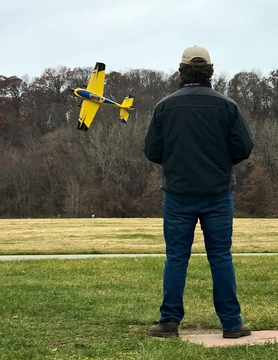
It is a scale or free-flight model airplane, helicopter, or multirotor craft that a ground-based pilot steers in real time using a handheld transmitter and a receiver bolted to the airframe. Unlike autonomous drones, an RC aircraft depends on the pilot's continuous input to ailerons, elevators, rudder, and throttle to stay in the air.
How does RC aircraft differ from a drone?
In everyday language, "drone" usually means a multirotor or fixed-wing craft that can hover or fly on autopilot, while "RC aircraft" implies a model that requires constant manual piloting. The lines blur because many multirotor builds are also radio-controlled, but the RC community has historically centered on piloted fixed-wing and helicopter flight.
What radio protocol do most modern RC systems use?
Nearly all hobby-grade transmitters and receivers now operate on the 2.4 GHz ISM band using protocols such as FrSky, Spektrum, FlySky, or the open-source ELRS standard. This replaced the older 72 MHz and 27 MHz analog channels and lets several pilots fly simultaneously in the same field without cross-interference.
What are the main categories of RC aircraft?
Fixed-wing planes (gliders, sport jets, warbirds), single-rotor helicopters, and multirotor craft (quadcopters, hexacopters) make up the three broad families. Within each family you'll find sub-niches like 3D aerobatics, scale modeling, speed racing, and FPV freestyle.
What does it cost to get started, and what should a beginner buy first?
A ready-to-fly electric trainer plus a basic 2.4 GHz transmitter and receiver typically runs between $200 and $400. Most experienced pilots recommend starting with a forgiving, high-wing trainer (often called a "bush plane" or "Cub"-style model) before graduating to 3D aerobatic or jet-powered aircraft.
Who are some of the most recognized figures and brands in the RC aviation world?
Long-standing manufacturers like Graupner, Futaba, Hitec, and Horizon Hobby (E-flite) have shaped the hobby for decades, while open-source projects such as Betaflight and ArduPilot reshaped the multirotor scene in the 2010s. Individual record-holders and world-championship pilots in categories like speed, endurance, and 3D aerobatics are celebrated in the community's annual competitions.
What regulations apply to flying RC aircraft?
Most countries require registration once the airframe exceeds a small weight threshold (for example, 250 g in the EU or 0.55 lb in the US for recreational flights) and prohibit operations over people or in controlled airspace without permission. Pilots are generally responsible for maintaining line-of-sight, yielding to full-scale traffic, and following local no-fly-zone maps.
What are some standout performance records in RC aviation?
RC jet aircraft have broken the 400 mph (≈640 km/h) barrier in closed-course speed events, and lightweight electric gliders have climbed past 10,000 m in altitude-competition classes. Multirotor speed records in straight-line sprints have crossed 200 mph, and endurance gliders have logged flights lasting well over an hour on a single charge.
How steep is the learning curve for a new RC pilot?
Most beginners need several dozen practice sessions—often in a flight simulator first—before they can launch, land, and perform basic maneuvers confidently. Progressing to inverted flight, knife-edge, or 3D aerobatics typically takes months of deliberate practice, and heli or jet flying adds a further step in complexity.
Where do RC pilots compete, and what do the major events look like?
National and world championships are organized by bodies such as the National Association of Radio Controlled Aircraft (NARCA) and the International Air Race Flying Association (IARFA), with events spanning 3D aerobatics, scale flying, speed, and endurance. Local clubs often host monthly "fly-ins" at grass airfields, and FPV racing leagues run obstacle-gate circuits in both outdoor and indoor venues.