Paleo-Hebrew Leviticus Scroll
Fragmentary Torah scroll in Paleo-Hebrew script from Qumran Cave 11.
The Paleo-Hebrew Leviticus Scroll, also known as 11QpaleoLev, is an ancient manuscript found in Qumran Cave 11, written in the Paleo-Hebrew script that was used by Israelites before the Babylonian exile. Its fragmentary remains preserve portions of the Book of Leviticus on leather parchment, offering a rare example of this archaic script in a Torah scroll from the late Second Temple period. The scroll is notable for its palaeographic significance, despite being centuries later than earlier Paleo-Hebrew inscriptions.
Quick Facts
- Material
- tanned leather or parchment
- Writing
- Paleo-Hebrew characters
- Created
- c. late 2nd–1st-century BC or 30 BC-68 AD
- Discovered
- 1956
- Location
- IAA
Facts from the source article.
Priority
For a time, the Paleo-Hebrew Leviticus Scroll was considered the oldest surviving fragment of a Torah scroll, inscribed sometime after 200 BCE but before the end of the first century BCE. However, a Paleo-Exodus scroll (4Q22) dates to 125–100 BCE, and an even older manuscript containing parts of Exodus and Leviticus (4Q17), copied in 250 BCE in the square alphabet, is now regarded as the oldest extant Torah fragment if the Hinnom Scrolls are excluded. The style of the Paleo-Hebrew script in the Qumran fragments suggests a date after the Maccabean revolt and the introduction of Hasmonean coinage in 135 BCE, which used the old script. The dating of the scroll depends on the form of the letter kaph, which more closely resembles kaphs on Hasmonean coins than on the Lachish ostraca from around 590 BCE. It has been suggested that using the old script on coins was a nationalist affectation to proclaim pre-exilic Israelite origins for the Hasmonean state. Whether an alphabetic primer predating the Hasmonean coinage was shared between the Qumran texts and the mints remains an open question in scholarly literature.
Discovery
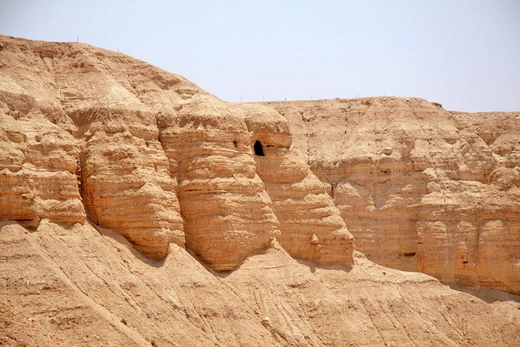
The Paleo-Hebrew Leviticus Scroll was discovered in January 1956 by Bedouins of the Ta'amireh clan in what is now called Qumran Cave 11, about 2 km north of Khirbet Qumran. The cave's entrance had been sealed by fallen debris and boulders, and part of its roof had collapsed, keeping it inaccessible for centuries. The cache in Cave 11 also included the Great Psalms Scroll (11QPs) and the Temple Scroll (11QT), the longest of the Dead Sea Scrolls. The Leviticus Scroll was acquired by the Rockefeller Museum (formerly the Palestine Archaeological Museum) in May 1956 and remained largely untouched in its scrollery for 12 years. After the Six-Day War in 1967, the museum came under Israeli administration and assigned the scroll to D.N. Freedman for study, who published the first report in 1974. The scroll is now held by the Israel Antiquities Authority. It was first photographed in 1956 by the Palestine Archaeological Museum, and again in 1970 under the IAA using infrared photography; the 1956 photographs preserve readings lost by 1970. One fragment, Fragment L (formerly 11Q1), showing Leviticus 21:7–12 and 22:21–27, was purchased by Georges Roux of France from antiquities dealer Khalil Eskander Shaheen (Kando) in 1967.
Description
The Paleo-Hebrew Leviticus Scroll comprises fifteen fragments and one scroll of seven columns, measuring 100.5 cm in length. It was originally part of a larger Torah scroll made of individual parchment sheets sewn together; the surviving portion shows only the bottom part of two sheets, about one-fifth of the original height, now 10.9 cm tall. The two sheets are sewn together, one with three columns and the other with four, for a total of seven extant columns. The Paleo-Hebrew script is written on horizontal ruled lines indented into the parchment by a semi-sharp instrument, with letters hanging from the lines. The parchment is light to dark brown tanned leather, inscribed on the grain side (where hair once grew), and is thought to come from a small domesticated animal, likely a kid goat rather than a sheep. The ink is lampblack, and words are divided by dots, as in the Siloam inscription. The top of the scroll is irregularly worn, not deliberately cut; letter and line calculations suggest the original height was about four times the extant portion. Columns 4 to 7 measure 14.9 cm in width, except the final narrow column; columns 2 and 3 measure 13.6 cm and 12.0 cm respectively. The scroll contains much of Leviticus chapters 22–27 and smaller fragments from other chapters, and is considered a primary textual witness of the Proto-Masoretic Text.
Orthography
A comparison between the Masoretic Text (MT) and the Leviticus Scroll reveals a tradition of orthography that slightly differs from the MT in plene and defective scripta, with the scroll generally showing more full spellings. This is consistent with the period before the Masoretes added vowel pointing, when fuller spellings aided readers in discerning vowel sounds. The Talmud indicates that during the Second Temple period, sages began establishing an authoritative text, which became the MT. The 11QpaleoLev scroll is unique in that where the MT requires reading לו in Leviticus 25:30 as the qeri, though the ketiv is written לא, the Paleo-Hebrew scroll shows the original reading as לו without needing a change, suggesting the Masoretes had access to an early orthographic tradition. Another feature is the scribal practice of aligning words naturally without stretching them to justify the left margin; instead, the scribe broke words at the end of a line and continued them on the next line, as seen with the Tetragrammaton in Leviticus 24:9 and other words. In column 4, the scroll shows no section break for Leviticus 25:35, where most MT readings mark a closed section; this anomaly reflects a dispute among some Geonim over whether that verse should have a section break, as noted by the medieval scribe Menahem Meiri in his Kiryat Sefer.
More in Qumran
Spotted an error? Know more?
Reader corrections go straight into our review queue. Suggest an edit · How this site is sourced