Frequently Asked Questions
The most-asked questions about pufferfish and boxfish.
What exactly are pufferfish and boxfish, and why do fans group them together?
Both belong to the order Tetraodontiformes, a family of bony fish with no pelvic or pectoral fins in the boxfish case and a thick, spiny body in the pufferfish case. Enthusiasts lump them together because they share the same superfamily (Tetraodontoidea), similar defensive strategies, and a small but passionate hobbyist community that keeps and studies them side by side.
What is the single biggest difference between a pufferfish and a boxfish?
Pufferfish have a rounded, soft-bodied frame covered in small spines that flatten against the skin when relaxed, while boxfish have a rigid, bony carapace that looks almost like a geometric box fused to the body. That structural difference means boxfish can never fully inflate the way puffers can.
Why are both groups famous for being toxic?
They accumulate tetrodotoxin, a potent neurotoxin produced by symbiotic bacteria in their gut and skin, which makes their flesh, liver, and ovaries dangerous to most predators and to humans. The toxin is not something they synthesize themselves; it is sequestered from their microbiome, which is why even well-fed aquarium specimens carry it.
How does a pufferfish actually inflate, and how fast does it happen?
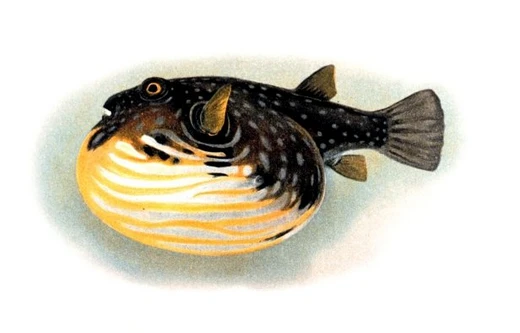
The fish gulps a large volume of water (or air, if stranded) into a specialized, elastic stomach that sits behind the jaw, expanding the body to roughly two to three times its normal volume in under a second. The spines then erect outward, turning the animal into a near-impassable sphere.
Which species do fans and keepers consider the 'main characters' of the hobby?
The green puffer (Tetraodon mbu), the porcupine puffer (Dichotomyctere fluviatilis), and the clown triggerfish (Balistes capriscus) are the most commonly kept and photographed. Among boxfish, the yellow boxfish (Ostracion cubicus) and the cowfish (Lactorforidae family) are the go-to species for public aquarium displays and viral videos.
Where in the wild do you find them, and do they overlap in range?
Pufferfish occupy warm tropical and subtropical waters worldwide, from reef flats to brackish mangroves, while boxfish are almost exclusively Indo-Pacific and Atlantic reef dwellers. Their ranges overlap in places like the Red Sea, the Great Barrier Reef, and the Caribbean, which is why a single dive can feature both.
What is the most surprising scientific fact fans love to cite?
Boxfish and some puffer species have the densest bones of any vertebrate, with a bone density that can exceed that of many rocks, a trait linked to their reduced swimming speed and reliance on jet propulsion. A second favorite fact is that certain puffers can learn to navigate mazes and recognize individual human faces, placing them unusually high on the invertebrate-adjacent intelligence scale.
If I'm a total newcomer, where should I start learning or keeping them?
Start by reading a species-specific care sheet for the exact puffer or boxfish you are considering, because water chemistry, diet, and tank-mate requirements vary wildly between a brackish porcupine puffer and a saltwater yellow boxfish. Joining a dedicated forum or local Tetraodontiformes club is the fastest way to get practical, up-to-date advice before committing to a tank.
Are pufferfish and boxfish actually dangerous to handle or to be around in an aquarium?
The tetrodotoxin is concentrated in internal organs and, to a lesser degree, the skin, so a casual touch or a splash of tank water will not poison a healthy person. The real risk is ingesting the flesh or handling the viscera without gloves, which is why fugu chefs in Japan must hold a multi-year license.
What is the most common misconception fans run into from outsiders?
People assume the inflation display is a voluntary, reflexive 'angry puffer' trick, when in reality it is a last-resort stress response triggered by a threat, poor water quality, or disease, and chronic inflation is a sign of a sick fish. A second widespread myth is that all species in the group are equally toxic; in practice, toxicity levels vary by species, region, and even season, and a few freshwater puffers carry little to no detectable tetrodotoxin.