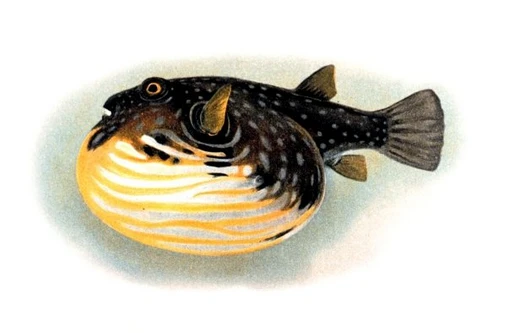
Tetrosomus gibbosus
A boxfish with a hump, poisonous flesh, and a Lessepsian migration story.
Last updated

Diego Delso · via Wikipedia: Tetrosomus gibbosus · CC BY-SA 4.0
Tetrosomus gibbosus, commonly called camel cowfish because of the hump on its dorsal keel, is one of 22 species in the boxfish family, Ostraciidae. It is a ray-finned fish found in the wide Indo-West Pacific. It has been recorded since 1988 on rare occasions in the Levantine waters of the Mediterranean Sea, likely following entry via the Suez Canal, and is the first species from the family Ostraciidae to be found in the Mediterranean Sea.
Scientific classification
- KingdomAnimalia
- PhylumChordata
- ClassActinopterygii
- DivisionTeleostei
- OrderTetraodontiformes
- FamilyOstraciidae
- GenusTetrosomus
- SpeciesTetrosomus gibbosus
Named by (Linnaeus, 1758)
Close relatives
Other species of Tetrosomus with a Codexery entry.
- Tetrosomus concatenatus Tetrosomus concatenatus
- Tetrosomus reipublicae Tetrosomus reipublicae
Sources: Wikipedia taxobox: Tetrosomus gibbosus (CC BY-SA 4.0) · order, family and genus agree with WoRMS AphiaID 219915 (CC BY 4.0)
Conservation status
Least Concern (LC)
- LC▲ this species
- NT
- VU
- EN
- CR
- EW
- EX
Source: IUCN Red List assessment · GBIF copy of the Red List category
How big is it?
Largest length in the source, 0.3 m, next to a 1.8 m person.
Diagram: drawn by Codexery, schematic shapes to scale (not a likeness). Length: Wikipedia: Tetrosomus gibbosus
Where the tetrosomus gibbosus has been recorded
Each dot is a place where the species has been observed and reported (1,253 records, half-degree grid) — not a modelled range. 25 inland records left out (institution coordinates). 1 isolated far-off record not drawn.
Map: drawn by Codexery. Data: GBIF occurrence search (records CC0 / CC BY) · Natural Earth basemap (public domain) · place coordinates: Wikipedia (CC BY-SA 4.0)
Background
Tetrosomus gibbosus is characterized by a carapace—a hard upper shell formed by thick scale plates—that completely encases its body except for small openings for the mouth, eyes, and gills. Its mouth is small with fleshy lips and conical teeth usually numbering less than 15.
The species is hermaphroditic: all individuals are born female, but some may change into males as they grow. Juveniles live together in small schools, but become solitary as adults. It is an omnivore, feeding on seaweeds, sponges, molluscs, worms, and crustaceans found on the bottom of its habitat.
The fish has poisonous flesh, organs, and spines, and is known to secrete poisonous mucus in defense or when disturbed. This poison can be fatal to humans or other marine organisms. It lives in shallow tropical waters or warm seas with muddy bottoms, sometimes near seagrass beds, and is also found in coral reefs. It is considered an endangered species in the South China Sea.
More in Pufferfish and Boxfish
Sources
Compiled from Wikipedia and the sources listed below. Text from Wikipedia is available under CC BY-SA 4.0; this entry is adapted from it.
- Wikipedia: Tetrosomus gibbosus (CC BY-SA 4.0).
- Classification: the source article's taxobox; order, family and genus checked against WoRMS, the World Register of Marine Species (CC BY 4.0).
- Conservation status: IUCN Red List assessment.
- Occurrence records: GBIF (CC0 / CC BY). Basemap: Natural Earth (public domain).
- Word definitions: the Codexery glossary, each quoted from its Wikipedia article.
Spotted an error? Know more?
Reader corrections go straight into our review queue. Suggest an edit · How this site is sourced