Ptolemaic coinage
Ptolemaic coinage used a distinct weight standard and enforced a single currency.
Last updated
Ptolemaic coinage was the currency system of the Ptolemaic Kingdom, notable for its use of the Phoenician weight standard rather than the Attic standard common elsewhere in the Hellenistic world. This made Ptolemaic coins smaller than contemporary Hellenistic tetradrachms. The dynasty introduced standard coinage to Egypt, where earlier native dynasties had made very limited use of coins.
Quick Facts
- Weight of ptolemaic tetradrachm
- about 14.2 grams
- Weight of attic tetradrachm
- about 17.28 grams
- First ptolemaic mint
- Memphis
- Later mint location
- Alexandria
- Key figure in monetization
- Ptolemy II Philadelphus
Facts from the source article.
History
Silver was scarcer than gold in Egypt, and the exact value ratio is unclear; silver was probably shipped from abroad, and Ptolemaic Cyprus produced some silver for local coinage. Pre-Ptolemaic native dynasties did not use coinage; foreign currency found in Egypt was used as bullion. Under Ptolemaic rule, Egypt transformed from a largely currency-free society to a monetized one by the third century BC, influenced by Ptolemy II Philadelphus. Greek rule monetized taxation, a key reason for the state's success.
Before the Ptolemies, copper and grain served as mediums of exchange; the Ptolemies introduced coinage, banks, and tax farming. The kingdom did not use the Attic weight but the smaller Phoenician weight, and briefly used the Rhodian standard during the transition. The Rhodian standard was lighter than Attic but heavier than Phoenician, showing a downward scale in coin size; political reasons and trade partnerships explain this better than a theory of silver appreciation under Ptolemy I.
Design and symbolism
Ptolemaic coinage used Phoenician weight, also called Ptolemaic weight, of about 14.20 grams for a tetradrachm, smaller than the Attic weight of about 17.26 grams. The kingdom maintained full royal control over circulating coinage. The largest bronze denominations weighed up to 100 grams. Artistically, the coins followed contemporary Greek currencies.
A common dynastic symbol was an eagle standing on a thunderbolt, first adopted by Ptolemy I Soter. Some issues were "dynastic issues," such as a medal-like coin after the death of Arsinoe II, showing Ptolemy II and Arsinoe II on one side and Ptolemy I and Berenice I on the other. The coin-making process often left a central depression, similar to Seleucid coinage.
Mints
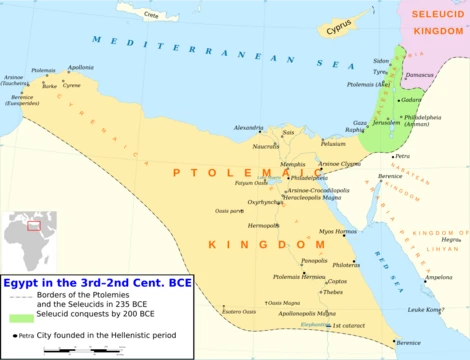
The first Ptolemaic mint was at Memphis, later moved to Alexandria. In Syria, Tyre was the most important coastal city among five Ptolemaic mints. After the Seleucid conquest of Coele-Syria, Ptolemais in Phoenicia (Acre) continued striking coins on the Phoenician weight and remained prolific. The Seleucids discontinued a Ptolemaic mint in Jaffa.
In Greece, Ptolemaic coinage mainly came from the Peloponnese and Euboea; Corinth did not strike Ptolemaic coinage during its brief subordination. Cyprus had many important mints and struck large amounts of Ptolemaic coinage from 200 BC to 80 BC, with abbreviations for mints and dates on gold and silver coinage; Cypriot mints included Salamis (ΣA), Kition (KI), and Paphos (Π, later ΠA). At Crete, no royal coinage was used, and cities minted their own.
No evidence exists of Ptolemaic mints in Asia Minor; regions like Cilicia and Lycia had no autonomous mints, and local Pamphylian silver coinage ceased under Ptolemaic control.
More in Ptolemaic Kingdom
Sources
Compiled from Wikipedia and the sources listed below. Text from Wikipedia is available under CC BY-SA 4.0; this entry is adapted from it.
- Wikipedia: Ptolemaic coinage (CC BY-SA 4.0).
Spotted an error? Know more?
Reader corrections go straight into our review queue. Suggest an edit · How this site is sourced