Arashk (band)
Iranian hard rock/metal band active 2004–2008.
Last updated

Roob2023 · CC BY-SA 4.0
Arashk was an Iranian hard rock and metal band from Tehran, active from 2004 to 2008. The group formed in 2001 when vocalist and guitarist Pouyan Khajavi teamed up with drummer Shahram Khosraviani. Guitarist Salim Ghazi Saeedi joined in 2004. The band played occasional concerts at Iranian universities.
They released four albums: Abrahadabra (2006), Sovereign (2007), Ustuqus-al-Uss (2008), and YELL (2008). The first three were instrumental works composed by Ghazi Saeedi, blending progressive rock, progressive metal, rock in opposition, and acid jazz, with comparisons to Rush, King Crimson, and Univers Zero. These albums also drew on Arabian and Iranian music. One webzine called Abrahadabra "the Ultima Thule of instrumental progressive metal."
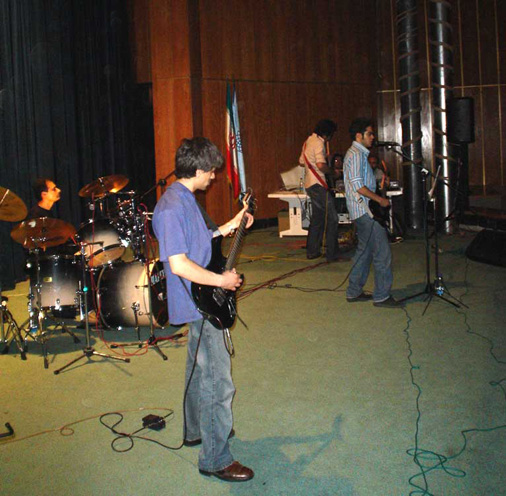
The fourth album, YELL, was a hard rock record with Persian vocals, using poems by Ferdowsi, Masud Sa'd Salman, Mehdi Akhavan-Sales, and Saadi. It was mainly composed by Khajavi and Khosraviani, with Ghazi Saeedi playing secondary guitars and handling recording and mixing. The band became inactive after 2008 due to limited live performance opportunities in Iran. Ghazi Saeedi later continued as a solo act.
Formation & Early Years
Arashk traces its origins to 2001 in Tehran, where vocalist and guitarist Pouyan Khajavi teamed up with drummer Shahram Khosraviani to form the group. The duo operated for several years before Salim Ghazi Saeedi joined the lineup in 2004, solidifying the three-piece configuration that would define the band's recording output. Although the group was technically formed in 2001, their active period as a performing and recording entity is generally dated from 2004 through 2008.
During those years, Arashk based themselves in Tehran and built a modest live presence, performing at occasional concerts held at universities across Iran. These campus shows represented the primary venue for the group to present their material to audiences, as the broader Iranian music scene offered limited opportunities for hard rock and metal acts to play publicly. The band's relatively short window of activity—roughly four years of full operation—meant that their entire recorded catalog was compressed into a tight span, with all four albums arriving between 2006 and 2008.
Discography & Creative Division
Arashk's recorded output consists of four albums released over a concentrated two-year window. The first three—Abrahadabra (2006), Sovereign (2007), and Ustuqus-al-Uss (2008)—were composed by Salim Ghazi Saeedi, establishing a cohesive instrumental voice across the early catalog. The fourth release, YELL (2008), marked a significant shift in creative leadership: it was composed primarily by Pouyan Khajavi and Shahram Khosraviani, the original founding duo, while Salim stepped into a supporting role, handling secondary guitar parts and taking charge of recording and mixing.
This division of labor reveals two distinct creative currents within the group. Salim's compositions drove the progressive, instrumental direction of the first three records, whereas the founding pair channeled their energy into a more vocal, hard-rock-oriented statement on YELL. The fact that both creative camps produced work in the same year—2008—suggests the band was navigating a natural evolution or internal divergence in its final active period.
Musical Style & Influences
The first three Arashk albums are entirely instrumental and draw on a wide palette of influences, including progressive rock, progressive metal, rock in opposition, and acid jazz. Critics and listeners have drawn comparisons to the progressive-era work of Rush, to the experimental textures of King Crimson, and to the atmospheric compositions of Univers Zero. What distinguishes Arashk from purely Western prog acts is the deliberate weaving of Arabian and Iranian musical traditions into their rock framework, giving the compositions a distinctive cultural identity.
The webzine Gnosis2000 went so far as to describe the debut, Abrahadabra, as "the Ultima Thule of instrumental progressive metal," a phrase that underscores how far the band pushed the boundaries of the genre. The fourth album, YELL, departs from this instrumental approach entirely, presenting a hard rock record built around Persian-language vocals. The lyrics draw from a lineage of classical and modern Persian poets, including Ferdowsi, Masud Sa'd Salman, Mehdi Akhavan-Sales, and Saadi, grounding the music in a deep literary tradition.
Dissolution & Aftermath
Arashk's run as a functioning band came to an end following the release of YELL in 2008. The primary reason cited for their inactivity was the scarcity of live performance opportunities available to hard rock and metal musicians in Iran. With university concerts representing the main outlet for their shows and the broader scene offering few additional stages, the practical infrastructure needed to sustain an active band simply was not there. After the group dissolved, Salim Ghazi Saeedi continued his musical work independently, performing as a one-man project under his own name.
This continuation suggests that the creative energy generated during the Arashk years did not simply vanish but found a new channel through his solo efforts. The band's brief but concentrated existence—roughly four active years yielding four albums—leaves a compact yet diverse legacy spanning instrumental progressive metal and vocal hard rock rooted in Persian poetry. Their story remains a small but notable chapter in the history of Iranian heavy music, a scene that has always operated under significant structural constraints.
Frequently Asked Questions
Who is Arashk?
Arashk was a Tehran-based hard rock and metal trio active from 2004 to 2008. The lineup consisted of vocalist-guitarist Pouyan Khajavi, drummer Shahram Khosraviani, and guitarist Salim Ghazi Saeedi, who joined in 2004.
Where did Arashk perform live?
The trio played occasional concerts at Iranian universities during their short active period. They did not tour widely but kept a steady presence in Tehran's underground metal scene.
More in Progressive metal musical groups
Sources
Compiled from Wikipedia and the sources listed below. Text from Wikipedia is available under CC BY-SA 4.0; this entry is adapted from it.
- Wikipedia: Arashk (band) (CC BY-SA 4.0).
Spotted an error? Know more?
Reader corrections go straight into our review queue. Suggest an edit · How this site is sourced