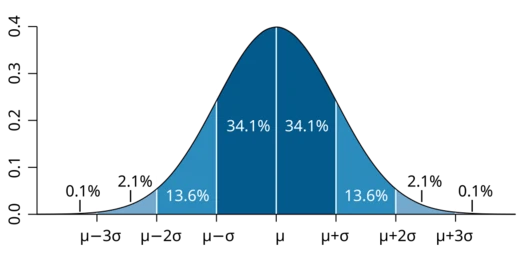
Variance
Variance measures how far numbers spread from their average.

Variance is a measure of dispersion in probability theory and statistics, defined as the expected value of the squared deviation from the mean of a random variable. It is the second central moment of a distribution and the covariance of the random variable with itself. Variance is often represented by symbols such as σ², s², Var(X), V(X), or 𝕍(X). The standard deviation, the square root of the variance, is more commonly reported in practical applications because its units match those of the random variable, whereas the variance’s units are squared. A key algebraic advantage of variance over other dispersion measures, like the expected absolute deviation, is its tractability; for instance, the variance of a sum of uncorrelated random variables equals the sum of their individual variances. However, a notable disadvantage is that variance is not finite for many distributions, such as the Cauchy distribution, which lacks a finite expected value.
Two distinct concepts are both called "variance." One is a theoretical property of a probability distribution, defined by an equation. The other is a characteristic calculated from a set of observations, typically from a real-world system. If all possible observations are included, this is the population variance. Usually, only a subset is available, yielding a sample variance that estimates the population variance. These concepts are linked: if an infinite number of observations are generated from a theoretical distribution, the sample variance from that infinite set matches the distribution’s variance. Variance plays a central role in statistics, underpinning descriptive statistics, statistical inference, hypothesis testing, goodness of fit, and Monte Carlo sampling. The variance of a random variable X can be expressed as the expected value of X² minus the square of the expected value of X, though this formula suffers from catastrophic cancellation in floating-point arithmetic when the two terms are similar. For a discrete random variable with probability mass function, variance is the sum of squared deviations from the mean, weighted by probabilities. For an absolutely continuous random variable with a probability density function, variance is given by an integral of squared deviations. For example, the exponential distribution with parameter λ has variance 1/λ², while a fair six-sided die has a variance of 35/12.
- field
- Probability theory and statistics
- known_for
- Measure of dispersion; expected value of squared deviation from the mean; second central moment; covariance of a random variable with itself
Lore & Background
Variance is a measure of dispersion that quantifies how far a set of numbers is spread out from their average value. It is formally defined as the expected value of the squared deviation of a random variable from its mean, making it the second central moment of a probability distribution. Variance can also be understood as the covariance of a random variable with itself. The standard deviation, which is the square root of the variance, is more commonly reported in practical applications because its units match those of the original variable, whereas the units of variance are the square of that variable. A key algebraic advantage of variance over other dispersion measures, such as the expected absolute deviation, is that the variance of a sum of uncorrelated random variables is simply the sum of their individual variances. However, a notable limitation is that variance is not finite for many probability distributions, such as the Cauchy distribution. There are two distinct concepts both called variance: one belonging to a theoretical probability distribution, defined by an equation, and the other being a characteristic calculated from a set of observations. When all possible observations from a system are available, the calculated variance is the population variance. When only a subset is available, the calculated value is the sample variance, which serves as an estimate of the full population variance. If an infinite number of observations were generated from a theoretical distribution, the sample variance from that infinite set would exactly match the distribution’s theoretical variance. Variance plays a central role in statistics, appearing in descriptive statistics, statistical inference, hypothesis testing, goodness of fit, and Monte Carlo sampling.
Reader's Guide
There are two distinct concepts both called 'variance.' One is part of a theoretical probability distribution and defined by an equation. The other is a characteristic of a set of observations, typically measured from a real-world system. If all possible observations are present, the calculated variance is called the population variance; if only a subset is available, it is called the sample variance, which estimates the full population variance. The two kinds are closely related: if an infinite number of observations are generated using a distribution, the sample variance from that infinite set matches the distribution's equation for variance. Variance has a central role in statistics, including descriptive statistics, statistical inference, hypothesis testing, goodness of fit, and Monte Carlo sampling.
Did You Know?
- Variance is defined as the expected value of the squared deviation from the mean of a random variable.
- The standard deviation is the square root of the variance.
- Variance is the second central moment of a distribution and the covariance of the random variable with itself.
- A disadvantage of variance is that its units differ from the random variable, unlike the standard deviation.
More in Probability And Stochastic Processes 1-21
Spotted an error? Know more?
This is a living reference — every entry is fact-audited, and reader corrections feed straight into our audit queue. Suggest an edit · See this site's audit record