Petriellaceae
Extinct gymnosperm family from Triassic Gondwana.
Last updated
Petriellaceae is the sole family within the extinct gymnosperm order Petriellales, known from Middle to Late Triassic floras of Gondwana. Its fossils have been found in Antarctica, Australia, southern Africa, and South America. The family is distinguished by fan-shaped leaves with anastomosing veins and separate female and male reproductive structures.
Scientific classification
- CladeTracheophytes
- Order†Petriellales
- Family†Petriellaceae
Named by (Taylor, 1994)
Sources: Wikipedia taxobox: Petriellaceae (CC BY-SA 4.0)
Quick Facts
- Order
- Petriellales
- Temporal range
- Middle Triassic (Olenekian) to Late Triassic (Rhaetian)
- Geographic range
- Gondwana (Antarctica, Australia, southern Africa, South America)
- Foliage genus
- Rochipteris
- Ovulate organ genus
- Kannaskoppia
- Microsporangiate organ genus
- Kannaskoppianthus
Facts from the source article.
Taxonomy and classification
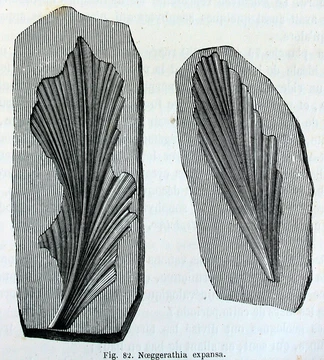
Foliage and reproductive structures of Petriellales are usually found separately, complicating classification. The foliage genus Rochipteris, established in 2001, includes fan-shaped leaves with sparse reticulate anastomosing venation; specimens were earlier assigned to Chiropteris or Psygmophyllum. Rochipteris differs from Chiropteris by apetiolate leaves and sparse reticulate veining. Connection between Rochipteris (junior synonym Kannaskoppifolia) and reproductive organs Kannaskoppia and Kannaskoppianthus was confirmed by co-occurring fossils in 2003.
Morphology
Rochipteris plants were slender, erect, woody shrubs. Leaves are cuneate to flabellate, attached directly or with a short stalk; venation is fine, forking, radiating from the base, subparallel to margins, and anastomosing. Laminae range from entire to trifid to segmented into narrow lobes. The ovulate organ Kannaskoppia consists of a proximally forked strobilus bearing 8–12 megasporophylls in two rows at a 90° angle; each megasporophyll carries one cupule that bends backward and opens into three lobes.
No seeds or ovules have been found. The microsporangiate organ Kannaskoppianthus is a ginkgoopsid strobilus with a proximally forked axis bearing up to 20 microsporophylls, each spathulate and flattened, hosting 5–10 elliptic microsporangia. Diagnostic species characters include strobilus size and forking, number of microsporophylls per limb, and number of microsporangia per head.
Paleoecology
Petriellales fossils from the Upper Triassic Molteno Formation of southern Africa are most often associated with Heidiphyllum thicket, floodplain wetlands, riverine sandbanks, and fern meadows. Antarctic fossils from the Fremouw Formation indicate the group inhabited a warm polar forest biome with extreme seasonal daylight, part of humid, densely vegetated high-latitude Gondwanan forests under greenhouse conditions.
More in Prehistoric Plant Orders
Sources
Compiled from Wikipedia and the sources listed below. Text from Wikipedia is available under CC BY-SA 4.0; this entry is adapted from it.
- Wikipedia: Petriellaceae (CC BY-SA 4.0).
- Word definitions: the , each quoted from its Wikipedia article.
Spotted an error? Know more?
Reader corrections go straight into our review queue. Suggest an edit · How this site is sourced