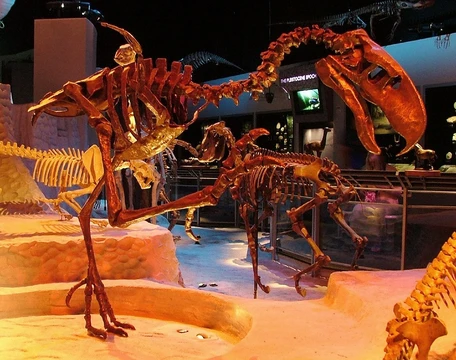
Palaelodidae
Extinct relatives of flamingos, widespread from Oligocene to Pleistocene.
Last updated
Palaelodidae were ancient relatives of flamingos, found globally except Antarctica during the Neogene. Their oldest fossils come from the Oligocene, with peak diversity in the Miocene. After declining, they survived into the Pleistocene in Australia.
Scientific classification
- KingdomAnimalia
- PhylumChordata
- ClassAves
- OrderPhoenicopteriformes
- Family†Palaelodidae
Named by Stejneger, 1885
Sources: Wikipedia taxobox: Palaelodidae (CC BY-SA 4.0)
Quick Facts
- Type species
- Palaelodus ambiguus
- Subdivision
- Adelalopus
- Megapaloelodus
- Palaelodus
Facts from the source article.
History of discovery
The first palaelodid remains were discovered in the mid-19th century near Saint-Gérand-le-Puy, France. Alphonse Milne-Edwards described them, naming the genus Palaelodus from Greek words meaning 'ancient' and 'inhabitant of marshes'. He initially named three species—P. ambiguus, P. gracilipes, and P. crassipes—and later added P. minutus and P. goliath, though most were later considered a single variable form. About 20 years later, Leonhard Stejneger established the family Palaelodontidae after misinterpreting the etymology; the spelling was later amended by Howard to Paloelodidae and then by Brodkorb to Palaelodidae.
In the 1940s–1950s, similar remains from the western United States led Alden H. Miller to name the genus Megapaloelodus, noting its larger size. Pierce Brodkorb later named Megapaloelodus opsigonus. A major revision in the 1980s by Jacques Cheneval synonymized much French material into one species and transferred P. goliath to Megapaloelodus. Discoveries in the early Oligocene of Africa and Oligocene–Miocene of Australia expanded the family's range.
Unambiguous skull remains were first described in 1992. In 2002, Jiří Mlíkovský proposed lumping Palaelodus and Megapaloelodus into one genus, but this was not widely accepted.
Species
The genera Probalearica and the species 'Grus' miocenicus and Pliogrus germanicus were originally described as cranes but later recognized as palaelodids. The family's most extensive record is in Europe, beginning with Adelalopus from the early Oligocene of Hoogbutsel, Belgium. Palaelodus is widespread, with thousands of bones from Saint-Gérand-le-Puy, France, and multiple German localities. Megapaloelodus also occurs at Saint-Gérand-le-Puy and in Germany.
Asian records are sparse, with one described species from Mongolia's Middle Miocene Ooshin Formation. In the Americas, Megapaloelodus is known from Miocene formations on the west coast, including Oregon's Juntura Formation, California's Barstow Formation and Sharktooth Hill Bonebed, and inland from South Dakota's Rosebud Formation. African remains, though no described species, come from Egypt's early Oligocene Jebel Qatrani Formation and a possible Megapaloelodus from Namibia's early Miocene Northern Sperrgebiet.
Description
Palaelodids broadly resemble flamingos in proportions, with long legs and elongated necks, but differ in details: the neck lacks a pronounced kink at the notarium, and the tarsometatarsus is shorter than the humerus. Their limb bones are laterally flattened, similar to grebes, and the toes share this flattening with limited flexion, suggesting webbed feet adapted for swimming or diving. However, these traits evolved independently from grebes. Skull material, known only from Palaelodus ambiguus, shows a straight, conical bill unlike the curved bill of flamingos, and confirms the presence of salt glands.
Palaelodus is the smallest genus; Palaelodus pledgei is the smallest species, while P. kurochkini is medium-sized, comparable to an American flamingo. Larger Palaelodus species overlap in size with small Megapaloelodus species such as M. goliath and M. opsigonos. Megapaloelodus connectens and Adelalopus are larger than M. goliath, with M. connectens reaching the size of a large male greater flamingo.
Paleobiology
Many palaelodid-bearing rock units represent shallow lakes that were occasionally or permanently brackish or saline, similar to modern flamingo habitats. Adelalopus inhabited a lagoon shore in Belgium. At Saint-Gérand-le-Puy, over half of identified bird taxa preferred brackish conditions, and cyclical dry and wet seasons likely altered lake salinity. The presence of juvenile birds and eggs indicates palaelodids bred there.
In Australia's Lake Eyre Basin, salt lakes preserved juvenile palaelodids alongside more derived flamingos such as Phoenicopterus novaehollandiae and Phoeniconotius eyerensis. Some palaelodids also occupied freshwater environments. The Jebel Qatrani Formation in Egypt represents tropical lowland swamp and marshland fed by river channels. Palaelodus aotearoa from New Zealand inhabited paleo-Lake Manuherikia, a large lake with wave activity and currents.
The Northern Sperrgebiet of Namibia also shows freshwater conditions without saline lakes. The Barstow Formation likely represented a freshwater environment as well.
More in Prehistoric Bird Families
Sources
Compiled from Wikipedia and the sources listed below. Text from Wikipedia is available under CC BY-SA 4.0; this entry is adapted from it.
- Wikipedia: Palaelodidae (CC BY-SA 4.0).
- Word definitions: the , each quoted from its Wikipedia article.
Spotted an error? Know more?
Reader corrections go straight into our review queue. Suggest an edit · How this site is sourced