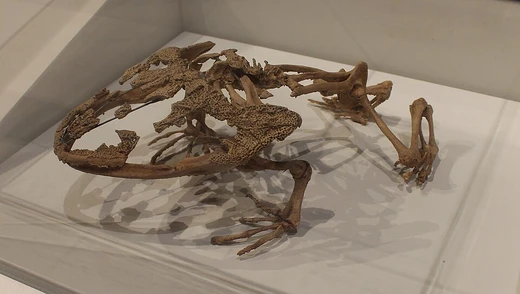
Plesiorycteropus
Extinct Malagasy mammal related to tenrecs, known from subfossil remains.
Last updated
Plesiorycteropus, also known as the bibymalagasy or Malagasy aardvark, is a recently extinct genus of mammals from Madagascar. It was initially classified with the aardvark upon its description in 1895, but molecular evidence now suggests a closer relationship to tenrecs. Two species are recognized: the larger P. madagascariensis and the smaller P. germainepetterae.
Scientific classification
- KingdomAnimalia
- PhylumChordata
- InfraclassPlacentalia
- OrderAfrosoricida
- SuborderTenrecomorpha
- Genus†Plesiorycteropus
Named by Filhol, 1895
Sources: Wikipedia taxobox: Plesiorycteropus (CC BY-SA 4.0)
Quick Facts
- First described by
- Henri Filhol
- Year described
- 1895
- Number of species
- 2
- Largest species
- P. madagascariensis
- Smallest species
- P. germainepetterae
- Estimated mass range
- 6 to 18 kg / 39.7 lb
Facts from the source article.
Taxonomy
Henri Filhol named Plesiorycteropus madagascariensis in 1895 from a partial skull found in a cave at Belo. Though his description was vague, he linked the animal to the aardvark. The genus name means “near Orycteropus,” and the species name points to Madagascar. In 1946, Charles Lamberton noted wide variation in the remains but did not split them into species.
Ross MacPhee, in 1994, separated two species: the larger P. madagascariensis and a smaller new one, P. germainepetterae, named for Germaine Petter. These differ in several skeletal features besides size. Researchers have mistaken Plesiorycteropus bones for rodents and primates. Charles Immanuel Forsyth Major in 1908 described Myoryctes rapeto as a giant fossil rat, later renamed Majoria, but MacPhee showed its pelvic bones match Plesiorycteropus.
Guillaume Grandidier assigned a thigh bone to a giant rodent called Hypogeomys boulei, but Lamberton and MacPhee recognized it as Plesiorycteropus. Other material was wrongly attributed to the giant aye-aye Daubentonia robusta and to a dwarf lemur, Cheirogaleus.
Description
MacPhee used the cross-sectional area of thigh bones to guess at the animal's weight. The lightest guess, based on armadillos and pangolins, was 6 kilograms for the smallest bone, which belonged to P. germainepetterae. The heaviest guess, based on caviomorph rodents, was 18 kilograms for the largest bone, from P. madagascariensis. MacPhee preferred the lower numbers because armadillo leg bones look like those of Plesiorycteropus, even though the rodent model did a better job of predicting its brain size.
Either way, the creature was much bigger than the largest living tenrec, Tenrec ecaudatus, which tops out at 2 kilograms. The higher weight estimates would make it bigger than any mammal native to Madagascar today. Four skulls survive, all damaged and missing their front sections. Three of them broke at the paranasal cavities, hinting that the front of the skull was thin and fragile.
MacPhee put the full skull length of P. madagascariensis at 101 millimeters. The frontal bone averaged 35.4 millimeters long in that species and 29.4 millimeters in P. germainepetterae.
Ecology, behavior, and extinction
The forelimbs show specializations for scratch-digging, with the forefeet placed against the substrate, claws entered, and forefeet drawn back. Large hindlimbs and a broad tail also indicate digging adaptations. The vertebral column and pelvis suggest the animal often sat erect. It may have climbed, perhaps like gymnures and shrew tenrecs, which are small-eyed like Plesiorycteropus.
It was probably myrmecophagous, eating ants and termites, but may have eaten other soft food; its small size likely prevented foraging in termite mounds like the aardvark. MacPhee had material from twelve sites in central, western, and southern Madagascar. P. madagascariensis occurs throughout this range; P. germainepetterae is definitely recorded only from the center, with small southern bones possibly belonging to it. The extinction is poorly known.
MacPhee assumed it may have happened around 1000 years ago, when other subfossil fauna extinctions concluded. One bone was radiocarbon dated to 200 BCE. Its extinction is anomalous because other recently extinct Madagascan animals were larger and not exclusively insectivorous, while some specialized species survived. Early human colonists may have caused extinction through forest destruction.
Literature cited
Ali, J.R. and Huber, M. 2010 Mammalian biodiversity on Madagascar controlled by ocean currents (subscription required). Nature 463:653–656. Asher, R.J. 2007. A web-database of mammalian morphology and a reanalysis of placental phylogeny.
BMC Evolutionary Biology 7:108. Asher, R.J., Novacek, M.J. and Geisler, J.H. 2003. Relationships of endemic African mammals and their fossil relatives based on morphological and molecular evidence (subscription required). Journal of Mammalian Evolution 10(1–2):131–194.
Asher, R.J., Emry, R.J. and McKenna, M.C. 2005. New material of Centetodon (Mammalia, Lipotyphla) and the importance of (missing) DNA sequences in systematic paleontology (subscription required). Journal of Vertebrate Paleontology 25(4):911–923. Buckley, M. 2013.
A molecular phylogeny of Plesiorycteropus reassigns the extinct mammalian order 'Bibymalagasia'. PLoS ONE 8(3):e59614. Burney, D.A., Robinson, G.S. and Burney, L.P. 2003. Sporormiella and the late Holocene extinctions in Madagascar Proceedings of the National Academy of Sciences 100(19):10800–10805.
Burney, D.A., Burney, L.P., Godfrey, L.R., Jungers, W.L., Goodman, S.M., Wright, H.T. and Jull, A.J.T. 2004. A chronology for late prehistoric Madagascar (subscription required). Journal of Human Evolution 47(1-2):25–63. Burney, D.A. and Flannery, T.F. 2005.
Fifty millennia of catastrophic extinctions after human contact. Trends in Ecology & Evolution 20(7):395–401. Douady, C.J., Catzeflis, F., Kao, D.J., Springer, M.S. and Stanhope, M.J. 2002. Molecular evidence for the monophyly of Tenrecidae (Mammalia) and the timing of the colonization of Madagascar by Malagasy tenrecs (subscription required).
Molecular Phylogenetics and Evolution 22(3):357–363. Everson, K.M., Soarimalala, V., Goodman, S.M. and Olson, L.E. 2016. Multiple loci and complete taxonomic sampling resolve the phylogeny and biogeographic history of tenrecs (Mammalia: Tenrecidae) and reveal higher speciation rates in Madagascar's humid forests. Systematic Biology 65(5):890–909.
Forsyth Major, C.I. 1908. A giant sub-fossil rat from Madagascar, Myoryctes rapeto gen. et sp. nov. (subscription required). Geological Magazine (5)5:97–98. Godfrey, L.R., Atkinson, M. and Semprebon, G.M. 2001.
Paul Methuen's sleeping treasure: Subfossil lemurs in the zoological collections of the University Museum, Oxford (subscription required).
More in Prehistoric Animals of Madagascar
Sources
Compiled from Wikipedia and the sources listed below. Text from Wikipedia is available under CC BY-SA 4.0; this entry is adapted from it.
- Wikipedia: Plesiorycteropus (CC BY-SA 4.0).
- Word definitions: the , each quoted from its Wikipedia article.
Spotted an error? Know more?
Reader corrections go straight into our review queue. Suggest an edit · How this site is sourced