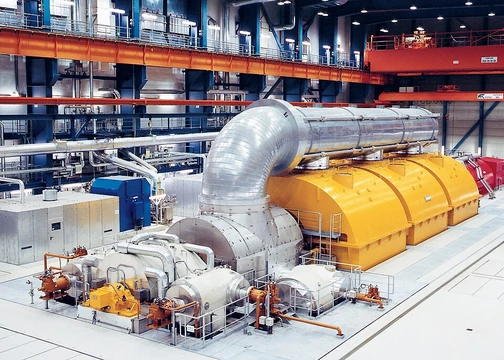
Thermal power station
Facility converting heat from fuel into electrical power.
A thermal power station converts heat energy from various fuel sources into electrical energy, typically by using a thermodynamic power cycle to drive a turbine connected to a generator. The majority of such stations worldwide rely on steam turbines, gas turbines, or a combination of both. Their overall efficiency depends on how effectively the heat content of the fuel is transformed into saleable electricity.
Quick Facts
- Type
- Power station
- Common cycles
- Rankine cycle
- Brayton cycle
- Diesel cycle
- Key components
- Boiler
- steam turbine
- generator
- condenser
- stack gas cleanup
Facts from the source article.
Did You Know?
- Non-nuclear thermal power stations that do not use cogeneration are sometimes referred to as conventional power stations.
- The reciprocating steam engine was used for central electrical power stations when the first commercially developed ones were established in 1882.
Boiler and steam cycle
In a pressurized water reactor, a steam generator is a large heat exchanger that thermally connects the primary reactor system to the secondary steam system. Boiling water reactors generate steam directly in the reactor core without a separate steam generator. Heat recovery steam generators produce steam by capturing heat from industrial processes, most often from gas turbine exhaust. Geothermal plants use naturally occurring steam and may employ heat exchangers if the steam is corrosive or contains solids. A fossil-fuel steam generator includes an economizer, steam drum, furnace tubes, and superheater coils, with safety valves to prevent overpressure. The air and flue gas path comprises forced-draft and induced-draft fans, an air preheater, the furnace, fly ash collectors, and the stack. Feed water, a mix of recirculated condensate and purified makeup water, transfers heat from the fuel to the turbine. Makeup water is demineralized to a conductivity of 0.3–1.0 microsiemens per centimeter; a 500 MWe plant requires about 120 US gallons per minute of makeup. The condensate flow at full load in such a plant is roughly 6,000 US gallons per minute.
Steam turbine generator
A steam turbine generator comprises multiple steam turbines connected to a generator on a common shaft. Typically, a high-pressure turbine is followed by an intermediate-pressure turbine and then one, two, or three low-pressure turbines. As steam expands and loses pressure, its volume increases, requiring larger-diameter blades at each stage. The rotating assembly may exceed 200 metric tons and 100 feet in length. To prevent shaft bowing, it is kept turning at about 3 rpm even when shut down, a function powered by emergency batteries along with lighting, communications, alarms, the hydrogen seal system, and lube oil. Superheated steam enters the high-pressure turbine at 2400 psi and 1000°F, exits at 600 psi and 600°F, is reheated in the boiler to 1000°F, then passes through the intermediate-pressure turbine and finally the low-pressure turbines before reaching the condenser. The generator, roughly 30 feet long and 12 feet in diameter, contains a stator and rotor with miles of copper conductor. It produces up to 21,000 amperes at 24,000 volts AC (504 MWe) while spinning at 3000 or 3600 rpm. The rotor is cooled by hydrogen gas, which has the highest heat transfer coefficient of any gas and low viscosity. During startup, air in the chamber is first displaced by carbon dioxide before hydrogen is introduced to avoid an explosive mixture.
Stack gas path and cleanup
Combustion flue gas leaving the boiler passes through a rotating air preheater that transfers heat to incoming fresh air. The gas contains fly ash, nitrogen, carbon dioxide, sulfur dioxide, and nitrogen oxides. Fly ash is removed by fabric bag filters or electrostatic precipitators; the collected ash can sometimes be used in concrete manufacturing. Many coal-fired plants worldwide lack such cleanup equipment, though legislation in Europe, Japan, and the United States has reduced pollution. Where required, stack gas scrubbers using a limestone or alkaline wet slurry remove sulfur and nitrogen oxides; other devices use catalysts to remove nitrous oxide compounds. By the time gas reaches the flue-gas stack, its temperature may have dropped to about 50°C. Stacks are typically 150–180 meters tall to disperse remaining components; the tallest, at the Ekibastuz GRES-2 Power Station in Kazakhstan, is 419.7 meters. In the United States and some other countries, atmospheric dispersion modeling determines the required stack height to comply with air pollution regulations. U.S. regulations also require stack height to meet good engineering practice standards; if an existing stack exceeds that height, modeling must use the GEP height rather than the actual height.
Auxiliary systems
Continuous steam withdrawal and condensate return cause water losses from blowdown and leaks, which are compensated by adding makeup water to maintain the boiler drum level. Raw water contains calcium and magnesium salts that cause hardness; if not removed, these salts form deposits on tube surfaces, leading to overheating and failure. A demineralising plant removes ions using cation, anion, and mixed bed exchangers, producing water that consists essentially of hydrogen and hydroxide ions. This very pure water becomes highly corrosive when it absorbs oxygen. The demineralising plant's capacity depends on the type and quantity of salts in the raw water. A storage tank, often made of PVC to resist corrosion, holds demineralised water for boiler makeup; piping and valves are usually stainless steel. A steam blanketing arrangement or stainless steel float may be used to prevent air contact. Demineralised water is typically added at the vacuum side of the surface condenser, where it is sprayed and deaerated. In coal-fired stations, raw coal is crushed, conveyed to hoppers, and pulverized into fine powder by ball mills or other grinders. Stations burning fuel oil keep the oil warm above its pour point in storage tanks and heat it to about 100°C before it is pumped through furnace spray nozzles.
More in Power Generation
Spotted an error? Know more?
Reader corrections go straight into our review queue. Suggest an edit · How this site is sourced