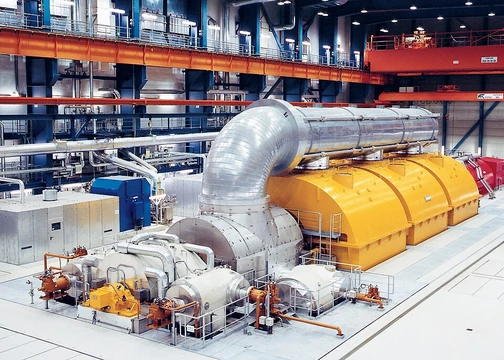
Nuclear reactor
Device that controls nuclear fission for energy, propulsion, and research.
A nuclear reactor is a device that sustains a controlled fission nuclear chain reaction, primarily using fissile nuclei such as uranium-235 or plutonium-239. These reactors are employed for commercial electricity generation, marine propulsion, weapons production, and research, with fuel efficiency vastly exceeding that of fossil fuels. The first artificial critical reactor, Chicago Pile-1, was built in 1942, and commercial nuclear power began with the Soviet Obninsk plant in 1954 and Calder Hall in England in 1956.
Quick Facts
- First critical reactor
- Chicago Pile-1 (1942)
- First commercial power station
- Calder Hall
- Sellafield
- England (1956)
- Share of global electricity
- 9%
- Dominant reactor type
- Pressurized water reactor (about 70% of commercial reactors)
Facts from the source article.
Did You Know?
- During early 1940s research, the phrase 'atomic pile' was used for uranium assemblies; after Chicago Pile-1, 'reactor' became common.
- Radioisotope thermoelectric generators and radioisotope heater units derive power from nuclear decay but are not considered nuclear reactors.
- The SL-1 accident in 1961 and the K-19 reactor accident in 1961 are among serious nuclear and radiation incidents.
Operation
Nuclear reactors convert the energy from controlled nuclear fission into thermal energy, which is then used to generate electricity or mechanical power, similar to conventional thermal power stations. When a fissile nucleus like uranium-235 absorbs a neutron, it splits into lighter nuclei, releasing kinetic energy, gamma radiation, and free neutrons. Some of these neutrons can trigger further fission events, creating a chain reaction. Control rods containing neutron poisons and neutron moderators regulate this reaction by adjusting the proportion of neutrons that cause additional fission. The reactor core produces heat from the kinetic energy of fission products colliding with atoms, from gamma ray absorption, and from the radioactive decay of fission products and activated materials. This decay heat persists even after shutdown. A kilogram of uranium-235 releases about three million times more energy than a kilogram of coal, equivalent to 19 billion kilocalories or the energy from burning 2.7 million kilograms of coal.
History
The neutron was discovered in 1932 by James Chadwick, and in 1933 Leó Szilárd conceptualized a neutron-mediated nuclear chain reaction, filing a patent the following year. However, his idea did not involve nuclear fission, which was discovered in 1938 by Otto Hahn, Lise Meitner, and Fritz Strassmann when they found that neutron bombardment of uranium produced barium, indicating fission. In February 1939, Hahn and Strassmann predicted additional neutrons from fission, enabling a chain reaction, which was confirmed by Szilárd and Fermi. On 2 August 1939, Albert Einstein signed a letter to President Franklin D. Roosevelt, written by Szilárd, warning that uranium fission could lead to extremely powerful bombs. The US nuclear project proceeded, though with delays due to skepticism, including from Enrico Fermi.
Reactor types
All commercial power reactors use nuclear fission, typically with uranium and plutonium fuel, though a thorium cycle is possible. They are divided into thermal-neutron and fast-neutron reactors. Thermal-neutron reactors, which constitute almost all current reactors, slow neutrons using a moderator to increase the probability of fissioning fissile nuclei like uranium-235, allowing use of low-enriched or natural uranium. The moderator is often also the coolant, usually pressurized water. Fast-neutron reactors lack a moderator and require more highly enriched fuel (about 20% or more) because fast neutrons have a lower fission probability for uranium-238. They can produce less transuranic waste but are more expensive to build and operate. Early power stations and some Russian naval units were fast reactors. Graphite-moderated reactors, such as the Chicago Pile and RBMK, were common in early designs, while water-moderated reactors are widely used. Fusion power, which would use nuclear fusion of elements like deuterium, remains an ongoing research topic with no self-sustaining reactor ever built.
More in Power Generation
Spotted an error? Know more?
Reader corrections go straight into our review queue. Suggest an edit · How this site is sourced