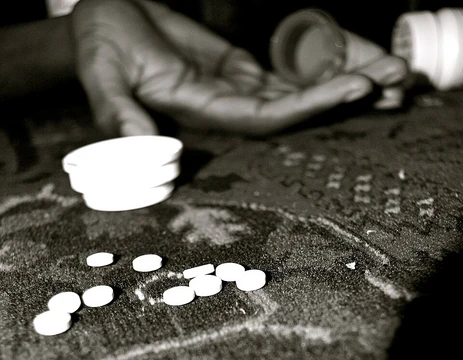
Barbiturate overdose
Barbiturate overdose is now a rare cause of poisoning.

Barbiturate overdose happens when someone takes too much of a barbiturate drug. Signs include trouble thinking clearly, clumsiness, a reduced level of consciousness, and shallow or slowed breathing. A possible complication is fluid buildup in the lungs not caused by heart problems. If the person dies, it is usually because they stop breathing. Overdoses can be accidental or intentional, and the effects are worsened when combined with alcohol or benzodiazepines. How much of the drug is lethal depends on the person’s tolerance and how they took it. Barbiturates work by affecting the GABA neurotransmitter, and exposure can be confirmed through blood or urine tests. These drugs were once a common cause of overdose but are now rarely involved.
The drugs work by lengthening the time the chloride channel on the GABAA receptor stays open, making GABA more effective. Benzodiazepines, in contrast, increase how often that channel opens, making GABA more potent.
Treatment focuses on supporting breathing and blood pressure. There is no specific antidote, but activated charcoal can help, sometimes requiring multiple doses. Hemodialysis might be considered in some cases. For barbiturate poisoning, giving sodium bicarbonate to make the urine more alkaline (pH above 7.5) and ensuring urine output is at least 2 mL per kilogram per minute can be useful. If the person is drowsy but awake, can swallow, and breathes without trouble, simply monitoring them closely may be enough. If they are not breathing, mechanical ventilation may be needed until the drug wears off. A psychiatric consultation is usually recommended.
The list of people who died by suicide from barbiturate overdose includes Stefan Zweig, Gillian Bennett, Charles Boyer, Ruan Lingyu, Victor Folke Nelson, Dalida, Jeanne-Paule Marie Deckers, Felix Hausdorff, Abbie Hoffman, Phyllis Hyman, Marilyn Monroe, Cesare Pavese, C. P. Ramanujam, George Sanders, Carole Landis, Jean Seberg, Lupe Vélez, and the members of the Heaven’s Gate cult. Accidental overdoses killed Pier Angeli, Brian Epstein, Judy Garland, Jimi Hendrix, Inger Stevens, Dinah Washington, Ellen Wilkinson, and Alan Wilson, though some of these cases are suspected to be suicides. Those who died from a mix of barbiturates and other drugs include Rainer Werner Fassbinder, Dorothy Kilgallen, Malcolm Lowry, Edie Sedgwick, and Kenneth Williams.
- Lethal dose variability
- Varies with a person's tolerance and how the drug is taken
- Target urinary ph for treatment
- Greater than 7.5
- Target urine output for treatment
- Surpasses 2 mL/kg/min
- Common cause status
- Now a rare cause of overdose
Lore & Background
Barbiturate overdose may occur by accident or purposefully in an attempt to cause death. The toxic effects are additive to those of alcohol and benzodiazepines. The effects of barbiturates occur via the GABA neurotransmitter, and exposure may be verified by testing the urine or blood. The mechanism involves increasing the time that the chloride pore of the GABAA receptor is opened, thereby increasing the efficacy of GABA, in contrast to benzodiazepines which increase the frequency of pore opening.
Reader's Guide
The significance of barbiturate overdose lies in its historical prevalence and its current rarity as a cause of poisoning. The article notes that while once common, barbiturates are now a rare cause of overdose, reflecting changes in prescribing practices and the availability of safer alternatives. Treatment focuses on supportive care, including supporting breathing and blood pressure, with activated charcoal and possibly hemodialysis or urinary alkalinization with sodium bicarbonate. The differential diagnosis includes other sedative substances and natural diseases such as hypoglycemia and myxedema coma. The article lists numerous notable cases, including deaths by suicide, accidental overdoses, and combined drug overdoses, highlighting the drug's role in both intentional and unintentional fatalities. The legacy of barbiturate overdose is thus one of a once-dominant cause of poisoning that has receded in clinical importance but remains a subject of historical and forensic interest.
Did You Know?
- The toxic effects of barbiturates are additive to those of alcohol and benzodiazepines.
- There is no antidote for barbiturate overdose, but activated charcoal may be useful.
- Notable individuals who died by suicide from barbiturate overdose include Marilyn Monroe and members of the Heaven's Gate cult.
Neuropharmacology & Toxicological Profile
Barbiturates exert their sedative and ultimately lethal effects through the GABA neurotransmitter system. Specifically, they prolong the duration that the chloride ion channel of the GABAA receptor remains open, thereby amplifying the overall efficacy of GABA signaling. This mechanism is distinct from benzodiazepines, which instead increase how frequently that same chloride channel opens, boosting GABA's potency rather than its duration. In overdose scenarios, the toxic effects of barbiturates are additive when combined with alcohol or benzodiazepines, compounding respiratory depression and loss of consciousness. The lethal threshold is not fixed; it shifts depending on an individual's accumulated tolerance and the route by which the drug was taken. Death, when it occurs, is most commonly the result of respiratory failure—the body simply stops making the effort to breathe. Complications can extend beyond the airway, with noncardiogenic pulmonary edema representing a serious secondary threat.
Clinical Presentation & Medical Management
A person suffering barbiturate poisoning typically presents with clouded thinking, impaired coordination, a progressively diminished level of consciousness, and a marked reduction in respiratory drive. The clinical response is stratified by severity. A drowsy but alert individual who can still swallow and breathe unassisted may require nothing more than close observation. At the other extreme, a patient who has ceased breathing entirely necessitates mechanical ventilation, maintained until the drug's effects naturally dissipate. There is no specific antidote for barbiturates. Supportive care centers on sustaining ventilation and blood pressure. Activated charcoal, sometimes administered in multiple doses, can limit further absorption. In select cases, hemodialysis is considered. Urinary alkalinization using sodium bicarbonate is another tool, with the goal of pushing urinary pH above 7.5 while ensuring output exceeds 2 mL per kilogram per minute. A psychiatric consultation is generally advised, particularly when the overdose was intentional.
A Catalogue of Tragic and Notable Deaths
The history of barbiturate overdose is marked by an extraordinary roster of well-known figures. Among those who died by deliberate self-poisoning are writers Stefan Zweig and Cesare Pavese, the mathematician Felix Hausdorff, the physicist C. P. Ramanujam, the counterculture icon Abbie Hoffman, and actors including Marilyn Monroe, Jean Seberg, Carole Landis, and Lupe Vélez. The Heaven's Gate cult members also perished through this means. Accidental overdoses claimed musicians Judy Garland, Dinah Washington, Jimi Hendrix, and Alan Wilson, as well as the manager Brian Epstein and the actress Pier Angeli; in several of these instances, suicide has been speculated. A few deaths involved barbiturates combined with other substances, including Rainer Werner Fassbinder, Edie Sedgwick, and Kenneth Williams. Maurice Chevalier's 1971 attempt—swallowing barbiturates and cutting his wrists—left him alive but with severe organ damage that ultimately killed him nine months later. Ingeborg Bachmann's death may have resulted from unrecognized barbiturate withdrawal while she was hospitalized for burns.
Diagnostic Considerations & Shifting Prevalence
Confirming barbiturate exposure relies on toxicological analysis of urine or blood samples. Because the clinical picture—drowsiness, poor coordination, reduced consciousness, shallow breathing—overlaps with many other conditions, a thorough differential diagnosis is essential. Clinicians must rule out intoxication by benzodiazepines, anticonvulsants such as carbamazepine, various alcohols including ethanol, ethylene glycol, and methanol, opioids, carbon monoxide, sleep aids, and gamma-hydroxybutyric acid. Natural medical conditions that produce disorientation, such as hypoglycemia and myxedema coma, must also be excluded, and hypothermia should be considered in the appropriate clinical context. Despite the dramatic historical cases, barbiturates have shifted from being a common cause of fatal overdose to a comparatively rare one in modern practice, a decline that reflects changes in prescribing habits and the availability of alternative sedative medications.
Frequently Asked Questions
What is Barbiturate overdose?
Barbiturate overdose is a poisoning event that occurs when a person ingests an excessive amount of a barbiturate-class sedative. The drug overstimulates GABA-mediated pathways in the brain, producing a cascade of neurological and respiratory depression.
What signs does Barbiturate overdose produce?
Victims typically show impaired cognition, uncoordinated movements, a dropping level of consciousness, and progressively shallow or slowed breathing. In severe cases, non-cardiogenic pulmonary edema can develop as a secondary complication.
What makes Barbiturate overdose more dangerous?
The toxic effect is significantly amplified when barbiturates are combined with alcohol or benzodiazepines, as all three depress the central nervous system. The exact lethal threshold also shifts depending on an individual's prior tolerance and the route of administration.
How is Barbiturate overdose treated?
Clinical management aims to alkalinize the urine to a pH above 7.5 and push urine output beyond 2 mL per kilogram per minute to enhance renal excretion of the drug. Airway support is critical because respiratory arrest is the usual mechanism of death.
Why is Barbiturate overdose rarely encountered today?
Barbiturate overdose has fallen out of prominence as a cause of poisoning, largely because these agents have been largely displaced by safer alternatives in clinical practice. It now accounts for only a small fraction of drug-related overdoses.
More in Poisoning by Drugs, Medicaments and Biological Substances 1-24
Spotted an error? Know more?
Reader corrections go straight into our review queue. Suggest an edit · How this site is sourced