The Seagull (poem)
A 14th-century Welsh love poem addressing a seagull as messenger.
Last updated
Composed around the 1340s, “The Seagull” (Yr Wylan) is a 30-line love poem by Dafydd ap Gwilym, a 14th-century Welsh poet often hailed as his nation’s finest. This piece remains one of his most cherished and famous works.
Quick Facts
- Poet
- Dafydd ap Gwilym
- Original title (welsh)
- Yr Wylan
- Date
- probably 1340s
- Lines
- 30
- Metre
- cywydd
- Form
- 15 rhyming couplets
Facts from the source article.
Imagery
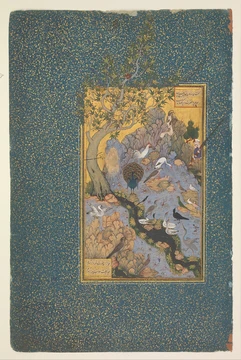
The imagery in "The Seagull" goes beyond anything in earlier Welsh poetry, according to the critic Huw Meirion Edwards. Anthony Conran wrote that the poem has "the visual completeness, brilliance and unity of a medieval illumination, a picture from a book of hours." Dafydd was a master of the love-messenger poem, which follows a pattern: addressing the llatai (messenger), praising it, asking it to carry a message to the beloved, and praying for its safe return.
In this poem, the seagull is more than a conventional llatai; its appearance and behaviour are closely observed, and the scholar Rachel Bromwich noted "an almost mystical reverence" for the bird. The gull's white purity suggests the girl, while its flight embodies freedom, contrasting with the enclosing castle (possibly Aberystwyth or Criccieth). The girl is a redhead, unusual in medieval Welsh poetry, and Dafydd gives her little physical detail compared with his other love poems.
Construction
The poem consists of 30 lines (15 rhyming couplets) in the cywydd metre. Each line has 7 syllables, with a break usually after the 3rd or 4th syllable. In each couplet, one line ends in a monosyllable and the other in a polysyllable, so that the rhyme falls on a stressed syllable in one line and an unstressed one in the other.
{{lang|cy|Cynghanedd}} ("Sound-harmony")
Each line uses cynghanedd (sound-harmony). Three types appear in the poem. Cynghanedd groes repeats all consonants except the last in the first half of the line in the same order in the second half (lines 1, 4, 8–12, 16, 17, 19, 20, 24, 26, 27); the matched consonants must be arranged around the stressed vowel identically in each half, but the final letters of the two halves must not match. Cynghanedd draws has some consonants at the start of the second half that do not repeat any in the first half (lines 2, 6, 7, 14, 15, 22, 28).
Cynghanedd sain divides the line into three parts; the first two rhyme and the second and third have repeating consonants (lines 3, 5, 13, 18, 21, 23, 25, 29, 30). The fourth type, cynghanedd lusg (internal rhyme without consonant matching), is not used. The twin requirements of rhyme and cynghanedd often cause words to be chosen for sound as much as meaning; one rhyming word in a couplet must be a monosyllable (or polysyllable stressed on the final) and the other a polysyllable with penultimate stress.
References to older poetry
Dafydd compares his beloved to Eigr, wife of Uther Pendragon and mother of King Arthur, the heroine he most often cites as the archetypical beautiful woman. He also mentions Myrddin and Taliesin together, a pairing common in Welsh verse; Myrddin is sometimes presented as a lover, but Taliesin is not, making Dafydd's reference to him in that role unusual. These figures may pay tribute to the native Welsh poetic tradition, while the poet's submission to the girl acknowledges the influence of courtly love literature from Provence.
Did You Know?
- Glyn Jones wrote a poem, "Dafydd's Seagull and the West Wind", which gives the seagull's response.
- John Hardy set "The Seagull" as part of a song-cycle called Fflamau Oer: Songs for Jeremy.
- David Vaughan Thomas wrote a musical setting of the poem in 1924, published posthumously in 1950.
More in Poems About Birds
Sources
Compiled from Wikipedia and the sources listed below. Text from Wikipedia is available under CC BY-SA 4.0; this entry is adapted from it.
- Wikipedia: The Seagull (poem) (CC BY-SA 4.0).
Spotted an error? Know more?
Reader corrections go straight into our review queue. Suggest an edit · How this site is sourced