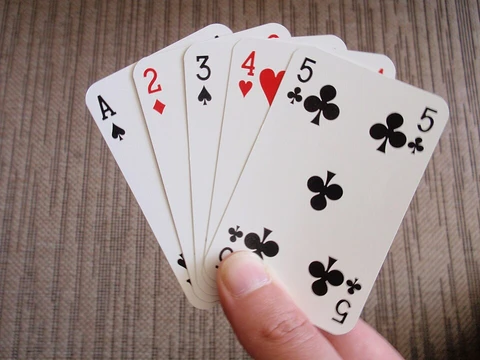
Bicycle Playing Cards
Flagship brand of the United States Playing Card Company since 1885.

via Wikipedia: Bicycle Playing Cards · see source
Bicycle Playing Cards is a brand of playing cards first manufactured by the United States Printing Company in 1885. The name was chosen to reflect the popularity of the bicycle at the end of the 19th century, and the brand is generally recognized as the flagship brand of the United States Playing Card Company (USPCC). The Bicycle ace of spades first referenced the numerical designation 808 in 1894, the same year USPCC incorporated as an independent entity from the other Russell & Morgan printing concerns. After years in Cincinnati, Ohio, USPCC is now based in Erlanger, Kentucky.
Quick Facts
- First manufactured
- 1885
- Year uspcc incorporated
- 1894
- Current location
- Erlanger, Kentucky
- Previous location
- Cincinnati, Ohio
- Most popular back design
- Rider Back (No. 63)
Facts from the source article.
Design
Bicycle playing cards use the standard French deck structure: 52 cards split into two red and two black suits, plus two jokers. The ace of spades carries the Bicycle trademark, and modern decks also include two advertisement cards. While many back designs exist, the Rider Back (No. 63) is the most popular. The cards come in poker size (3.5 x 2.5 in), bridge size (3.5 x 2.25 in), and pinochle decks, along with Jumbo Index and Lo Vision versions for those with visual impairments. Special backs, sizes, colors, and custom designs are made for magic tricks and as novelties or collectibles. 82 different historic back designs have been produced under the Bicycle brand.
Significance in American wars
Toward the end of World War I, USPCC produced four War Series decks under the Bicycle brand, each representing a branch of the U.S. armed services: Flying Ace for the Aviation Section of the Signal Corps, Dreadnaught for the Navy, Invincible (also called Conqueror) for the Marine Corps, and Big Gun for the Army. Printed in 1917, they received an extremely limited release before being withdrawn; one theory holds they were intended for troops overseas and were destroyed when Armistice was declared in 1918.
Only a handful survive. During World War II, cards were produced that could be peeled apart when submerged in water, with map portions drawn on the inside surfaces and reassembled into an innocuous-looking deck. These were supplied to POWs for escapes; at least one example is on display at the International Spy Museum in Washington, DC. Modern limited-edition reproductions have been sold.
During the Vietnam War, the company provided crates of ace of spades cards for U.S. soldiers, based on a belief that the Viet Cong regarded the card as a symbol of death. The origin is attributed to a letter written by Lt. Charles W. Brown in early 1966 to Allison F. Stanley, President of USPCC. Brown requested 1,000 aces of spades to leave for the enemy to find. Stanley pulled cards from the production line and sent them free of charge.
The story was reported by news outlets including Stars and Stripes, leading more units to request cards. Thousands of special decks containing only aces of spades were donated by the card company to soldiers.
More in Playing Cards
Spotted an error? Know more?
Reader corrections go straight into our review queue. Suggest an edit · How this site is sourced