Frequently Asked Questions
The most-asked questions about plate and mushroom corals.
What exactly are plate and mushroom corals?
They are solitary scleractinian corals—meaning each individual polyp builds its own small, free-standing calcium-carbonate skeleton rather than joining a colonial structure. Their flat, disc-shaped or slightly domed profile is what earns them the common names 'plate coral' and 'mushroom coral' in the reef-aquarium hobby.
Which taxonomic group do they belong to?
Plate and mushroom corals fall under the family Fungiidae within the order Scleractinia. The best-known genus is Fungia, though a few closely related genera (such as Favia in some older classifications) are sometimes grouped with them.
How are they different from the 'stony corals' that build reefs?
Most reef-building corals are colonial, with many polyps sharing one massive skeleton. Fungiidae corals are strictly solitary: a single polyp sits atop its own small plate, so you will never see them forming the broad, fused frameworks that make up a coral reef.
Where do you find them in the wild?
They inhabit shallow, sunlit tropical waters of the Indo-Pacific, typically from the surface down to about 30 metres. They favour sandy or rubble substrates where they can rest their flat base and receive ample light for their symbiotic algae.
How do they get their nutrition?
Like most reef corals, they host photosynthetic zooxanthellae algae inside their tissues, which supply sugars from sunlight. At night or in dimmer light, they extend their tentacles to capture plankton and small organic particles drifting past.
Can they actually move?
Yes—Fungia are famous for slowly repositioning themselves on the seafloor, rotating their skeleton a few centimetres per day. This lets them track the best light angle or nudge away from sediment, a behaviour unique among scleractinian corals.
What is the difference between a 'mushroom coral' and a 'mushroom anemone'?
In the hobby, 'mushroom coral' usually means a Fungia plate coral (a true stony coral with a hard skeleton), while 'mushroom anemone' refers to Discosoma, which is a soft-bodied sea anemone with no calcium skeleton at all. They look superficially similar but belong to entirely different biological groups.
What do their skeletons look like up close?
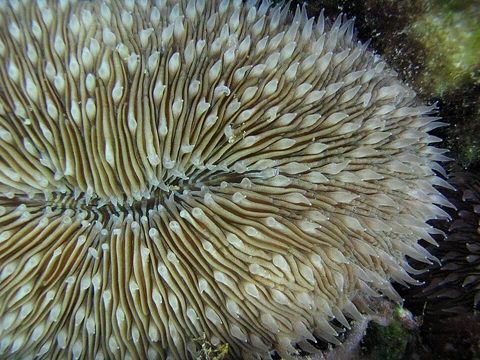
Each skeleton is a shallow, roughly circular plate with a slightly concave upper surface and a flatter base, often marked by radial grooves that follow the polyp's septa. The upper surface is covered by the living tissue and a thin mucus layer, while the underside shows the bare calcareous structure.
Why are they popular in reef aquariums?
Their small footprint, hardy nature, and vivid tissue colours (greens, yellows, purples, or multi-toned) make them easy additions to mixed reefs. They tolerate a wide range of flow and lighting conditions and rarely compete aggressively with neighbouring corals.
What is a fun or surprising fact about them?
Despite being 'corals,' a single Fungia polyp can be surprisingly large for a solitary scleractinian—some specimens reach 15–20 cm across—and the entire animal is essentially one polyp, not a colony of many. That makes each plate coral a single, self-contained individual in a world where most corals are superorganisms.