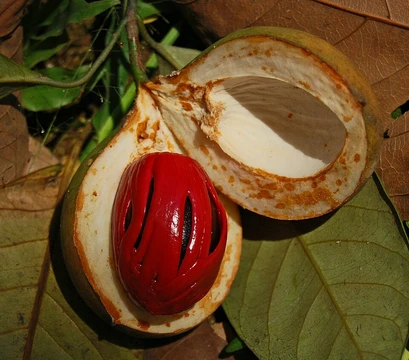
Nut (fruit)
A hard-shelled, indehiscent fruit protecting a single seed.

A nut is a type of fruit with a hard, tough shell that protects a single seed inside. Botanically, the term "nut" specifically refers to fruits whose shells do not naturally open to release the seed—a characteristic called indehiscence. Unlike many other seeds, which are freed from their fruit on their own, true nuts like hazelnuts, chestnuts, and acorns have a hard shell wall and come from a compound ovary. Because they stay closed at maturity, these nuts depend on outside help for seed dispersal, often through animals that eat them and later excrete the seeds.
The seed itself is a mature, fertilized ovule made up of three parts: an embryo that can grow into a new plant, stored food for the embryo, and a protective seed coat. Botanically, a nut is a fruit with a woody outer layer (pericarp) that develops from a syncarpous gynoecium. Some nuts are surrounded by an involucre—a cup-shaped structure formed from flower bracts—which can be scaly, spiny, leafy, or tubular depending on the species. Most nuts come from flowers with inferior ovaries, and all are indehiscent. True nuts are produced by plant families in the order Fagales, including beech, chestnut, oak, stone-oak, and tanoak (family Fagaceae), as well as hazel, filbert, and hornbeam (family Betulaceae).
A small nut is sometimes called a "nutlet" (formerly a nucule, though that term now usually refers to the oogonium of stoneworts). In botany, "nutlet" can also describe a pyrena or pyrene—a seed covered by a stony layer, like the kernel inside a drupe. Walnuts and hickories (including pecans) from the family Juglandaceae have fruits that are hard to classify. Some definitions, including that of the authoritative Angiosperm Phylogeny Group, consider them nuts, while others call them drupaceous nuts.
Many nuts used for food can cause allergic reactions, ranging from mild symptoms to severe, life-threatening anaphylaxis. This reaction happens when the body releases histamine in response to an allergen in the nuts, affecting the skin and other systems. Tree nut allergies are different from peanut allergies—peanuts are legumes, while tree nuts are hard-shelled nuts—but experts advise that people allergic to peanuts should also avoid tree nuts, and vice versa.
For both wildlife and humans, nuts provide a high number of calories, mainly from unsaturated fats like linoleic and linolenic acids, as well as monounsaturated fats. They are rich in B vitamins, vitamin E, and essential amino acids. While nutrient content varies among different nuts, they generally have low water and carbohydrate levels and are high in protein, dietary minerals, and dietary fiber. Many nuts and seeds are edible and used in cooking: they can be eaten raw, sprouted, or roasted as a snack; soaked and filtered to make nut milk; ground into nut butters; or pressed for oil used in cooking and cosmetics.
- type
- Fruit
- botanical_definition
- Fruit with a woody pericarp developing from a syncarpous gynoecium
- key_families
- Fagaceae, Betulaceae
- dispersal_method
- External vectors (e.g., herbivores)
- common_examples
- Hazelnut, chestnut, acorn
Lore & Background
Botanically, a nut is a fruit with a woody pericarp developing from a syncarpous gynoecium. Nuts may be contained in an involucre, a cup-shaped structure formed from flower bracts, which can be scaly, spiny, leafy, or tubular depending on the species. Most nuts come from pistils with inferior ovaries and are indehiscent, meaning they do not open at maturity. True nuts are produced by plant families of the order Fagales, including beech, chestnut, oak, stone-oak, and tanoak in the family Fagaceae, as well as hazel, filbert, and hornbeam in the family Betulaceae. Note that the family Juglandaceae (walnuts and hickories) produces drupaceous nuts—fruits with a fleshy outer layer—rather than true nuts.
Reader's Guide
Nuts are significant as a food source for both wildlife and humans, supplying a relatively large quantity of calories from unsaturated fats, such as linoleic acid and linolenic acid, and monounsaturated fats. They are rich sources of B vitamins, vitamin E, and essential amino acids, and generally have low water and carbohydrate content with high levels of protein, dietary minerals, and dietary fibre. Many nuts and seeds are edible and used in cooking, eaten raw, sprouted, or roasted as a snack food, soaked and filtered to make nut milk, ground to make nut butters, or pressed for oil used in cooking and cosmetics. However, nuts used for food are a common source of food allergens, with reactions ranging from mild to life-threatening anaphylaxis. Tree nut allergies are distinct from peanut allergy, as peanuts are legumes, but experts suggest that a person with an allergy to peanuts should avoid eating tree nuts, and vice versa.
Did You Know?
- A small nut may be called a 'nutlet,' formerly called a nucule.
- Walnuts and hickories, including pecans, are botanically drupes (or drupaceous nuts) because their outer layer is fleshy and dehiscent, not a hard, indehiscent shell like a true nut.
- True nuts are indehiscent, meaning they do not open at maturity to release the seed.
- The involucre of a nut may be scaly, spiny, leafy, or tubular depending on the species.
Frequently Asked Questions
What is a Nut (fruit) in Plant Biology 1-16?
A nut is a fruit type defined by a tough, woody outer shell that encases exactly one seed. Botanically, it forms from a syncarpous gynoecium and is characterized by its indehiscent pericarp, meaning the shell never splits open on its own.
What separates a true nut from other fruits?
The defining trait is indehiscence: a true nut's hard pericarp stays permanently closed and never releases its seed by splitting. It must also develop from an inferior ovary and hold a single seed, setting it apart from drupes, capsules, and other fruit categories.
Which plant families produce true nuts?
The Fagaceae and Betulaceae families are the primary sources of true nuts in the botanical canon. Familiar examples drawn from these families include the hazelnut, the chestnut, and the acorn.
How does a Nut (fruit) disperse its seed?
Because the shell never opens, nuts rely entirely on external vectors—most often herbivores that consume the nut and later deposit the intact seed at a new location. This makes animal-mediated transport the sole dispersal pathway for this fruit type.
Why is the Nut (fruit) entry important in Plant Biology 1-16?
It pins down the strict botanical definition of a nut, distinguishing it from the loose everyday use of the word. That clarification is foundational for understanding seed-protection strategies and dispersal ecology across the Fagaceae and Betulaceae families.
More in Plant Biology 1-16
Spotted an error? Know more?
This is a living reference — every entry is fact-audited, and reader corrections feed straight into our audit queue. Suggest an edit · See this site's audit record