Frequently Asked Questions
The most-asked questions about planetary nebulae.
What is a planetary nebula?
A planetary nebula is the luminous shell of ionized gas that a dying star expels in the final chapter of its life. It appears when a sun-like star sheds its outer layers, revealing a scorching-hot core that bathes the ejected material in ultraviolet light and makes it glow.
Why is it called 'planetary' when it has nothing to do with planets?
Eighteenth-century observers such as William Herschel noticed that several of these objects presented small, round, planet-like disks through their telescopes. The misleading name simply stuck in the astronomical vocabulary long after their true stellar nature was understood.
How does a planetary nebula form?
A star between roughly 0.8 and 8 solar masses runs out of core fuel, swells into a red giant, and then gently puffs off its outer envelope over tens of thousands of years. The newly exposed core, which will cool into a white dwarf, radiates intense ultraviolet photons that excite the surrounding gas and produce the characteristic glow.
How long does the visible planetary-nebula phase last?
The bright, easily observable stage is remarkably short, typically spanning only about 10,000 to 50,000 years. After that the gas drifts apart and fades into the interstellar medium, so only a tiny fraction of stars are in this phase at any given moment.
What shapes and colors do planetary nebulae come in?
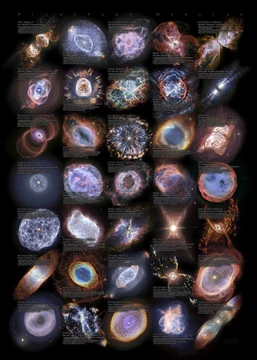
They range from near-perfect rings, like the Ring Nebula in Lyra, to elaborate bipolar 'butterfly' or 'hourglass' structures such as the Helix Nebula. Colors shift from blue-green (oxygen and hydrogen emission) to red (nitrogen) and pink (sulfur), depending on which elements are being excited.
Which planetary nebulae are the most famous?
The Ring Nebula (M57) in Lyra, the Helix Nebula (NGC 7293) in Aquarius, and the Cat's Eye Nebula (NGC 6543) in Draco are among the most widely photographed and studied. The Owl Nebula (M97) in Ursa Major is another classic, beloved target for amateur observers.
How does a planetary nebula differ from a star-forming nebula like Orion?
A star-forming nebula is a vast cloud of gas and dust in which new stars are being born, whereas a planetary nebula is the final exhalation of a single dying star. In essence, one marks the beginning of a stellar life and the other marks its end.
Can I see a planetary nebula with a backyard telescope?
Yes—objects like the Ring Nebula and the Owl Nebula are resolvable in modest 6- to 8-inch telescopes under reasonably dark skies, though they look faint and small. Using averted vision and a dedicated nebula filter can help bring out their subtle color and internal structure.
What happens to the gas after a planetary nebula fades?
The expelled material slowly disperses and mixes back into the interstellar medium, enriching it with carbon, nitrogen, and other elements forged inside the star. That chemically enriched gas will eventually take part in forming new stars and planetary systems.
How many planetary nebulae are known, and where can I find them?
Roughly three thousand have been catalogued in the Milky Way, with several hundred more identified in nearby galaxies. They are scattered across every constellation, so there is at least one observable target visible in any given season of the year.