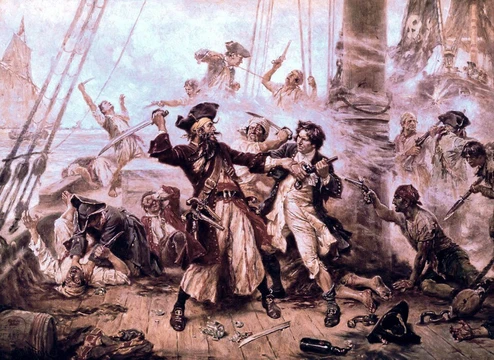
Woodes Rogers
English sea captain who rescued Alexander Selkirk and governed the Bahamas.

via Wikipedia: Woodes Rogers · see source
Woodes Rogers was an English sea captain, privateer and colonial administrator who served as the governor of the Bahamas from 1718 to 1721 and again from 1728 to 1732. He is remembered as the captain of the vessel that rescued marooned Scottish sailor Alexander Selkirk, whose plight is generally believed to have inspired Daniel Defoe's novel Robinson Crusoe. Rogers came from an experienced seafaring family, grew up in Poole and Bristol, and served a marine apprenticeship to a Bristol sea captain. His father, who held shares in many ships, died when Rogers was in his mid-twenties, leaving Rogers in control of the family shipping business.
Quick Facts
- Office
- Governor of the Bahamas
- Took office
- 6 January 1718
- Left office
- June 1721
- Appointer
- George I
- Predecessor
- New creation
- Successor
- George Phenney
- Born
- c. 1679
- Birthplace
- England
Facts from the source article.
Did You Know?
- Rogers stocked his ships with limes to fend off scurvy, a practice not universally accepted at that time.
- The expedition was forced to almost 62° South latitude, which Rogers claimed was 'the furthest that any one has yet been to the southward'.
- After leaving Juan Fernández on 14 February 1709, the expedition captured and looted a number of small vessels and launched an attack on the town of Guayaquil.
- Rogers's father-in-law was Rear Admiral Sir William Whetstone.
Early life
Woodes Rogers was the firstborn child of Woods Rogers, a well-to-do merchant captain. He grew up partly in Poole, England, where he probably went to the local school; his father, a part-owner of many vessels, spent most of the year away with the Newfoundland fishing fleet. The family relocated to Bristol at some point between 1690 and 1696. In November 1697, Rogers began a seven-year apprenticeship under Bristol sailor John Yeamans. At eighteen, he was rather old for such a term, perhaps because it helped him gain freeman status in Bristol. He finished the apprenticeship in November 1704, married Sarah Whetstone the next January, and inherited his father’s ships and business after Captain Rogers died at sea in 1706.
Privateering expedition
In late 1707, William Dampier approached Rogers to propose a privateering expedition against the Spanish during the War of the Spanish Succession. Dampier had recently returned from a failed privateering voyage into the Pacific, but Rogers agreed to lead the expedition. Financing came from Bristol investors including Thomas Goldney II and Thomas Dover. Rogers commanded two frigates, Duke and Duchess, captaining the first. The ships departed Bristol on 1 August 1708, with Dampier serving as sailing master. Over three years, the expedition circumnavigated the globe, capturing several ships in the Pacific. On 1 February 1709, they rescued Alexander Selkirk from Juan Fernández Island. The expedition returned to England in October 1711, having doubled the investors' money, but Rogers was badly wounded and his brother was killed in Pacific fights.
Governor and later life
After returning, Rogers faced financial ruin. He was successfully sued by over 200 crew members who claimed they had not received their fair share of profits, and he was forced into bankruptcy. His book A Cruising Voyage Round the World sold well but could not cover his debts. His wife gave birth to a fourth child who died in infancy, and the couple permanently separated.
In 1713, Rogers led an expedition ostensibly to purchase slaves in Madagascar, but also to gather intelligence on pirates there. He persuaded many pirates to sign a petition for clemency to Queen Anne. The British East India Company vetoed his plan to colonize Madagascar, so Rogers turned his attention to the Bahamas, which were infested with pirates and lacked effective government. Through connections with advisers to King George I, Rogers forged an agreement for a company to manage the Bahamas in exchange for a share of the colony's profits.
The Lords Proprietor leased their rights to Rogers's company for twenty-one years. Rogers was twice appointed Governor of the Bahamas, where he warded off Spanish threats and rid the colony of pirates. His first term was financially ruinous, and on returning to England he was imprisoned for debt. He died in Nassau during his second term as governor, aged about 53.
More in Piracy in the Pacific Ocean
Spotted an error? Know more?
Reader corrections go straight into our review queue. Suggest an edit · How this site is sourced