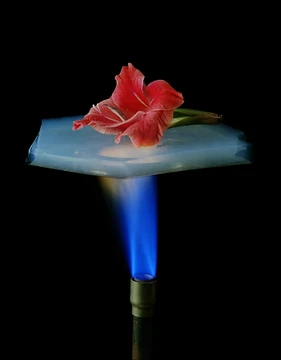
Eutectic system
A mixture with a melting point lower than its constituents.

A eutectic system, also called a eutectic mixture, is a homogeneous blend whose melting point is lower than that of any of its individual components. The lowest possible melting temperature across all possible mixing ratios is known as the eutectic temperature, and it appears as the eutectic point on a phase diagram.
In non-eutectic mixtures, the different components melt at different temperatures because their crystal lattices break down one at a time. As such a mixture cools, each component solidifies into its own lattice at a distinct temperature, so the material does not have a single melting or freezing point. Instead, it passes through a slushy state between the liquidus (where it first begins to solidify) and the solidus (where it becomes fully solid).
Eutectic behavior has practical uses. For example, in eutectic bonding, silicon chips are attached to gold-plated substrates using ultrasound. Eutectic alloys are also employed in soldering, brazing, metal casting, electrical protection, fire sprinkler systems, and as nontoxic alternatives to mercury.
The term *eutectic* was introduced in 1884 by British physicist and chemist Frederick Guthrie. It comes from Greek roots: *eû* meaning "well" and *têxis* meaning "melting." Before his work, chemists believed that the alloy with the lowest melting point must have its constituents in simple atomic proportions, but Guthrie showed this is not always true.
During a eutectic phase transition, a liquid cools at the eutectic temperature and transforms directly into two solid solutions, labeled α and β. This is an invariant reaction because it occurs at thermal equilibrium—the Gibbs free energy change is zero. The liquid and both solid solutions coexist simultaneously in chemical equilibrium, and the temperature remains constant throughout the phase change (a thermal arrest). The resulting solid structure depends mainly on how the two solid solutions nucleate and grow. The most common form is lamellar, but rodlike, globular, and acicular structures are also possible; a vermicular microstructure has been observed in a high-entropy alloy.
Compositions that are not at the eutectic point are called hypoeutectic or hypereutectic. Hypoeutectic mixtures have more of species α and less of species β than the eutectic composition; hypereutectic mixtures have more of species β and less of species α. When a non-eutectic composition cools, one component precipitates before the other. In a hypereutectic solution, a proeutectoid phase of species β forms first; in a hypoeutectic solution, a proeutectic α phase forms first.
Eutectic alloys contain two or more materials at the eutectic composition. When a non-eutectic alloy solidifies, its components solidify at different temperatures, producing a plastic melting range. In contrast, a well-mixed eutectic alloy melts at a single, sharp temperature. The phase transformations during solidification can be understood by drawing a vertical line from the liquid to the solid phase on the alloy’s phase diagram.
Uses for eutectic alloys include: NEMA eutectic alloy overload relays for protecting three-phase motors in pumps, fans, conveyors, and other factory equipment; soldering alloys, both traditional lead-tin (e.g., Sn63Pb37 and Sn62Pb36Ag2) and lead-free tin-silver-copper (e.g., Sn96.5Ag3.5); casting alloys like aluminium-silicon and cast iron (at 4.3% carbon in iron, producing an austenite-cementite eutectic); eutectic bonding of silicon chips to gold-plated substrates using ultrasonic energy; brazing, where diffusion can remove alloying elements so eutectic melting occurs only early in the process; temperature-responsive materials such as Wood's metal and Field's metal for fire sprinklers; nontoxic mercury replacements like galinstan; experimental glassy metals with high strength and corrosion resistance; and eutectic sodium-potassium (NaK) alloys that are liquid at room temperature and used as coolant in experimental fast neutron nuclear reactors.
Other eutectic systems include salts and water; for instance, magnesium perchlorate has a eutectic point.
- coined_by
- Frederick Guthrie
- field
- Physics, Chemistry
- nationality
- British
- known_for
- Defining eutectic systems and disproving the assumption of simple atomic proportions in minimum-fusing-point alloys
Lore & Background
A eutectic system is a homogeneous mixture whose melting point is lower than that of any of its individual constituents. The lowest possible melting temperature across all mixing ratios is termed the eutectic temperature, and on a phase diagram it appears as the eutectic point. In contrast, non-eutectic mixtures do not have a single melting or freezing temperature; instead, they exhibit a liquidus temperature, where the mixture changes from liquid to slush, and a lower solidus temperature, where it becomes fully solid. The term "eutectic" was introduced in 1884 by British physicist and chemist Frederick Guthrie, who disproved the earlier assumption that the alloy with the lowest melting point must have its constituents in simple atomic proportions. During a eutectic phase transition, the liquid and two solid solutions coexist in chemical equilibrium, and the temperature remains constant during the change. The resulting solid microstructure can be lamellar, rod-like, globular, or acicular, depending on how the solid solutions nucleate and grow. Compositions not at the eutectic point are classified as hypoeutectic (richer in one component) or hypereutectic (richer in the other), and as they cool, one component solidifies before the other, creating a proeutectic phase. Eutectic alloys are used in soldering, brazing, metal casting, electrical protection, fire sprinklers, and as nontoxic mercury substitutes. Salt and water form a eutectic mixture exploited for snow removal and ice cream making, while ethanol-water has a eutectic point near pure ethanol, limiting the maximum proof achievable by fractional freezing.
Reader's Guide
The significance of eutectic systems lies in their unique phase behavior and wide practical applications. By having a melting point lower than any of their constituents, eutectic mixtures enable processes that require precise, low-temperature melting or solidification. This property is critical in electronics soldering, where eutectic alloys like Sn63Pb37 provide a sharp melting point essential for reliable joints. In metallurgy, eutectic compositions such as cast iron (4.3% carbon) and aluminium-silicon alloys are fundamental for casting, offering improved fluidity and reduced shrinkage. Eutectic bonding uses the silicon-gold eutectic to attach silicon chips to substrates. Fire sprinklers rely on eutectic alloys like Wood's metal that melt at a specific temperature to activate the system. The use of eutectic salt mixtures for thermal energy storage in concentrated solar power plants demonstrates their role in renewable energy. The primary strengthening mechanism of eutectic structures in metals is composite strengthening, where load transfer between phases enhances toughness. By tuning the spacing of the secondary phase, finer eutectic structures improve load transfer and act as barriers to dislocations. The legacy of Frederick Guthrie's work is the understanding that eutectic compositions are not necessarily simple atomic proportions, opening the field to complex mixtures with tailored properties.
Did You Know?
- A non-eutectic mixture does not have a single melting point but rather a liquidus and a solidus temperature.
- Eutectic alloys of sodium and potassium (NaK) are liquid at room temperature and used as coolant in experimental fast neutron nuclear reactors.
- Menthol and camphor, both solids at room temperature, form a eutectic that is a liquid at room temperature in proportions such as 8:2 or 7:3.
Frequently Asked Questions
Who is Eutectic system?
A eutectic system is a homogeneous mixture that melts at a temperature below that of every pure component it contains. The term was coined by British scientist Frederick Guthrie, who also challenged the older idea that minimum-fusing-point alloys always followed simple atomic proportions.
What are Eutectic system's powers/role?
Its signature trait is melting at a point lower than any of its individual constituents, making it the lowest-melting combination available for a given set of components. On a phase diagram this shows up as the eutectic point, the single lowest-temperature vertex of the liquidus curve.
How does Eutectic system's story end?
The narrative reaches its climax at the eutectic temperature, which is the absolute lowest melting point achievable across every possible mixing ratio. At that moment the liquid solidifies into a single uniform solid phase rather than separating into distinct constituent crystals.
Why is Eutectic system important to the canon?
It sits at the crossroads of physics and chemistry and underpins how we model phase behavior in alloys, solders, and many industrial mixtures. Guthrie's work on it also helped dismantle the earlier assumption that minimum-fusing-point alloys must obey simple whole-number atomic ratios.
What is Eutectic system's origin story?
The concept was named and formally defined by Frederick Guthrie, a British scientist who demonstrated that certain mixtures could melt below the melting points of their pure ingredients. His findings reshaped how chemists and physicists approached alloy composition and phase equilibria in the 19th century.
More in Physical Chemistry And Thermodynamics 1-20
Spotted an error? Know more?
This is a living reference — every entry is fact-audited, and reader corrections feed straight into our audit queue. Suggest an edit · See this site's audit record