Canaanite religion
Polytheistic religion of the southern Levant with a rich mythology.
Last updated
Canaanite religion was the polytheistic belief system of the people in the southern Levant during the first three millennia BCE, influenced by Egyptian and Mesopotamian practices. Its pantheon was headed by El and Asherah, with deities such as Baal, Anat, and Astarte. The religion is known from archaeological finds like the Ugaritic texts and references in the Hebrew Bible.
Quick Facts
- Key deities
- El
- Asherah
- Baal
- Anat
- Astarte
- Dagon
- Rešep
- Major site
- Ugarit (Ras Shamra, Syria)
- Influences
- Ancient Egyptian and Mesopotamian religious practices
Facts from the source article.
History
Knowledge of Canaanite religion is fragmentary and comes largely from archaeological discoveries. The Ebla tablets from the late 3rd millennium BCE list offerings to El, Baal, and Dagon. Amorite personal names from the late 3rd to early 2nd millennium BCE show the same deities.
Inscriptions from Idrimi of Alalakh (15th century BCE) and tablets from Emar (14th–13th centuries BCE) provide additional information. The most substantial source is the Ugaritic texts, found near Ras Shamra and dated to around 1275 BCE, which include myths, legends, incantations, prayers, and ritual texts. Earlier knowledge came from the Hebrew Bible and later Greek sources such as Lucian and Philo of Byblos.
Beliefs
Canaanites believed that after death the npš (soul) went to the land of Mot. Bodies were buried with grave goods, and offerings of food and drink were made to the dead to prevent them from troubling the living. Dead relatives were venerated and sometimes asked for help.
No cosmology has been found in the Ugaritic tablets; syntheses rely on later sources like Philo of Byblos, who reported that the creator was Elion, father of the divinities, married to Beruth. Twin mountains appear as a recurring motif, possibly linked to El Shaddai as 'God of the Mountain(s)' or to a Semitic goddess associated with breasts. The late date of these sources makes it difficult to determine influences from Roman, Greek, or Hebrew traditions.
Practices
Canaanite religious practices included animal sacrifice, as seen in Early Bronze Age layers at Tell es-Safi where donkeys, sheep, and goats were sacrificed, with a complete donkey found beneath a building foundation. Child sacrifice was known to surrounding peoples, and under military crisis human sacrifice might be offered to a city's divine patron. Deities like Baal were represented by figures placed in hilltop shrines or high places surrounded by groves, often with Asherah poles and standing stones.
Funerary rites were important, involving incense, libations, music, songs, and sometimes trance rituals or necromancy. At Tel Megiddo, graves contained wine vessels, beeswax, animal fat, olive oil, resin, and vanilla, possibly for funerary feasts or offerings. Evidence of opium use has been found at a Late Bronze Age site in the southern Levant.
Contact with other areas
Canaanite religion was strongly influenced by its more powerful neighbors, Egypt and Mesopotamia. Families focused on veneration of the dead through household gods while acknowledging deities like Baal, El, Mot, and Asherah. Kings played a religious role and in ceremonies such as the hieros gamos may have been revered as gods.
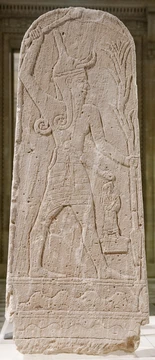
Because Canaan was a land bridge between Asia and Africa, cross-cultural exchange was frequent, and there was no local pantheon; the Canaanites selectively worshipped deities from their neighbors. During the Hyksos period, Baal became associated with the Egyptian god Set and was shown wearing the crown of Lower Egypt. Athirat, Athtart, and Anat were portrayed with Hathor-like Egyptian wigs.
More in Phoenician Mythology
Sources
Compiled from Wikipedia and the sources listed below. Text from Wikipedia is available under CC BY-SA 4.0; this entry is adapted from it.
- Wikipedia: Canaanite religion (CC BY-SA 4.0).
Spotted an error? Know more?
Reader corrections go straight into our review queue. Suggest an edit · How this site is sourced