Filipino martial arts
Filipino martial arts blend weapons and empty-hand combat.
Filipino martial arts (FMA; Sining panlaban ng Pilipinas) are ancient and newer modified fighting methods devised in the Philippines, incorporating elements from both Western and Eastern martial arts. The most popular forms are known as Arnis, Eskrima, and Kali. Their development was driven by the need for self-preservation amid invaders and evolving local conflict.
Quick Facts
- Popular forms
- Arnis
- Eskrima
- Kali
Facts from the source article.
History
Historically, no term for 'martial arts' existed in any Philippine language; the Filipino term 'sining panlaban' is a loan translation from English. The lack of historical accounts and archaeological records makes it difficult to pinpoint when native Filipinos began codifying a fighting system. Filipino martial artists often cite the Battle of Mactan as evidence, but the chronicler Antonio Pigafetta described only the battle's events and native culture superficially.
Spanish reports from the late 16th to 19th centuries did not name a native fighting method, though natives carried weapons constantly. The earliest description of native fighting methods appears in a report by Francisco de Sande in Manila, noting men in Zambales carrying daggers and battle-axes, but no formalized drills were described. A 1629 report implied natives were recently taught sword-wielding in the Spanish style, and a 1764 report by Baltasar Vela mentioned 'drilled Indians' attacking the English in Manila.
In the late 19th to early 20th century, the US administration introduced boxing; later, Japanese businessmen introduced Judo, and during World War II, Filipino martial artists commonly incorporated Japanese martial arts into their styles.
Weapons
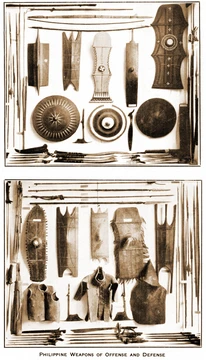
Filipino martial artists are noted for fighting with weapons or empty hands interchangeably and for turning ordinary household items into lethal weapons. Weapons training takes precedence because it provides an edge in real fights, prepares students psychologically to face armed opponents, and allows any object to be used as a weapon. Empty-hand techniques are translated from the use of the Daga (dagger) or Baston (stick). The Philippines is a blade culture; in the Southern Philippines, the Moros were never conquered by the Spaniards or Americans, and the headhunter tribes of the Northern Luzon mountains kept their weapons and fighting skills.
In Christianized provinces where citizens were disarmed, bolos and other knife variants remain common for farm work and occasional fights. Production of these weapons survives; in Aklan, Talibongs are still made in remote areas. Until the 1980s, balisong knives were commonly used in Manila as general-purpose pocket knives, but new laws made them illegal to carry without a permit or proof of livelihood necessity. They are still openly sold in Batangas, Quiapo, souvenir shops, and martial arts stores, used by practitioners and street gangs.
Even when fighting systems were outlawed by the Spaniards, Filipinos maintained their blade fighting techniques, which have been adapted and evolved to remain relevant.
Training
The triangle is a strong geometrical structure and stands for strength; many training halls incorporate it into their logo, representing philosophical, theoretical, and metaphysical principles. Applications of the triangle are found in defensive and offensive tactics, including footwork, stances, blocking, and disarms. The triangle also represents a trinity of deities, as most ethno-linguistic groups in the country have a trinity of ancient gods and goddesses.
Non-verbal gesture communication using hand, body, and weapons signals is used in teaching and identification. The three combat ranges are corto (close-range), medio (medium-range), and largo (long-range). Hakbang is the general term for footwork. Specific footwork includes Corto Mano (close range, minimal extension), Serrada (split step, short range, low stance), Largo Mano (long range, full extension), Fraile (short range hopping), Retirada (short range shuffling backward), and Banda y banda (side to side action).
Filipino martial arts contain a wide range of tactical concepts, both armed and unarmed, including striking methods such as Mano Mano, Suntukan, Pangamot, de Cadena, Cadena de Mano, panantukan, dirty boxing, Paa Paahan, Sikaran, Pananjakman, Sipa, patid, and sikad, as well as grappling.
More in Philippine Martial Arts
Spotted an error? Know more?
Reader corrections go straight into our review queue. Suggest an edit · How this site is sourced