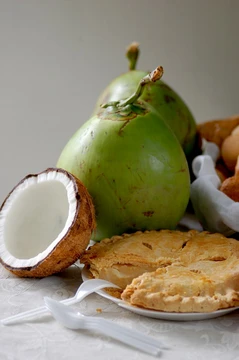
Buko pie
A Filipino baked young coconut pie from Laguna.
Buko pie, also called coconut pie, is a Filipino dessert made from young coconut and sweetened condensed milk, giving it a denser texture than cream-based pies. It is a specialty of Los Baños, Laguna, on Luzon island.
Quick Facts
- Country
- Philippines
- Region
- Laguna
- Creator
- Soledad Pahud
- Course
- Dessert
- Served
- Cold
- Main ingredients
- Pie shell
- custard
- young coconut
- sweetened condensed milk
- Calories
- 290
Facts from the source article.
Origin
The buko pie traces its roots to Laguna, where the Pahud sisters of Los Baños first made it. After earning a Ph.D. in the U.S. and managing a well-known clothing company in San Francisco for 13 years, Soledad Pahud came home. She had picked up apple pie baking abroad. When she and her sisters launched a bakeshop, they aimed to recreate that American treat. Apples, however, were not grown locally. Her sister Apolonia suggested using buko, or young coconut, which was plentiful nearby. This substitution led to their signature pastry. The family business eventually became Orient Buko Pie Bakeshop, dedicated to this creation. The sisters also developed other fillings, such as apple buko, pineapple, and tropical pie.
Nutrition
Buko pie is very high in calories and rich in fat, carbohydrates, and proteins. It provides calcium, iron, niacin, and folate. Due to white sugar and condensed milk, excess calories and simple carbohydrates are present. The pastry contains 66.9g of carbohydrates, with simple carbohydrates exceeding complex ones. It is a source of a healthy yield of iron, contains high amounts of sugar and magnesium, and an average amount of sodium.
Method of preparation
A double baking method is used. The pie crust and filling are prepared separately. For the crust, flour, salt, and sugar are mixed, then ice water and egg yolks are added to form dough. The dough is refrigerated, thinly rolled, blind-baked, and cooled. The filling ingredients are mixed and cooked on low heat. The filling is poured into the crust, a second crust covers it, and the pie is sealed. It is baked a second time until the crust is lightly browned.
Similar desserts
Buko pie is similar to the Dutch-Indonesian klappertaart and the South African klappertert. Klappertaart is a baked creamy coconut custard without crust, containing raisins and nuts. Klappertert has a crust like buko pie but adds apricot jam and cinnamon to the custard. Buko pie also resembles the coconut cream pie of the Southern United States but uses tender young coconut or macapuno with a higher coconut-to-custard ratio, and does not traditionally use nutmeg or vanilla.
More in Philippine Desserts
Spotted an error? Know more?
Reader corrections go straight into our review queue. Suggest an edit · How this site is sourced