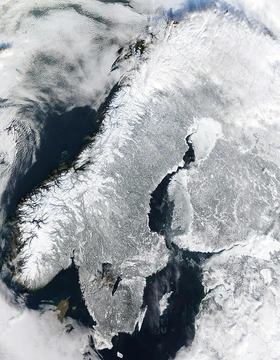
Scandinavian Peninsula
Largest European peninsula, spanning Norway, Sweden, and Finland.

The Scandinavian Peninsula is the largest peninsula in Europe, exceeding the Balkan, Iberian, and Italian peninsulas in area. It is located in Northern Europe and roughly comprises the mainlands of Sweden, Norway, and the northwestern part of Finland. The name derives from Scandinavia, the cultural region of Denmark, Norway, and Sweden, which in turn comes from Scania, the southern extremity of the peninsula. Scania was for centuries part of Denmark and is now part of Sweden. During the Ice Ages, the sea level of the Atlantic Ocean dropped so much that the Baltic Sea, the Gulf of Bothnia, and the Gulf of Finland disappeared, directly joining the surrounding countries—including Germany, Poland, the Baltic states, and Scandinavia—by land. In the modern era, the peninsula’s land connection to the rest of Europe extends as far north as the Arctic Circle, contributing to its seclusion. Locals and historic Germanic philology view it as a separate entity from “the Continent.” The peninsula is rich in timber, iron, and copper, with the best farmland in southern Sweden. Large petroleum and natural-gas deposits have been found off Norway’s coast in the North Sea and the Atlantic Ocean. The population is concentrated in the southern agricultural region, with the largest cities being Stockholm, Sweden; Oslo, Norway; Gothenburg, Sweden; Malmö, Sweden; and Bergen, Norway, in that order. The Scandinavian mountain range generally defines the border between Norway and Sweden. Its highest point is Galdhøpiggen in Norway, and the mountains also host Jostedalsbreen, the largest glacier on mainland Europe. About one quarter of the peninsula lies north of the Arctic Circle, with its northernmost point at Cape Nordkinn, Norway. The climate varies from tundra and subarctic in the north to humid continental in the central portion and marine west coast in the south and southwest.
- area
- Largest peninsula in Europe, greater than Balkan, Iberian, and Italian peninsula
- length
- Approximately 1,850 km (1,150 mi)
- width
- Varies from approximately 370 to 805 km (230 to 500 mi)
- highest_point
- Galdhøpiggen, Norway, at 2,469 m (8,100 ft) above sea level
- largest_glacier
- Jostedalsbreen, the largest glacier on mainland Europe
- northernmost_point
- Cape Nordkinn, Norway
- major_cities
- Stockholm, Sweden; Oslo, Norway; Gothenburg, Sweden; Malmö, Sweden; Bergen, Norw
Lore & Background
The Scandinavian Peninsula occupies part of the Baltic Shield, a stable crust segment of very old, crystalline metamorphic rocks. During the Ice Ages, glaciers scraped much of the soil, especially in the north, leaving a relatively small percentage of arable land. The glaciation deepened river valleys, which became fjords when the sea invaded after the ice melted. In the south, glaciers deposited terminal moraines, creating a chaotic landscape that covered what is now Denmark. The weight of nearly four kilometers of ice caused the terrain to sink; after the ice disappeared, the shield rose and continues to rise at about one meter per century, while the southern part sinks, causing flooding of the Low Countries and Denmark.
Reader's Guide
The Scandinavian Peninsula's significance lies in its unique geography, geology, and history. It is the largest peninsula in Europe, with a length of about 1,850 km and a width varying from 370 to 805 km. The Scandinavian mountain range defines the border between Norway and Sweden, and the peninsula contains the largest glacier on mainland Europe, Jostedalsbreen. About one quarter lies north of the Arctic Circle. The region is rich in timber, iron, copper, and petroleum deposits off Norway's coast. The population is concentrated in the south, which is the agricultural region. The peninsula's political development saw boundaries emerge gradually, with Sweden, Norway, and Finland gaining independence in the 20th century. The people of the peninsula had strong influence in international affairs, with Trygve Lie of Norway and Dag Hammarskjöld of Sweden serving as the first and second Secretaries-General of the United Nations.
Did You Know?
- The name 'Scandinavia' is derived from Scania, the region at the southern extremity of the peninsula that was for centuries part of Denmark and is now part of Sweden.
- During the Ice Ages, the sea level of the Atlantic Ocean dropped so much that the Baltic Sea, the Gulf of Bothnia, and the Gulf of Finland disappeared, directly joining the surrounding countries by land.
- The highest point on the peninsula was formerly Glittertinden at 2,470 m, but since its glacier partially melted, the highest elevation is now Galdhøpiggen at 2,469 m.
- The first recorded human presence in the southern area of the peninsula dates from 12,000 years ago, when reindeer hunters were attracted by the tundra biome.
- The first Secretary-General of the United Nations, Trygve Lie, was a Norwegian citizen, and the second, Dag Hammarskjöld, was a Swedish citizen.
Frequently Asked Questions
Who is Scandinavian Peninsula?
Scandinavian Peninsula is the largest landform of its kind in all of Europe, stretching across the mainland territories of Norway, Sweden, and the northwestern reaches of Finland. It sits in Northern Europe and extends its land connection to the rest of the continent as far north as the Arctic Circle.
What are Scandinavian Peninsula's powers/role?
It boasts Galdhøpiggen in Norway as its highest peak at 2,469 meters, and hosts Jostedalsbreen, the biggest glacier found on mainland Europe. Its dimensions range from roughly 370 to 805 km in width and span approximately 1,850 km in length.
How does Scandinavian Peninsula's story end?
Its narrative reaches its northernmost conclusion at Cape Nordkinn in Norway. Beyond that tip, the landform gives way to open sea and the Arctic waters beyond.
Why is Scandinavian Peninsula important?
It has long been regarded as a distinct geographic and cultural entity, with local traditions and historic Germanic scholarship treating it as separate from 'the Continent.' Its name traces back through Scandinavia to Scania, the southern tip of the landmass, linking it to the broader cultural region of Denmark, Norway, and Sweden.
Where does Scandinavian Peninsula rank among its peers?
It clearly outstrips the Balkan, Iberian, and Italian peninsulas in both area and overall scale, making it the undisputed largest in Europe. Its sheer size sets it apart from every other peninsula on the continent.
More in Peninsulas 1-24
Spotted an error? Know more?
This is a living reference — every entry is fact-audited, and reader corrections feed straight into our audit queue. Suggest an edit · See this site's audit record