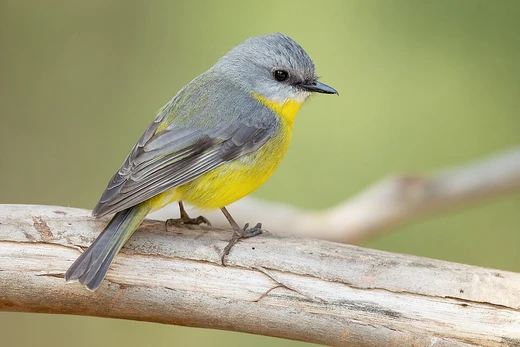
Neosittidae
Small Australasian passerines resembling nuthatches, now in their own family.
Last updated
They resemble nuthatches in appearance and foraging behavior but are now placed in their own family. Sittellas are non-migratory woodland birds with thin, pointed, down-curved bills and build open cup nests in forked branches.
Scientific classification
- KingdomAnimalia
- PhylumChordata
- ClassAves
- OrderPasseriformes
- FamilyNeosittidae
- GenusDaphoenositta
Named by De Vis, 1897
Sources: Wikipedia taxobox: Sittella (CC BY-SA 4.0)
Quick Facts
- Type species
- Daphoenositta miranda
- Subdivision
- D. miranda
- D. chrysoptera
- D. papuensis
Facts from the source article.
Evolution and taxonomy
The evolutionary relationships of the sittellas were long obscured by their strong resemblance to Northern Hemisphere nuthatches. As late as 1967 some authorities still placed them in that family, though doubts had been raised earlier. The two groups differ in sociality and nesting: sittellas build nests on branches, while nuthatches use tree cavities. Leg muscle morphology in sittellas is more similar to that of honeyeaters.
Over time, sittellas were moved to various families, including the Old World babblers, the true treecreepers (Certhiidae), and the Australian treecreepers (Climacteridae). S. A. Parker suggested a relationship with the Australian passerine radiation based on egg colour, nest structure, and nestling plumage, a placement later supported by Sibley and Ahlquist's DNA–DNA hybridization studies, which placed them in a monotypic tribe within the superfamily Corvoidea.
Today they are given their own family in a clade near the berrypeckers and longbills (Melanocharitidae) and the whistlers (Pachycephalidae). A 2019 molecular genetic study found Neosittidae to be sister to Mohouidae (yellowhead, whitehead, pipipi).
The single genus Daphoenositta contains three species. The varied sittella was once considered five separate species but is now treated as one with five subspecies due to extensive hybridization zones. The black sittella is monotypic, and the Papuan sittella has four subspecies.
Morphology
The three sittella species are small passerines that resemble nuthatches in appearance. They have long, broad wings with clearly fingered tips when spread, and their flight is generally weak, which may explain their failure to colonize Tasmania. The legs are short with long toes, yet show little adaptation for climbing. Body length ranges from 10 to 14 cm, weight from 8 to 20 g, and tails are short; the black sittella tends to be slightly larger and heavier.
The black sittella has a dagger-shaped bill, while the varied sittella's bill is slightly upturned. Plumage varies: the black sittella is mostly black with a red face; the varied and Papuan sittellas show more complex patterns, with subspecies differing in head and wing coloration. Some subspecies have entirely black heads, others white, and still others dark crowns with paler throats. Most have grey backs with darker wings and streaked or white undersides.
All sittellas exhibit some sexual dimorphism in plumage. Their calls are simple, mostly contact calls to maintain flock cohesion; the most common is a chip call, along with a rallying call and begging calls from incubating females.
Habitat and behaviour
Sittellas are social, restless birds of scrub, forests, and woodlands. In Australia they generally avoid dense rainforest, while in New Guinea that is the only habitat they occupy, avoiding lowland forest. They live at low densities (0.1–0.6 birds per hectare) and are sedentary. They are highly social, usually found in groups of five or more, rarely in pairs.
Studies of varied sittellas in New South Wales indicate they live in clans of eight to twelve individuals that defend mutual territories. Mutual preening is common, and groups roost communally in the evening. Birds arrive at roosts at 30–60 second intervals, likely to avoid attracting predators. Roost sites are high in trees on slightly inclined dead branches, where all birds roost touching and facing the same direction.
Males typically occupy positions at the edges of the group, while young birds are in the centre. The diet consists mainly of insects and other arthropods. In one New South Wales study, adult beetles (especially weevils, ladybirds, leaf beetles, and click beetles) made up about 36% of the varied sittella's diet, with spiders and true bugs comprising another quarter. Also taken are beetle and moth larvae, grasshoppers, termites, wasps, and bees; ants are taken infrequently.
Diet composition varies geographically and seasonally; another study found beetle larvae constituted 87% of the diet. The black sittella's diet is little studied, but one examined stomach contained caterpillars and spiders.
More in Passeri
Sources
Compiled from Wikipedia and the sources listed below. Text from Wikipedia is available under CC BY-SA 4.0; this entry is adapted from it.
- Wikipedia: Sittella (CC BY-SA 4.0).
- Word definitions: the , each quoted from its Wikipedia article.
Spotted an error? Know more?
Reader corrections go straight into our review queue. Suggest an edit · How this site is sourced