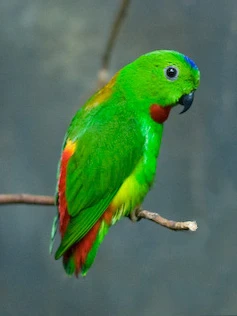
Pygmy hanging parrot
A tiny green parrot with an orange bill, endemic to Sulawesi.
Last updated
The pygmy hanging parrot (Loriculus exilis) is a small parrot in the family Psittaculidae, endemic to the Indonesian island of Sulawesi. It is notable for its bright green plumage, orange bill, red throat, and red tail, and is one of the smallest members of its genus. The species inhabits forests, mangroves, and other wooded habitats.
Scientific classification
- KingdomAnimalia
- PhylumChordata
- ClassAves
- Order
- FamilyPsittaculidae
- GenusLoriculus
- SpeciesLoriculus exilis
Named by Schlegel, 1866
Sources: Wikipedia taxobox: Pygmy hanging parrot (CC BY-SA 4.0)
Conservation status
Least Concern (LC)
- LC▲ this species
- NT
- VU
- EN
- CR
- EW
- EX
Source: IUCN Red List assessment · GBIF copy of the Red List category
How big is it?
Largest length in the source, 0.11 m, next to a 1.8 m person.
Diagram: drawn by Codexery, schematic shapes to scale (not a likeness). Length: Wikipedia: Pygmy hanging parrot
Where the pygmy hanging parrot has been recorded
Each dot is a place where the species has been observed and reported (703 records, half-degree grid) — not a modelled range. 29 inland records left out (institution coordinates).
Map: drawn by Codexery. Data: GBIF occurrence search (records CC0 / CC BY) · Natural Earth basemap (public domain) · place coordinates: Wikipedia (CC BY-SA 4.0)
Taxonomy
The pygmy hanging parrot belongs to the order Psittaciformes and the family Psittaculidae, within the subfamily Psittaculinae and tribe Micropsittini. This tribe has a deep stem age of 27.6 million years ago and is phylogenetically sister to Polytelini/Psittaculini. The species tree within Micropsittini is frequently revised due to limited genomic samples.
Although historically placed in Loriinae, the genus Loriculus is now considered to belong to a different subfamily, with similarities arising from convergent evolution. The name "pygmy hanging parrot" can be misleading, as true pygmy parrots belong to the genus Micropsitta. Loriculus exilis is monotypic, but forms a species group with Loriculus pusillus and Loriculus flosculus, once treated as a single species.
Description and Identification
Pygmy parrots are small, typically weighing around 11 grams, and Loriculus exilis measures 10–11 cm in length. Its plumage is mostly bright green with a slight yellow tinge on the underparts, a bright red or orange beak, orange legs, and a thin red mark on the throat bordered with a royal blue collar. The upper rump also has red feathers. Females have a reduced throat patch, sometimes lacking it entirely, and immature birds lack the patch and have yellower legs.
The species has modified tail shafts and long claws adapted for climbing tree trunks. It can be distinguished from other pygmy parrots by its brighter plumage, and from other hanging parrots by its smaller size. Its restricted range on Sulawesi and nearby islands also aids identification. Vocalizations are short, high-pitched, insect-like notes, often in sequences of two to four "tsi-tsi-tsik" sounds.
Behaviour and ecology
The habits of pygmy parrots are poorly known due to their small size and limited range. Loriculus exilis is inconspicuous, moving quietly and swiftly through the forest canopy, often hopping rather than walking with legs constantly crouched. It is non-migratory but may be nomadic, following flowering and fruiting trees. It is usually found singly or in pairs, most active after sunrise, and may delay foraging in overcast conditions, suggesting finely balanced energy budgets.
Breeding occurs in February and August; clutch size is unknown, but eggs measured in captivity are approximately 19 × 15 mm. Nests are made in holes in dead palms and stumps, occasionally in arboreal termitaria. The species feeds mainly on figs, nectar, and blossoms, though stomach content analyses have also found seeds, flowers, insects, lichen, and fungus. Its stiffened tails and strong feet and claws are adaptations for feeding on tree bark and clinging to vertical trunks.
Conservation status and future implications
The IUCN Red List classifies the pygmy hanging parrot as Least Concern, as its rate of decline is unlikely to exceed 30% in three generations and its habitat range exceeds 20,000 km². However, the population trend is suspected to be decreasing due to habitat degradation and trapping. Forests on Sulawesi, Buton, and Kabaena Islands are becoming increasingly fragmented.
The species is listed under Appendix II of CITES, meaning international trade is regulated. Many population variables remain unknown, and proposed conservation actions include population surveys, monitoring at key sites, protection of primary lowland forest, and remote sensing to track habitat loss. In captivity, the birds have been observed to refuse food and die within hours, posing challenges for study.
Did You Know?
- Over 2,100 individuals were reported in trade records from Indonesia in 1991, though no quotas were set in subsequent years.
- Its extent of occurrence is estimated at 414,000 km².
More in Parrots of Asia
Test yourself
Three questions drawn from this entry’s sources. Pick an answer to check it.
Answers checked against the source article
Sources
Compiled from Wikipedia and the sources listed below. Text from Wikipedia is available under CC BY-SA 4.0; this entry is adapted from it.
- Wikipedia: Pygmy hanging parrot (CC BY-SA 4.0).
- Conservation status: IUCN Red List assessment.
- Occurrence records: GBIF (CC0 / CC BY). Basemap: Natural Earth (public domain).
- Word definitions: the , each quoted from its Wikipedia article.
Spotted an error? Know more?
Reader corrections go straight into our review queue. Suggest an edit · How this site is sourced