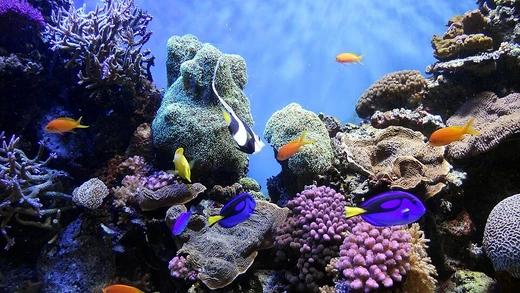
Vermiculated spinefoot
A venomous, commercially important rabbitfish of the Indo-West Pacific.
Last updated

Rickard Zerpe · via Wikipedia: Vermiculated spinefoot · CC BY 2.0
The vermiculated spinefoot is a species of rabbitfish first formally described in 1835 as Amphacanthus vermiculatus by Achille Valenciennes.[1]
Scientific classification
- KingdomAnimalia
- PhylumChordata
- ClassActinopterygii
- DivisionTeleostei
- OrderAcanthuriformes
- FamilySiganidae
- GenusSiganus
- SpeciesSiganus vermiculatus
Named by (Valenciennes, 1835)
Close relatives
Other species of Siganus with a Codexery entry.
- Mottled spinefoot Siganus fuscescens
- Bicolored foxface Siganus uspi
- Black foxface Siganus niger
- Blackeye rabbitfish Siganus puelloides
- Blotched foxface Siganus unimaculatus
- Blue-spotted spinefoot Siganus corallinus
- Dusky spinefoot Siganus luridus
- Foxface rabbitfish Siganus vulpinus
Sources: Wikipedia taxobox: Vermiculated spinefoot (CC BY-SA 4.0) · order, family and genus agree with WoRMS AphiaID 273927 (CC BY 4.0)
Conservation status
Least Concern (LC)
- LC▲ this species
- NT
- VU
- EN
- CR
- EW
- EX
Source: IUCN Red List assessment · GBIF copy of the Red List category
How big is it?
Largest length in the source, 0.45 m, next to a 1.8 m person.
Diagram: drawn by Codexery, schematic shapes to scale (not a likeness). Length: Wikipedia: Vermiculated spinefoot
Where the vermiculated spinefoot has been recorded
Each dot is a place where the species has been observed and reported (182 records, half-degree grid) — not a modelled range. 29 inland records left out (institution coordinates).
Map: drawn by Codexery. Data: GBIF occurrence search (records CC0 / CC BY) · Natural Earth basemap (public domain) · place coordinates: Wikipedia (CC BY-SA 4.0)
Biology and range
A slight depression exists above each eye, and the nape is convex.[2] The snout is both deep and blunt, and it also protrudes.[2] A flange on the front nostril is slightly broader towards the back.[2] A spine that lies flat is positioned in front of the dorsal fin.[2]
The largest recorded total length for this species is 45 cm, though a length of 30 cm is more common.[3] The geographic range of the vermiculated spinefoot extends from southern India and Sri Lanka eastward through the western Pacific Ocean, reaching as far as Palau and Guam.[4] Algae growing on seagrass, mangrove roots, and rocks is the food source for the vermiculated spinefoot.[5] During summer, adults form groups of several hundred fish to spawn, with the moon's cycle controlling the timing of this behavior.[5]
What the specialist sources record
The same source lists the species citation as Amphacanthus vermiculatus Valenciennes, 1835, from Histoire Naturelle des Poissons 10: 126.[6] The World Register of Marine Species records the environment as marine and brackish.[7] GBIF holds 414 occurrence records for this taxon as of 7 October 2026.[8] The FAO species identification guide describes the body depth as fitting 1.9 to 2.2 times into standard length.[2][9]
References
- Wikipedia, "Vermiculated spinefoot" (CC BY-SA 4.0), which cites: ; "Order Acanthuriformes (part 2): Families Ephippidae, Leiognathidae, Scatophagidae, Antigoniidae, Siganidae, Caproidae, Luvaridae, Zanclidae and Acanthuridae", The ETYFish Project Fish Name Etymology Database, 12 January (original not read by us) en.wikipedia.org
- Wikipedia, "Vermiculated spinefoot" (CC BY-SA 4.0), which cites: D.J. Woodland, "FAO species identification guide for fishery purposes. The living marine resources of the Western Central Pacific. Volume 6. Bony fishes part 4 (Labridae to Latimeriidae), estuarine crocodiles, sea turtle (we also read that source) en.wikipedia.org
- Wikipedia, "Vermiculated spinefoot" (CC BY-SA 4.0), which cites: ; D.J. Woodland, "FAO species identification guide for fishery purposes. The living marine resources of the Western Central Pacific. Volume 6. Bony fishes part 4 (Labridae to Latimeriidae), estuarine crocodiles, sea turtle; ; Bray, D.J., "Siganus vermiculatus", Fishes of Australia, 2018 (we also read that source) en.wikipedia.org
- Wikipedia, "Vermiculated spinefoot" (CC BY-SA 4.0), which cites: Larson, H., "Siganus vermiculatus", 2012; Bray, D.J., "Siganus vermiculatus", Fishes of Australia, 2018 (we also read that source) en.wikipedia.org
- Wikipedia, "Vermiculated spinefoot" (CC BY-SA 4.0), which cites: ; Larson, H., "Siganus vermiculatus", 2012 (original not read by us) en.wikipedia.org
- Bray, D.J., "Siganus vermiculatus", Fishes of Australia, 2018. facts only, no text reused. fishesofaustralia.net.au
- World Register of Marine Species, Siganus vermiculatus (AphiaID 273927). CC BY 4.0. marinespecies.org
- GBIF Backbone Taxonomy and occurrence index, Siganus vermiculatus (taxon key 2390251). CC BY 4.0 (backbone); counts are facts. gbif.org
- Open Library record, ISBN 9251045879 ("Living Marine Resources of the Western Central Pacific Vol. 5"). CC0 (metadata); book content not read. openlibrary.org
Each numbered sentence above was checked against the source it cites before publication. Sentences citing Wikipedia adapt text from the English Wikipedia article Vermiculated spinefoot (contributors), used under CC BY-SA 4.0; this entry is available under the same licence. Other sources were used for facts only; no text or images are copied from them.
Ranked in
More in Parrotfish and Rabbitfish
Test yourself
Three questions drawn from this entry’s sources. Pick an answer to check it.
Answers checked against the source article
Sources
Compiled from Wikipedia and the sources listed below. Text from Wikipedia is available under CC BY-SA 4.0; this entry is adapted from it.
- Wikipedia: Vermiculated spinefoot (CC BY-SA 4.0).
- Classification: the source article's taxobox; order, family and genus checked against WoRMS, the World Register of Marine Species (CC BY 4.0).
- Conservation status: IUCN Red List assessment.
- Occurrence records: GBIF (CC0 / CC BY). Basemap: Natural Earth (public domain).
- Word definitions: the Codexery glossary, each quoted from its Wikipedia article.
Spotted an error? Know more?
Reader corrections go straight into our review queue. Suggest an edit · How this site is sourced