Chao Lake archaeological sites
Neolithic to Han sites in a key rice-origin region.
Last updated
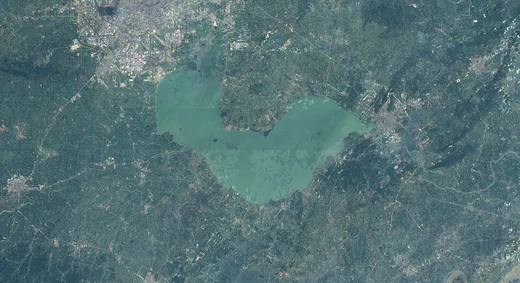
The Chao Lake basin, located 15 km from Hefei City in Anhui province, is the largest lake in the province and one of China's five major freshwater lakes. It contains hundreds of archaeological sites spanning the Neolithic Age through the Han Dynasty, and is suggested as one of the origin sites of paddy rice cultivation.
Quick Facts
- Location
- 31°31′47.1″N, 117°22′29.8″E
- Area
- Chao Lake basin, Anhui province, China
- Neolithic sites
- 52
- Shang-zhou sites
- 114
- Han dynasty sites
- 60
- Earliest known neolithic culture
- Linjiatan Culture (5.6–5.3 ka BP)
- Lake formation
- about 10 thousand years
Facts from the source article.
Holocene environment
Sediment from Chao Lake indicates three Holocene climate stages: warm and dry with low water from 9870 to 6040 cal. a BP, humid with flourishing vegetation from 6040 to 4960 cal. a BP, and the Holocene Optimum with optimal conditions from 5840 to 5500 cal. a BP. Human influence on vegetation increased from 10,500 cal B.P. to after 3,750 cal B.P., as forests were converted to farmland for rice, wheat, cotton, and tobacco.
Neolithic age
The Linjiatan Culture (5.6–5.3 ka BP) is the earliest known Neolithic culture in the basin, and its jade production technology became a focus of warfare between the Wu and Chu kingdoms. Three later prehistoric cultures—Majiabang, Songze, and Liangzhu—also occupied the area. The basin is considered one of the origin sites of paddy rice.
Shang-Zhou dynasties
The Shang-Zhou Dynasties (3.55–2.72 ka BP) represent the most culturally flourishing era in the basin, with about 120 archaeological sites. Population growth led to forest clearance for agriculture and settlement. Settlements moved from riverside locations in the Neolithic to warmer, more humid areas, with microclimates near rivers and foothills supporting agriculture.
Han dynasty
During the Han Dynasty (2.15–1.73 ka BP), culture in the Chao Lake basin declined due to climate change. Cao Cao, emperor of the Wei Kingdom, dug the Chao-Fei channel linking the lake to the Yangtze River, but the channel decayed after the Han as the economic center shifted. Natural disasters such as floods and earthquakes destroyed agriculture and economy, prompting relocation. After the Han, the basin remained a critical point for warfare between North and South.
More in Paleoanthropological Sites
Sources
Compiled from Wikipedia and the sources listed below. Text from Wikipedia is available under CC BY-SA 4.0; this entry is adapted from it.
- Wikipedia: Chao Lake archaeological sites (CC BY-SA 4.0).
- Word definitions: the , each quoted from its Wikipedia article.
Spotted an error? Know more?
Reader corrections go straight into our review queue. Suggest an edit · How this site is sourced