Jiangjunosaurus
A medium-sized stegosaur from the Jurassic of China.
Last updated
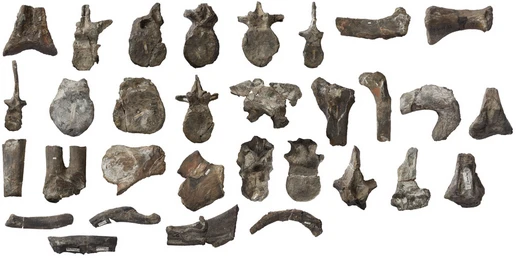
It is known from a nearly articulated subadult skeleton that includes the lower jaws, neck vertebrae, ribs, shoulder bones, and neck plates.
Scientific classification
- KingdomAnimalia
- PhylumChordata
- ClassReptilia
- CladeDinosauria
- Clade†Ornithischia
- Clade†Thyreophora
- Clade†Stegosauria
- Family†Stegosauridae
- Genus†Jiangjunosaurus
- SpeciesJiangjunosaurus junggarensis
Named by Jia et al., 2007
Sources: Wikipedia taxobox: Jiangjunosaurus (CC BY-SA 4.0)
Where the jiangjunosaurus has been recorded
Map: drawn by Codexery. Data: Natural Earth basemap (public domain) · place coordinates: Wikipedia (CC BY-SA 4.0)
Quick Facts
- Species
- junggarensis
Facts from the source article.
Discovery and naming
The stegosaurian Jiangjunosaurus junggarensis was named in 2007 by Jia Chengkai, Catherine Foster, Xu Xing, and James Clark. Its remains were first found in 2002 by Liu Yongfei, then collected by a joint Chinese-American team and prepared by Xiang Lishi and Ding Xiaoqing. The genus name comes from the ghost town of Jiangjunmiao, where jiangjun means "general" and the full place name "temple of the general" is linked to a general's burial. The species name points to the Junggar Basin as its origin.
The single known specimen, a subadult, is cataloged as IVPP V 14724. It came from the Oxfordian-aged Shishugou Formation and was discovered in near-perfect articulation. The bones include the lower jaws, rear skull fragments, eleven neck vertebrae, ribs, a scapula, a coracoid, and two plates from the neck.
Description
Jiangjunosaurus was a stegosaur of moderate size, with a length of 6 to 7 meters and a body mass of 2.5 metric tons. Its describers identified three features that set it apart: the tooth crowns are symmetrical and, when viewed from the side, are wider than they are tall; the spine of the axis, the second neck vertebra, has a rectangular side profile rather than a triangular one; and the rear neck vertebrae have large vein openings on their sides.
The skull is fairly long, with the widest point above the postorbital bones likely making up about 35 percent of the skull’s total length. The upper jaw, or maxilla, holds at least fourteen teeth. The quadratojugal bone has a sturdy horizontal front branch and a thin, short vertical branch that is only half the height of the quadrate shaft. There is no clear foramen paraquadraticum, an opening between the quadrate and quadratojugal.
The quadrate slants backward and has a depression on the part that contacts the pterygoid bone. No obvious opening exists between the front branches of the pterygoids. The predentary, the bony core of the lower beak at the front of the lower jaws, has a deep, hooked chin. A gap equal to about four tooth positions lies between the predentary and the tooth row.
A vertical plate rises from the rear of a bone shelf on the outside of the tooth row, hiding that row when seen from the side. This plate extends backward into a high coronoid process. Between the dentary, surangular, and angular bones, there is a fairly tall, triangular mandibular fenestra. The dentary holds twenty-one teeth, which are slightly larger than those in the upper jaws.
All teeth are symmetrical with a triangular profile, and both the front and rear edges have seven denticles each. In side view, the teeth are broad, about as wide as they are tall. Both the inner and outer sides curve convexly from front to back. The usual vertical ridges are present but weak; the frontmost and rearmost teeth lack them entirely, and there are no primary vertical ridges in the middle.
Phylogeny
When Jiangjunosaurus was first described in 2007, scientists assigned it to the stegosaurid family. They determined it held a primitive position within that group, though this conclusion came from comparing its anatomy to other dinosaurs rather than from a computer-based analysis of evolutionary relationships. The animal displays a combination of ancient and more advanced features. Traits typical of stegosaurids include a slanted quadrate bone, a vertical plate on the lower jaw, a depression on the quadrate's pterygoid flange, a shoulder blade whose lower edge is longer than the upper edge of the coracoid, and two rows of large plates on the neck.
Its primitive status is suggested by a horizontal front branch of the quadratojugal bone paired with a downward projection on the main body. Later studies using phylogenetic methods have placed Jiangjunosaurus in different spots within Stegosauridae. A 2025 analysis by Sánchez-Fenollosa and Cobos grouped it with the Chinese stegosaurines Wuerhosaurus and Yanbeilong, partly because its neck vertebrae resemble those of an unnamed species from the Hekou Group.
More in Oxfordian Dinosaurs
Test yourself
Three questions drawn from this entry’s sources. Pick an answer to check it.
Answers checked against the source article
Sources
Compiled from Wikipedia and the sources listed below. Text from Wikipedia is available under CC BY-SA 4.0; this entry is adapted from it.
- Wikipedia: Jiangjunosaurus (CC BY-SA 4.0).
- Occurrence records: GBIF (CC0 / CC BY). Basemap: Natural Earth (public domain).
- Word definitions: the , each quoted from its Wikipedia article.
Spotted an error? Know more?
Reader corrections go straight into our review queue. Suggest an edit · How this site is sourced