Bendigo Goldfields
Historic Otago goldfield with quartz and alluvial mining remains.
Last updated
The Bendigo Goldfields region sits in Central Otago, New Zealand's southern South Island, as part of the 1860s Otago gold rush. Miners arrived from rushes in California and Victoria, Australia, bringing cultures from England, Scotland, Wales, Ireland, Sweden, China, Australia, Canada, and the United States. The area took its name from the Bendigo goldfield in Victoria. Mining ran until 1943, when the government mining subsidy was withdrawn.
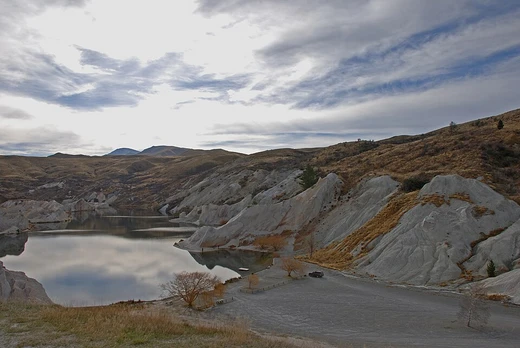
Interest revived in the 1980s, early in the 21st century, and again in the 2020s. The region lies 17 km northeast of Cromwell, at the head of Lake Dunstan. The Department of Conservation manages much of it as a Scenic Reserve and Historic Reserve, offering views of the Pisa Range across the upper Clutha Valley and north toward mountains beyond Lake Hāwea.
Geography
The Bendigo Goldfields region covers three former settlements: the township of Bendigo and the unofficial townships of Logantown and Welshtown. Bendigo first served early alluvial goldminers on the lower reaches of Bendigo Creek near Goodall's Hotel, Aurora Creek, and the upper Rise and Shine Creek. Logantown and Welshtown later became part of the wider Bendigo alluvial mining site when quartz miners drove dozens of shafts into the hills. Within the Bendigo Scenic Reserve, walks range from short wanders to a 5-hour loop trail, with interpretative panels.
Visitors can see stone building ruins, vertical shafts, adits, numerous battery sites, water races, pipelines, and remains of several wooden drays. Alluvial gold was first discovered in Bendigo Creek in September 1862 during the rush to the Dunstan area. Prospectors reached Bendigo Creek, a tributary of the Clutha River, by crossing Thomson's Saddle in the Dunstan Mountains and dropping into Thomson Gorge. After reports of significant quartz finds, people flocked to Bendigo, but the Provincial Government did not survey and lay out an official town until 1869.
Bendigo
The town followed a simple grid pattern similar to the Cromwell Company's Solway Battery, with two primary streets: York and Oxford. At its peak, Bendigo supported a population of 130 and by 1869 included the Solway Battery, Goodall's Bendigo Reef Hotel, Mitchinson and Harrison's General Store, a blacksmith, a drapers, a billiards saloon, and huts of men working at the battery. A second hotel, The Solway, opened in 1870, followed by a bakery and butcher's shop in 1872.
Bendigo's popularity was short-lived; by late 1875, most businesses were abandoned for nearby Logantown. Today, little remains of Bendigo—York and Oxford Street form part of the Bendigo Loop Road, and all that is left are the stone remains of the bakery, some mature poplar trees, and remains of other stone walls. Extensive vineyards now cover the terraces and lower slopes.
Mining history
Although alluvial gold was first discovered in Bendigo Creek in September 1862, the greatest rewards came from quartz reefs in the nearby hills. Of all the mining claims and leases taken up at Bendigo, only the Cromwell Quartz Mining Company's battery proved profitable. That battery started crushing in March 1869, and the success of those first crushings spurred the rush to the Bendigo reefs. The initial alluvial discovery happened when a party of miners used Thomson's Saddle, an old Māori greenstone trail over the Dunstan Mountains, to take the ferry across the Clutha River at Wakefield (now Crippletown) near Rocky Point, on their way to the Shotover, Arrow, and Cardrona goldfields.
Initial alluvial gold discovery
Gold in the gravels of Bendigo Gully was poor and referred to as a tucker field—only enough gold for a miner's subsistence. However, by 1864, with the advent of sluicing companies' water races, up to 150 miners had pegged out claims along the creek, some yielding 5–15 troy ounces (155–467 g) a week. Most alluvial mining on the Bendigo goldfield took place in Bendigo Creek itself, Aurora Creek and its tributary Swipers Creek, and the upper Rise and Shine Creek.
A group of Swedes worked the latter in the 1860s and, in 1867, brought a water race a considerable distance across the Thomson Range to provide water for sluicing. The early alluvial rush lasted from 1862 to 1866. It was Thomas Logan's discovery of the gold-rich Cromwell Reef that made Bendigo famous. Despite the shift toward quartz reef mining, of the 52 claims being worked by mid-1870, only 18 were quartz claims—the rest remained alluvial.
Cromwell Reef (Logan's Reef / Solway Reef)
Thomas Logan, born in St Bees, Cumberland in 1836, came to Otago after the gold rush in Victoria and worked as an alluvial miner. In 1863, he began prospecting the lower slopes of Bendigo Hill, searching for quartz reefs from which the alluvial gold had been liberated. Logan located several lines of gold-bearing reefs, including the rich Cromwell (or Logan's) Reef.
More in Otago Gold Rush
Sources
Compiled from Wikipedia and the sources listed below. Text from Wikipedia is available under CC BY-SA 4.0; this entry is adapted from it.
- Wikipedia: Bendigo Goldfields (CC BY-SA 4.0).
Spotted an error? Know more?
Reader corrections go straight into our review queue. Suggest an edit · How this site is sourced