Frequently Asked Questions
The most-asked questions about open clusters.
What exactly is an open cluster?
An open cluster is a loose, gravitationally bound family of stars that all ignited from the same giant molecular cloud. They tend to be relatively young, irregularly shaped, and contain a wide mix of stellar masses, setting them apart from the ancient, spherical globular clusters.
How do open clusters differ from globular clusters?
Open clusters are younger, less densely packed, and reside in the disk of a galaxy, while globular clusters are billions of years old, nearly spherical, and orbit in the galactic halo. In terms of population, open clusters usually hold a few hundred to a few hundred thousand stars, whereas globular clusters can pack in millions.
Where in the sky are open clusters most concentrated?
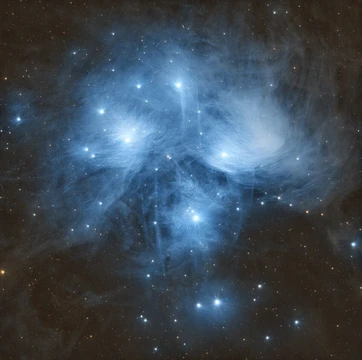
They cluster along the spiral arms of the Milky Way, so the best viewing directions point roughly toward the galactic plane. The Pleiades (M45) and the Hyades, both in Taurus, are the classic naked-eye examples that beginners spot first.
How long does an open cluster typically survive?
Most dissolve within a few hundred million years as stellar winds, tidal shear, and close gravitational encounters gradually fling members into the field star population. A handful of exceptionally massive clusters, particularly in satellite galaxies, can hang together for several billion years.
Which open cluster should a newcomer look at first?
The Pleiades, nicknamed the Seven Sisters, is the standard starting point because it is bright, large, and visible from both hemispheres. The Hyades, sitting only about 150 light-years away in the same constellation, is another superb naked-eye target that rewards binoculars or a small telescope.
How are open clusters actually born?
A turbulent giant molecular cloud collapses under its own gravity and fragments into thousands of protostars that ignite in a relatively short window. The initial shape, mass spread, and internal structure of the cluster are stamped by the turbulence and magnetic fields present in that parent cloud.
How many stars does a typical open cluster contain?
A middle-of-the-road open cluster ranges from a few hundred to several hundred thousand members, with the Pleiades hosting roughly a thousand stars bright enough to catalog. The most massive known examples, found in the Large Magellanic Cloud, can exceed a million stars.
What happens to an open cluster as it ages?
The heaviest, bluest stars exhaust their fuel first and die, leaving behind white dwarfs while the overall population thins. Over tens to hundreds of millions of years the cluster loses its gravitational cohesion and its stars blend into the general disk population of the galaxy.
Do open clusters exist outside the Milky Way?
Yes; the Large and Small Magellanic Clouds host some of the youngest and most luminous open clusters known, such as NGC 604 and R136. Their extreme youth makes them natural laboratories for watching stellar formation and early evolution in near real time.
What's a favorite piece of trivia that fans love to share?
Galileo resolved the Beehive Cluster (M44) in Cancer into individual stars back in 1609, a milestone that helped cement the idea that the Milky Way is built from countless suns. Another crowd-pleaser is that the Hyades contains Sun-like stars, giving astronomers a nearby yardstick for tracking solar-type evolution.