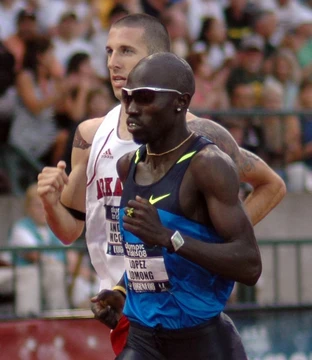
Edwin Moses
American former hurdler, Olympic gold medalist, and sports reformer.

Edwin Corley Moses was born on August 31, 1955, in Dayton, Ohio, to parents who were both educators; his father also served as a Tuskegee Airman. He attended Morehouse College in Atlanta, where he studied physics and industrial engineering while running for the school track team, though the college had no track of its own—Moses trained at local public high school facilities. He earned an MBA from Pepperdine University in 1994.
Moses initially competed in the 120-yard hurdles and 440-yard dash, running only one 400-meter hurdles race before March 1976. Once he focused on the event, his 6'2" frame allowed him to use a consistent 13-step pattern between hurdles, pulling away in the second half as rivals often took 15 strides or changed their rhythm. At the 1976 Montreal Olympics, his first international meet, he won gold and set a world record of 47.63 seconds. He broke his own record the next year at Drake Stadium with 47.45 seconds, then lost to West Germany’s Harald Schmid on August 26, 1977, in Berlin—his fourth defeat in the event. The following week, he beat Schmid by 15 meters in Düsseldorf and did not lose again for nine years, nine months, and nine days. Moses qualified for the 1980 U.S. Olympic team but could not compete due to the boycott; he received one of 461 Congressional Gold Medals created for those athletes. At the 1984 Los Angeles Olympics, he recited the Olympic Oath and won his second gold medal. By the time Danny Harris beat him in Madrid on June 4, 1987, Moses had won 122 consecutive races, set the world record twice more, and claimed three World Cup titles, a World Championship gold, and two Olympic golds. After that loss, he won ten more races in a row, including a second world gold in Rome in August 1987. He finished third in his final 400-meter hurdles race at the 1988 Seoul Olympics.
In 1979, Moses took a leave from his job at General Dynamics to run full-time. Over the next two years, he helped reform Olympic eligibility rules, pushing for an Athletes Trust Fund that allowed athletes to receive government or private stipends, direct payments, and endorsement money without losing eligibility. He presented the plan to IOC President Juan Antonio Samaranch, and it was ratified in 1981, forming the basis for many Olympic athlete support programs, including the USOC’s Direct Athlete Assistance Programs.
Moses was named Track & Field News Athlete of the Year in 1980, despite missing the Moscow Games. In 1981, he became the first recipient of USA Track & Field’s Jesse Owens Award. He received the AAU’s James E. Sullivan Award in 1983, was named ABC’s Wide World of Sports Athlete of the Year in 1984, and shared Sports Illustrated’s Sportsman of the Year with gymnast Mary Lou Retton that same year, when he also delivered the Athlete’s Oath at the 1984 Olympics. Dayton renamed two streets “Edwin C. Moses Boulevard” in 1984. In 1999, ESPN ranked him #47 on its SportCentury 50 Greatest Athletes list. He received the Laureus Lifetime Achievement Award in 2018.
As a sports administrator, Moses helped develop anti-drug policies and assisted track and field in creating one of the most stringent random in-competition drug testing systems. In December 1988, he designed amateur sports’ first random out-of-competition drug testing program. His background in physics helped him create structures and protocols that reduced the use of performance-enhancing drugs in athletics for decades.
After retiring from track, Moses competed in a 1990 World Cup bobsled race in Winterberg, Germany, winning a two-man bronze medal with Brian Shimer. He was inducted into the National Track and Field Hall of Fame in 1994. Since 2000, he has served as chairman of the Laureus World Sports Academy, which aims to increase participation in sport and use it as a tool for social change. Through the Laureus Sports for Good Foundation, dozens of Olympic and world champion athletes assist disadvantaged youth worldwide. In 2008, Moses presented the Dayton Literary Peace Prize’s Lifetime Achievement Award to Taylor Branch, Martin Luther King Jr.’s biographer.
- born
- August 31, 1955, Dayton, Ohio
- field
- 400 m hurdles
- nationality
- American
- known_for
- 107 consecutive finals wins (122 consecutive races), four world records, Olympic
Verified Timeline
Lore & Background
Moses was born in Dayton, Ohio, to educators; his father was a Tuskegee Airman. He matriculated at Morehouse College in 1973, majoring in physics and industrial engineering while competing for the school track team. Morehouse did not have its own track, so Moses used public high school facilities to train. Initially competing mostly in the 120-yard hurdles and 440-yard dash, he ran only one 400 m hurdles race before March 1976. Once he focused on the event, he quickly found success. Standing 6'2", his trademark technique was taking a consistent 13 steps between each hurdle, pulling away in the second half as rivals often took 15 strides or changed their stride pattern. He qualified for the 1976 U.S. Olympic team and won gold in Montreal, setting a world record of 47.63 seconds. The next year he broke his own world record at Drake Stadium with 47.45 seconds, then lost to West Germany's Harald Schmid on August 26, 1977, in Berlin—his fourth defeat in the 400 m hurdles. Beginning the next week, Moses beat Schmid by 15 metres in Düsseldorf and did not lose another race for nine years, nine months, and nine days. He qualified for the 1980 U.S. Olympic team but could not compete due to the boycott; he received one of 461 Congressional Gold Medals created for the athletes. At the 1984 Los Angeles Olympics, Moses recited the Olympic Oath and won his second Olympic gold medal. By the time Danny Harris beat him in Madrid on June 4, 1987, Moses had won 122 consecutive races, set the world record twice more, won three World Cup titles, a World Championship gold, and his two Olympic gold medals. After the loss, he won 10 more races in a row, collecting his second world gold in Rome in August 1987. Moses finished third in the final 400 m hurdles race of his career at the 1988 Summer Olympics in Seoul.
Reader's Guide
Edwin Moses's impact goes beyond his racing. In 1979 he took a leave of absence from General Dynamics to run full-time. Over the next two years, he was instrumental in reforming international and Olympic eligibility rules. At his urging, an Athletes Trust Fund program was established to allow athletes to benefit from government- or privately supplied stipends, direct payments, and commercial endorsement money without jeopardizing their Olympic eligibility. Moses presented the plan to IOC President Juan Antonio Samaranch, and the concept was ratified in 1981. This fund is the basis of many Olympic athlete subsistence, stipend, and corporate support programs, including the U.S. Olympic Committee's Direct Athlete Assistance Programs. As a sports administrator, Moses also participated in developing anti-drug policies and helped create one of sports' most stringent random in-competition drug testing systems. In December 1988 he designed and created amateur sports' first random out-of-competition drug testing program. A physicist, Moses has been a leader in creating structures and protocols that have significantly reduced the use of illegal, performance-enhancing pharmaceuticals in athletics for many decades. In 2000 he was elected the first Chairman of the Laureus World Sports Academy, an international service organization of world-class athletes. The Edwin Moses Track at Morehouse's B. T. Harvey Stadium is named in his honor, and he is the school's only alumnus to win an Olympic gold medal.
Did You Know?
- Moses ran only one 400 m hurdles race before March 1976, then won Olympic gold and set a world record in his first international meet.
- Between 1977 and 1987, Moses won 122 consecutive races and did not lose for nine years, nine months, and nine days.
- Moses received a Congressional Gold Medal for being part of the 1980 U.S. Olympic team that was boycotted from the Moscow Games.
- In December 1988, Moses designed and created amateur sports' first random out-of-competition drug testing program.
- Moses is the only alumnus of Morehouse College to win an Olympic gold medal.
Frequently Asked Questions
Who is Edwin Moses?
Edwin Moses is a retired American 400-meter hurdler best known for his extraordinary dominance in the event during the late 1970s and 1980s. Born in Dayton, Ohio in 1955, he went on to claim Olympic gold in both 1976 and 1984.
What is Edwin Moses's most famous streak?
Between 1977 and 1987, Moses went 107 consecutive finals without losing, which translates to 122 straight victories across all his races. That run is widely regarded as one of the most dominant stretches in the history of Olympic track and field.
Did Edwin Moses win gold at two consecutive Olympics?
He won the 400 m hurdles title at the 1976 Montreal Games and then repeated in 1984 in Los Angeles. The 1980 Moscow Olympics were boycotted by the United States, so his two golds came four years apart rather than at back-to-back Games.
How many world records did Edwin Moses set in the 400 m hurdles?
Moses broke the world record in the 400 m hurdles four times during his career. Each new mark further cemented his reputation as the undisputed king of the event during that era.
What did Edwin Moses do after his competitive career?
He became a vocal advocate for cleaner sport, pushing for reforms in Olympic eligibility rules and drug-testing protocols. In 2000 he was elected the first Chairman of the Laureus World Sports Academy, extending his influence well beyond the track.
More in Olympic Track & Field 1-24
Spotted an error? Know more?
This is a living reference — every entry is fact-audited, and reader corrections feed straight into our audit queue. Suggest an edit · See this site's audit record