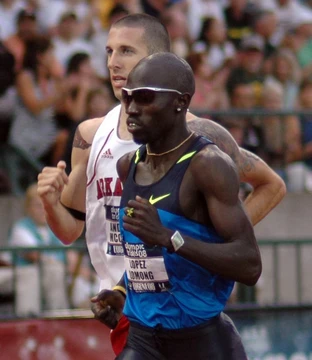
Edwin Moses
American former hurdler, Olympic gold medalist, and sports reformer.
Last updated
He was also an innovative reformer in Olympic eligibility and drug testing, and in 2000 became the first Chairman of the Laureus World Sports Academy.[1]
Key facts and history
He ran his first 400-meter hurdles race several months before the 1976 Olympics, and in one year transformed how athletes would run the event.[2] Moses mathematically calculated that the fastest way to run the 400-meter hurdles was to take 13 steps between hurdles, while most hurdlers at the time took 15.[2] The following week in Düsseldorf, Moses defeated Schmid by 15 meters, beginning a winning streak that lasted nine years, nine months, and nine days.[3]
What the cited sources add
The Andscape article notes that Moses initially started running track at Morehouse to relieve academic stress, often practicing at local high schools because Morehouse lacked a track.[2] The same source states that Moses, a physics major, calculated that running closest to the inside line in 13 steps was the fastest way to run the 400-meter hurdles.[2] The Picturing Black History account explains that Moses and other Morehouse runners used coursework in biology and chemistry to inform their diets, strategies, and training regimens.[4] The Irish Times article reports that Moses helped lead the clampdown on Russia's state-sponsored doping programme.[5]
That article also quotes Moses saying he negotiated agreements to test athletes, creating the first out-of-competition testing in 1988.[5]
References
- Wikipedia, "Edwin Moses" (CC BY-SA 4.0), which cites: Berry, "Film reveals Morehouse alum Edwin Moses' imprint on the track and field stars of today", Andscape, 19 September 2024; (we also read that source) en.wikipedia.org
- Berry, "Film reveals Morehouse alum Edwin Moses' imprint on the track and field stars of today", Andscape, 19 September 2024. facts only, no text reused. andscape.com
- Wikipedia, "Edwin Moses" (CC BY-SA 4.0), which cites: Caroccioli, "Boycott: Stolen Dreams of the 1980 Moscow Olympic Games", New Chapter Press, 2008, p. 243–253 (we also read that source) en.wikipedia.org
- Norton, "Edwin Moses and HBCU Black Excellence", Picturing Black History, 2026-02-06. facts only, no text reused. picturingblackhistory.org
- Edwin Moses still leading the fight against doping in athletics, Irish Times, Donald McRae, February 10, 2020. Retrieved July 30, 2021.. facts only, no text reused. irishtimes.com
Each numbered sentence above was checked against the source it cites before publication. Sentences citing Wikipedia adapt text from the English Wikipedia article Edwin Moses (contributors), used under CC BY-SA 4.0; this entry is available under the same licence. Other sources were used for facts only; no text or images are copied from them.
Career statistics and honours
Medals
- Gold Olympic Games — 1976 Montreal 400 m hurdles
- Gold Olympic Games — 1984 Los Angeles 400 m hurdles
- Bronze Olympic Games — 1988 Seoul 400 m hurdles
- Gold World Championships — 1983 Helsinki 400 m hurdles
- Gold World Championships — 1987 Rome 400 m hurdles
- Gold IAAF World Cup — 1977 Düsseldorf 400 m hurdles
- Gold IAAF World Cup — 1979 Montreal 400 m hurdles
- Gold IAAF World Cup — 1981 Rome 400 m hurdles
- Gold Goodwill Games — 1986 Moscow 400 m hurdles
Tables copied from the source article, totals included as the source gives them: Wikipedia: Edwin Moses (CC BY-SA 4.0). Wide tables scroll sideways.
More in Olympic Track & Field
Sources
Compiled from Wikipedia and the sources listed below. Text from Wikipedia is available under CC BY-SA 4.0; this entry is adapted from it.
- Wikipedia: Edwin Moses (CC BY-SA 4.0).
- Statistics, medals and awards: the tables of the source article.
Spotted an error? Know more?
Reader corrections go straight into our review queue. Suggest an edit · How this site is sourced