Yngling (keelboat)
Norwegian-designed keelboat, Olympic women's class 2004 and 2008.

The Yngling is a racing keelboat designed by Norwegian Jan Herman Linge as a one design racer, first built in 1967. It is a smaller, similar design to Linge's 1965 Soling. The Yngling gained international prominence as the Olympic Women's Keelboat for the 2004 and 2008 Summer Olympics.
- designer
- Jan Herman Linge
- nationality
- Norwegian
- first built
- 1967
- type
- Racing keelboat
- displacement
- 1,323 lb (600 kg)
- draft
- 3.44 ft (1.05 m)
- ISAF International status
- 1979
Lore & Background
The Yngling was designed by Norwegian Jan Herman Linge as a one design racer and first built in 1967. Its design is very similar to the larger 1965 Linge-designed Soling. The boat is built predominantly of fibreglass with wood trim, featuring a fractional sloop rig with aluminium spars, a spooned raked stem, a raised counter reverse transom, an internally mounted spade-type rudder controlled by a tiller, and a swept fixed fin keel. It displaces 1,323 lb (600 kg) and carries 683 lb (310 kg) of lead ballast, with a draft of 3.44 ft (1.05 m). The design includes a small cuddy cabin for stowage and is equipped with a 180 sq ft (17 m2) spinnaker, an end-boom mainsheet, foam buoyancy, and sail windows for visibility.
Reader's Guide
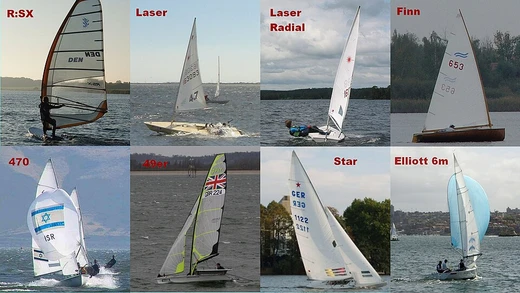
The Yngling is significant as a one-design racing keelboat that achieved international recognition, receiving ISAF International status in 1979. It was chosen as the Olympic Women's Keelboat for the 2004 and 2008 Summer Olympics, marking a high point in its competitive history. The class is supported by the International Yngling Association, with national clubs in multiple countries including Austria, Belgium, Germany, Norway, Switzerland, Denmark, the Netherlands, Sweden, the United States, and Australia. The Yngling was replaced by the Elliott 6m for the London 2012 Summer Olympics. In a 1994 review, Richard Sherwood noted the boat's high stability, unsinkability due to foam-filled tanks, and suitability for younger sailors. The design remains in production at Børresen Bådebyggeri in Denmark and by Mader Bootswerft in Germany.
Did You Know?
- The Yngling was designed by Norwegian Jan Herman Linge and first built in 1967.
- Its design is very similar to the larger 1965 Linge-designed Soling.
- The Yngling was chosen as the Olympic Women's Keelboat for the 2004 and 2008 Summer Olympics.
- The boat is unsinkable, with foam-filled tanks, and carries 50 percent of its weight in ballast.
More in Olympic sailing classes 1-24
Spotted an error? Know more?
This is a living reference — every entry is fact-audited, and reader corrections feed straight into our audit queue. Suggest an edit · See this site's audit record