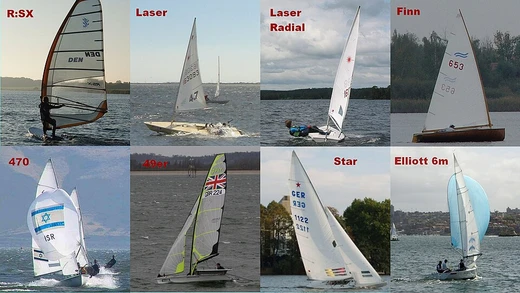
Star (keelboat)
Two-person one-design racing keelboat designed in 1911.

The Star is a 6.9-metre (23 ft) one-design racing keelboat built for a crew of two, first drawn up by Francis Sweisguth in 1911. It competed as an Olympic class from 1932 until 2012, with the exception of 1936, marking the final appearance of keelboats at the Summer Games. The class introduced a distinctive circular track for the boom vang, enabling the vang to keep the boom pressed down even when it swings far outboard during downwind legs. Star sailing is also notable for the extreme hiking posture taken by the crew—and sometimes the helmsman—who typically wear a harness to lean far out to windward, with only their lower legs still inside the boat.
The boat is sloop-rigged, with a mainsail that is proportionally larger than that of any other vessel of the same length. Unlike most modern racing craft, it does not carry a spinnaker when sailing downwind; instead, a whisker pole holds the jib out to windward to ensure proper airflow. Early Stars were built from wood, but contemporary boats are usually made of fiberglass. The minimum weight is 671 kg (1,479 lb), and the maximum total sail area is 26.5 m² (285 sq ft).
Sweisguth, a draftsman at the William Gardner Marine Architect office, designed the Star in 1911. Among his other work is the more traditional *Silent Maid*, a Barnegat Bay B-class catboat created shortly afterward. The first 22 Stars were constructed by Ike Smith in Port Washington, New York, during the winter of 1911–12. Since then, more than 8,600 boats have been built, with over 2,000 actively racing across 170 fleets.
The hull features a hard chine with a slight curve in the bottom section and a bulb keel. Originally, the Star carried a large, low-aspect-ratio gunter mainsail and jib; this was gradually replaced by a short Bermuda rig in the early 1920s, and the current tall Bermuda sail plan was adopted in 1930. In 1965, fiberglass became the primary hull material instead of wood. Other design rule changes over time include the introduction of flexible spars, the circular-track boom vang, and self-bailers.
The Star first appeared in the Olympics at the 1932 Los Angeles Games, was absent in 1936, then returned from 1948 to 2012. No Olympics were held in 1940 or 1944 due to World War II. In 1976, the Tempest replaced the Star for keelboat competition, but the Star returned. In 2011, keelboats were removed from the 2016 Rio de Janeiro Olymp
- designer
- Francis Sweisguth
- year_designed
- 1911
- length
- 6.9 metres (23 ft)
- crew
- two people
- rig
- sloop-rigged
- hull_material
- originally wood, modern boats generally fiberglass
- minimum_weight
- 671 kg (1,479 lb)
Lore & Background
The Star was designed in 1911 by Francis Sweisguth, a draftsman at the William Gardner Marine Architect office. The first 22 Stars were built in Port Washington, New York by Ike Smith during the winter of 1911–12. Since that time, over 8,600 boats have been built, with more than 2,000 actively racing in 170 fleets. The hull is a hard chine design with a slight curve to the bottom section, and a bulb keel. Originally rigged with a large, low-aspect-ratio gunter mainsail and jib, it was replaced by a short bermuda rig gradually during the early 1920s, before the current tall bermuda sail plan was adopted in 1930. In 1965, fiberglass replaced wood as the primary hull material.
Reader's Guide
The Star class holds a significant place in sailing history as a long-standing Olympic class and a design that influenced racing keelboat development. It was added to the Olympic roster for the 1932 Summer Olympics and remained until 2012, with the exception of 1976 when it was replaced by the Tempest. The class pioneered innovations such as the circular-track boom vang, flexible spars, and self-bailers. Notable sailors include John F. Kennedy, who won the Nantucket Sound Star Class Championship in 1936, and multiple Olympic and World champions such as Agostino Straulino, Paul Elvstrøm, Dennis Conner, and Robert Scheidt. The Star World Championships have been held annually since 1923. The Star Vintage Gold Cup, established in 2017, is an annual regatta for vintage Star-class yachts. The Star Sailors League was created in 2013 by athletes to establish a sustainable sailing circuit.
Did You Know?
- The Star does not use a spinnaker; ins
More in Olympic sailing classes 1-24
Spotted an error? Know more?
This is a living reference — every entry is fact-audited, and reader corrections feed straight into our audit queue. Suggest an edit · See this site's audit record