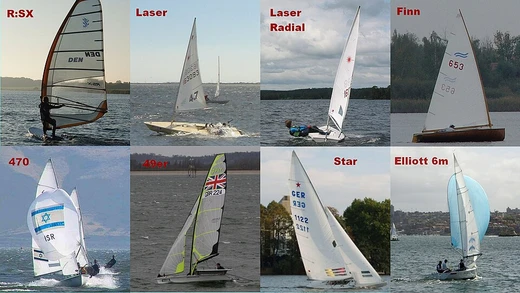
Finn (dinghy)
Longest-serving Olympic dinghy, designed for the 1952 Helsinki Games.

The Finn is a single-handed, cat-rigged dinghy that was once an Olympic class for men. It first appeared at the 1952 Summer Games in Helsinki and then sailed at every summer Olympics through 2020, holding the record as the longest-running dinghy in the Olympic regatta and ranking among the most enduring Olympic sailboats. Racing the Finn at elite levels is physically grueling, particularly because class rules permit unlimited hull rocking and sail pumping once the wind exceeds 10 knots. The boat was removed from the Olympic program starting in 2024.
**Design**
Swedish canoe designer Rickard Sarby created the Finn in 1949, specifically for the Helsinki Olympics. The original 1952 hulls were built from timber, and the sails were made of cotton. At first, sailors had little understanding of how a bendable mast could reduce sail power. Over time, however, Finn sailors learned to plane wood off the front of their masts for heavy winds and glue strips of timber onto the front for lighter winds. While the hull has remained largely unchanged, the rig has evolved. Wooden spars were standard until the late 1960s and early 1970s, when aluminum masts gradually took over. These aluminum masts, which are much more flexible and offer greater control over sail shape, became common after the 1972 Munich Olympics, where they were first supplied to Olympic sailors. More recently, carbon fiber masts have become standard on competitive Finns. Sails have also changed and are now typically made from laminates like Technora, polyester, and Kevlar. The International Finn Association oversees the class rules.
**Events**
**Olympic Games**
**World Championships** - Finn Gold Cup Open Worlds - Finn Youth World Championship for Under 23 - Finn Masters World Championship for sailors above 39 - The following league combined table of medalists is below
**Continental Championships** - 2006 Finn Open European Championship
**References**
**External links** - International Finn Class Association – Official Website - International Finn Class Association – Magazine - Finn on Instagram - Finn on Flickr
- designer
- Rickard Sarby
- design_year
- 1949
- type
- Single-handed, cat-rigged sailboat
- olympic_debut
- 1952 Summer Olympics, Helsinki
- last_olympic_appearance
- 2020
- governing_body
- International Finn Association
Quick Facts
- Fetchwikidata
- ALL
- Line Drawing
- Finn dinghy.svg
- Crew
- 1
- Loa
- 4.5 m
- Lwl
- 4.34 m
- Beam
- 1.47 m
- Draft
- 0.17 m
- Hull Weight
- 107 kg
- Mast Height
- 6.66 m
- Mainsail Area
- 10.6 m2
- D Pn
- 90.1
- Rya Pn
- 1060
Facts from the source article.
Lore & Background
The Finn was designed by Swedish canoe designer Rickard Sarby in 1949 specifically for the Helsinki Olympics. In 1952 the hulls were built of timber and the sails were of cotton. Initially there was little understanding of the role of a mast which could bend to reduce power, but over time Finn sailors learned how to plane timber off the front of their masts for heavy winds and to glue on strips of timber on the front of the masts for lighter winds.
Although the Finn hull has changed little since then, there have been developments to the rig. The original spars were made of wood until the late 1960s and early 1970s, when there was a gradual change to aluminum masts. Aluminum masts became commonplace after the 1972 Summer Olympics in Munich when they were first supplied to Olympic sailors. More recently, carbon fiber masts have become commonplace in competition Finns. The sails have evolved and are now commonly made of various laminates such as Technora, polyester, and Kevlar.
The Finn is a physically demanding boat to race at the highest levels, especially since the class rules now allow unlimited boat rocking and sail pumping when the wind is above 10 knots. The class rules are overseen by the International Finn Association.
Reader's Guide
The Finn dinghy holds a unique place in Olympic sailing history as the longest serving dinghy in the Olympic Regatta, appearing at every summer Olympics from 1952 through 2020. Its design by Swedish canoe designer Rickard Sarby in 1949 for the Helsinki Olympics proved remarkably durable, with the hull changing little over decades while the rig evolved from wood to aluminum to carbon fiber masts, and sails from cotton to modern laminates. The boat's physical demands increased over time, as class rules now allow unlimited boat rocking and sail pumping above 10 knots, making it a test of athleticism as well as skill. The Finn's legacy includes multiple world championship events: the Finn Gold Cup Open Worlds, the Finn Youth World Championship for Under 23, and the Finn Masters World Championship for sailors above 39. Its removal from the Olympic programme after 2020 marks the end of a 68-year Olympic run, but the class continues under the International Finn Association.
Did You Know?
- The Finn was designed by Swedish canoe designer Rickard Sarby in 1949 for the Helsinki Olympics.
- The Finn is the longest serving dinghy in the Olympic Regatta, appearing from 1952 to 2020.
- Aluminum masts became commonplace after the 1972 Summer Olympics in Munich when first supplied to Olympic sailors.
- Class rules now allow unlimited boat rocking and sail pumping when the wind is above 10 knots.
Frequently Asked Questions
What is the Finn dinghy?
The Finn is a single-handed, cat-rigged sailing dinghy that competed exclusively for male sailors at the Summer Olympics. It is governed internationally by the International Finn Association.
Who designed the Finn and when was it created?
Swedish canoe designer Rickard Sarby built the original Finn in 1949, and the class made its Olympic debut at the 1952 Helsinki Games.
How many consecutive Olympics did the Finn appear in?
From 1952 through 2020, the Finn was on the program at every single Summer Olympics, giving it the record as the longest-running dinghy class in Olympic regatta history.
What makes Finn racing so physically demanding?
Once winds exceed 10 knots, class rules allow unlimited hull rocking and sail pumping, turning each upwind beat into a brutal full-body workout. Elite Finn sailors are therefore renowned for their exceptional strength and cardiovascular fitness.
Why was the Finn removed from the Olympic program?
The class was dropped beginning with the 2024 Paris Games, bringing a 72-year Olympic run to a close. It remains a popular international one-design class outside the Olympic circuit.
More in Olympic sailing classes 1-24
Spotted an error? Know more?
This is a living reference — every entry is fact-audited, and reader corrections feed straight into our audit queue. Suggest an edit · See this site's audit record