Stade Roland Garros
Parisian tennis complex hosting the French Open since 1928.
Last updated

via Wikipedia: Stade Roland Garros · see source
Where it is
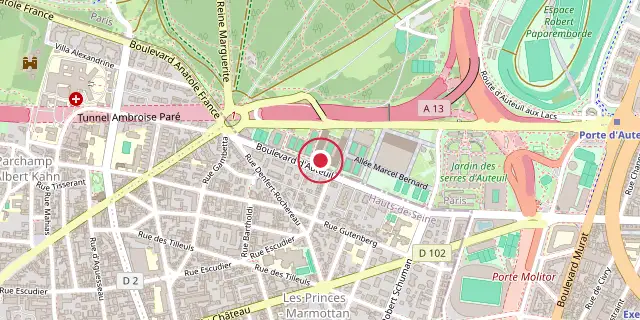
Coordinates: 48°50′49″N 2°14′46″E (48.8470, 2.2460) · Open in OpenStreetMap
Coordinates and connected clubs: the infobox of Wikipedia: Stade Roland Garros (CC BY-SA 4.0). Map: drawn by Codexery from OpenStreetMap tiles.
Stade Roland Garros is a tennis complex in Paris that hosts the French Open, a major annual championship played in late May and early June. The 13.5-hectare (34-acre) venue, named after pioneering French aviator Roland Garros (1888–1918), was constructed in 1928 to host France's first defense of the Davis Cup. It contains twenty courts, including three large-capacity stadiums, as well as Les Jardins de Roland Garros (a large restaurant and bar complex), Le Village (the press and VIP area), France's National Training Centre (CNE), and the Tenniseum, a bilingual multimedia museum of tennis history.
Playing surface
The courts at Stade Roland Garros are surfaced with white limestone covered by a few millimeters of powdered red brick dust. Beneath the 3-inch layer of porous limestone is 6 inches of volcanic rock, followed by 3 feet of sand, all resting on a slab of concrete. Crushed brick is pressed onto the limestone surface with rollers, then drenched in water; the process is repeated several times until a thin, compact layer coats each court. The crushed brick is deep enough to allow footprints and ball marks, but shallow enough to avoid making the court spongy or slippery.
Workers smooth the surface before matches and between sets by dragging rectangular lengths of chain-link across it. Red brick dust is replenished as needed, daily during major tournaments. This surface was a state-of-the-art solution in 1928 to the biggest problem with natural clay courts: poor drainage. At the time, it was not unusual for clay surfaces to be unplayable for two to three days after even short periods of precipitation.
The limestone/crushed brick combination, originally developed in Great Britain, played and looked similar to clay without clay's drainage issues, rendering natural clay obsolete as a tennis court surface. Since then, a multitude of other 'fast-dry' and synthetic clay surfaces have been developed. Venus Williams has said: 'All clay courts are different. None play the same. [Roland Garros] plays the best.'
Stadium courts
Court Philippe Chatrier was built in 1928 as Stade Roland Garros's centerpiece and remains its principal venue. It seats 15,225 spectators as of a 2019 renovation. The stadium was known simply as 'Court Central' until 2001 when it was renamed for the long-time president of the Fédération Française de Tennis (FFT) who helped restore tennis as a Summer Olympics sport in 1988. The four main spectator grandstands are named for the Four Musketeers—Brugnon, Borotra, Cochet, and Lacoste—in honor of their Davis Cup success, which prompted construction of the facility.
The trophy awarded each year to the French Open men's singles champion is known as La Coupe des Mousquetaires. After the 2018 tournament, the stadium was demolished down to its foundations and rebuilt with steeper grandstands in time for the 2019 tournament. A retractable roof and floodlights were added in time for the 2020 tournament, which was delayed to September of that year due to the COVID-19 pandemic. In 2025, on the first day of the 2025 French Open, a plaque commemorating Rafael Nadal's 14 Roland Garros trophies was unveiled set in the stadium's clay, attended by Nadal, Roger Federer, Novak Djokovic, and Andy Murray.
Court Suzanne Lenglen
Court Suzanne Lenglen, built in 1994 and originally designated 'Court A', is the secondary stadium with a capacity of 10,068 spectators. Its namesake, Suzanne Lenglen, won 31 major tournaments, including six French Open titles and six Wimbledon championships, between 1914 and 1926. A bronze bas relief of Lenglen by Italian sculptor Vito Tongiani stands over the east tunnel-entrance to the stadium. The trophy awarded each year to the French Open women's singles champion is named La Coupe Suzanne Lenglen.
The court has an underground irrigation system, the first of its kind, to control moisture levels within its surface. A retractable roof that covers the court was installed in time for the 2024 Summer Olympic Games, inaugurated on 26 May 2024 on the first day of the French Open. It is made up of two lateral structures measuring 100 meters by 20 meters, and a white canvas, closing in 15 minutes, inspired by Suzanne Lenglen's pleated skirt, and equipped with photovoltaic panels.
Court Simonne Mathieu
Court Simonne Mathieu, the 5,000-seat tertiary venue completed in March 2019, is technically located just outside the Roland Garros compound but operated as part of the complex, built on the adjacent municipal grounds of the Jardin des Serres d'Auteuil. The court's namesake, Simonne Mathieu, was the 1938 and 1939 women's singles champion and a leader of the French Resistance during World War II. The tennis court surface is four meters below ground level with greenhouses integrated on all four sides.
Court 1
Court 1, once the facility's third show court nicknamed the 'Bullring' because of its circular shape, was demolished in 2019. Designed by architect Jean Lovera, a former French junior champion, the 3,800-seat structure was built in 1980 as a deliberate contrast to the adjacent, angular Court Philippe Chatrier. An unusual design feature was its press seating in the first row at court level behind the south baseline.
Expansion project
In 2009, the FFT commissioned architect Marc Mimram to design an expansion of Stade Roland Garros. The proposal included lights and a retractable roof over Court Philippe Chatrier, plus a fourth stadium with retractable roof and 14,600 seats at the nearby Georges Hébert recreation area, along with two smaller show courts seating 1,500 and 750. Facing opposition from Paris City Council factions in 2010, the FFT considered moving the French Open to a new 55-court venue outside Paris, with sites including Marne-la-Vallée, Gonesse, and a vacant army base near Versailles, citing that Stade Roland Garros was less than half the size of other Grand Slam venues and had no covered courts, risking loss of Grand Slam status.
In February 2011, the FFT voted to keep the tournament at the current site, citing the prohibitive cost of a new venue ($630 million to $1 billion) versus $370 million for expansion. Further details in May 2013 included a complete rebuild of Chatrier court on existing foundations, a larger Place des Mousquetaires, and the new stadium at Porte d'Auteuil built below ground level with surrounding greenhouses. Deadlines were pushed to 2018, and local residents, wildlife enthusiasts, and municipal authorities continued opposition to the plan, which would expand grounds from 8.5 to 13.5 hectares.
Did You Know?
- The complex is named after Roland Garros, a pilot who completed the first solo flight across the Mediterranean Sea, invented the first forward-firing aircraft machine gun, and was a World War I hero who shot down four enemy aircraft.
- In October 1939, shortly after the outbreak of World War II, the facility was used as a detention centre for 'indésirables'—mostly Hungarians, Russians, Italians, Poles, and suspected communists—and journalist Arthur Koestler reported that posters advertising the last match before the war, between Cochet and Borotra, were still in place.
- The trophy awarded each year to the French Open men's singles champion is known as La Coupe des Mousquetaires, named after the Four Musketeers who helped France win the Davis Cup in 1927.
More in Olympic Boxing Venues
Sources
Compiled from Wikipedia and the sources listed below. Text from Wikipedia is available under CC BY-SA 4.0; this entry is adapted from it.
- Wikipedia: Stade Roland Garros (CC BY-SA 4.0).
Spotted an error? Know more?
Reader corrections go straight into our review queue. Suggest an edit · How this site is sourced