Frequently Asked Questions
The most-asked questions about old-time bands.
What is old-time music?
Old-time is a genre of American string-band music rooted in Appalachian, rural, and African-American traditions, typically built around fiddle, five-string banjo, guitar, mandolin, and upright bass. It emphasizes danceable reels, waltzes, and breakdowns with a looser, more improvisatory feel than its bluegrass successor.
How does old-time differ from bluegrass?
Old-time generally features a more relaxed tempo, allows for key changes mid-tune, and often includes a wider range of instruments such as piano, autoharp, and harmonica. Bluegrass, by contrast, is typically faster, more tightly arranged, and centers on mandolin, fiddle, and banjo with a strong vocal-harmony focus.
Who are the most essential artists to know?
The Carter Family's 1920s-and-30s recordings laid much of the groundwork, while later string bands like the Dillards, the Bakers, and the Clarks kept the tradition actively evolving through the 1970s and beyond. Béla Fleck's banjo work in the 1990s and 2000s brought old-time to a far broader audience.
Where should a newcomer start listening?
A solid entry point is the Carter Family's early recordings available through the Library of Congress archives, followed by a Dillards or Bakers album to hear the tradition in a more modern string-band context. Béla Fleck's albums 'Home' and 'Grown Up' also work well as a gateway for new listeners.
What instruments define an old-time band?
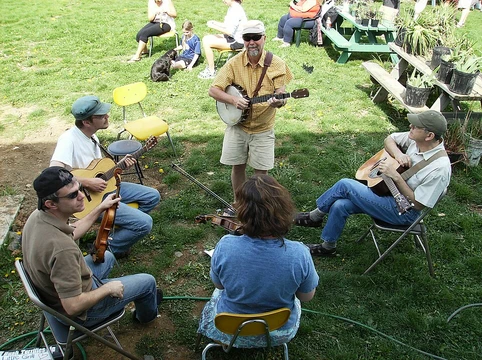
The core setup is fiddle, five-string banjo (often played in clawhammer style), guitar, mandolin, and upright bass, though autoharp, piano, and harmonica also appear regularly. The ensemble is usually small—three to six players—emphasizing interplay and groove over raw volume.
What is the clawhammer banjo style?
Clawhammer, also called frailing, is a rhythmic technique where the player strikes the strings with the back of the middle or ring finger in a downstroke, producing a percussive, driving pulse. It is the dominant banjo style in old-time and is distinct from the rolling, single-note approach more common in bluegrass.
What are some key historical moments in old-time music?
The 1920s and 1930s saw the first commercial recordings by the Carter Family and various Appalachian string bands, preserving the style for posterity. The 1970s folk revival and the 1990s new-traditionalist wave, sparked in part by Béla Fleck and the Dillards, each brought renewed commercial attention to the genre.
Are there major festivals dedicated to old-time music?
Events like the Old Fiddlers Convention in Galax, Virginia, and the old-time stages at MerleFest draw players and audiences from across the country. Smaller regional gatherings and community old-time jams also pop up in Appalachian towns and college cities year-round.
What makes old-time 'old-time' rather than just 'folk'?
The term specifically refers to a particular string-band tradition with roots in pre-20th-century Appalachian and rural American dance music, as opposed to the broader 'folk' label that can encompass singer-songwriters, Celtic music, and other traditions. Old-time carries connotations of specific tunings, dance forms like reels and jigs, and the social context of community dancing.
Can old-time music be played by musicians with no Appalachian background?
Absolutely—the genre has a long history of cross-cultural exchange, with African-American, European, and urban players all contributing to its vocabulary. Many contemporary musicians from coast to coast study old-time through workshops, recordings, and mentorship without any direct regional lineage.