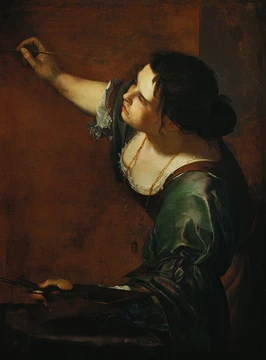
Lavinia Fontana
First female career artist in Western Europe.
Last updated
Born on 24 August 1552 and dying on 11 August 1614, Lavinia Fontana was a Mannerist painter who worked in both Bologna and Rome.[1] Fontana is considered the first woman in Western Europe to make her living as a professional artist, earning income from commissions.[1] While more than 100 of Fontana's works are recorded, only 32 pieces that she signed and dated are currently known.[2]
Life and work
She moved to Rome in 1604 at the invitation of Pope Clement VIII.[3] Fontana was the first female elected into the Accademia di San Luca of Rome.[4] Lavinia Fontana came into the world in Bologna during 1552, her parents being Antonia de' Bonardis and the painter Prospero Fontana, who later instructed her.[5][6] The baptism of Fontana occurred on 24 August 1552 at Bologna's San Pietro cathedral.[7]
According to Caroline P. Murphy, Prospero's decision to teach Lavinia painting may have been driven by financial difficulties.[6] In June 1577, Fontana wed Gian Paolo Zappi, a pupil of her father.[8] The terms of their marriage agreement allowed Fontana to keep working and freed her from domestic chores.[8]
What the cited sources add
The National Museum of Women in the Arts states Fontana is regarded as the first woman artist working within the same sphere as her male counterparts outside a court or convent.[9] The same source notes she was the portraitist of choice among Bolognese noblewomen for 20 years beginning in the 1580s.[9] The Smith College Museum of Art states Fontana studied art at the University of Bologna, where she earned a degree.[10] The same source notes Fontana is often considered the first woman artist of the Renaissance to work on par with male artists due to her prolific output and high prices.[10]
A Smithsonian Magazine article notes that several of Fontana's portraits were previously misattributed to Guido Reni, a contemporary who also studied under Denis Calvaert.[2]
References
- Wikipedia, "Lavinia Fontana" (CC BY-SA 4.0), which cites: Murphy, "Lavinia Fontana: A Painter and Her Patrons in Sixteenth-Century Bologna", Yale University Press, 2003, p. 30; "Artist Profile: Lavinia Fontana", National Museum of Women in the Arts; Weidemann, "50 Women Artists You Should Know", Prestel, 2008, p. 18, 19; De Girolami Cheney, "Lavinia Fontana's nude Minervas", Woman's Art Journal, 2015, p. 32 (we also read that source) en.wikipedia.org
- Wikipedia, "Lavinia Fontana" (CC BY-SA 4.0), which cites: Wizevich, "Expert Rediscovers Painting by Renaissance Master Lavinia Fontana, One of the First Professional Female Artists", Smithsonian Magazine, 26 March 2025; "Découverte d'une oeuvre majeure de Lavinia Fontana", Musée de la Chartreuse de Douai (we also read that source) en.wikipedia.org
- Wikipedia, "Lavinia Fontana" (CC BY-SA 4.0), which cites: Cheney, "Self-Portraits by Women Painters", Ashgate, 2000, p. 56 (original not read by us) en.wikipedia.org
- Wikipedia, "Lavinia Fontana" (CC BY-SA 4.0), which cites: "Lavinia Fontana Conservation and Research Project National Gallery of Ireland", National Gallery of Ireland; "Artist Profile: Lavinia Fontana", National Museum of Women in the Arts; "Lavinia Fontana, 1552–1614, Bolognese Painter by Felice Antonio Casone", National Gallery of Art (we also read that source) en.wikipedia.org
- Wikipedia, "Lavinia Fontana" (CC BY-SA 4.0), which cites: "Great Women Artists", Phaidon Press, 2019, p. 140 (original not read by us) en.wikipedia.org
- Wikipedia, "Lavinia Fontana" (CC BY-SA 4.0), which cites: Murphy, "Lavinia Fontana: A Painter and Her Patrons in Sixteenth-Century Bologna", Yale University Press, 2003, p. 20–21; Weidemann, "50 Women Artists You Should Know", Prestel, 2008, p. 18, 19 (we also read that source) en.wikipedia.org
- Wikipedia, "Lavinia Fontana" (CC BY-SA 4.0), which cites: Murphy, "Lavinia Fontana: A Painter and Her Patrons in Sixteenth-Century Bologna", Yale University Press, 2003, p. 18 (original not read by us) en.wikipedia.org
- Wikipedia, "Lavinia Fontana" (CC BY-SA 4.0), which cites: Molcan, Magnolia, "Art in Short: Lavinia Fontana, Renaissance Woman", www.famsf.org; M., "A companion to Renaissance and Baroque art", Wiley-Blackwell, 2013; Fortunati, "Lavinia Fontana of Bologna 1552–1614", Electa, 1998, p. 15; Cheney, "Lavinia Fontana, Boston 'Holy Family'", Woman's Art Journal, Spring–Summer 1984, p. 12–15 (we also read that source) en.wikipedia.org
- "Artist Profile: Lavinia Fontana", National Museum of Women in the Arts. facts only, no text reused. nmwa.org
- "Lavinia Fontana: Renaissance Artist", Smith College Museum of Art, 5 December 2019. facts only, no text reused. scma.smith.edu
Each numbered sentence above was checked against the source it cites before publication. Sentences citing Wikipedia adapt text from the English Wikipedia article Lavinia Fontana (contributors), used under CC BY-SA 4.0; this entry is available under the same licence. Other sources were used for facts only; no text or images are copied from them.
More in Old Masters
Sources
Compiled from Wikipedia and the sources listed below. Text from Wikipedia is available under CC BY-SA 4.0; this entry is adapted from it.
- Wikipedia: Lavinia Fontana (CC BY-SA 4.0).
Spotted an error? Know more?
Reader corrections go straight into our review queue. Suggest an edit · How this site is sourced